
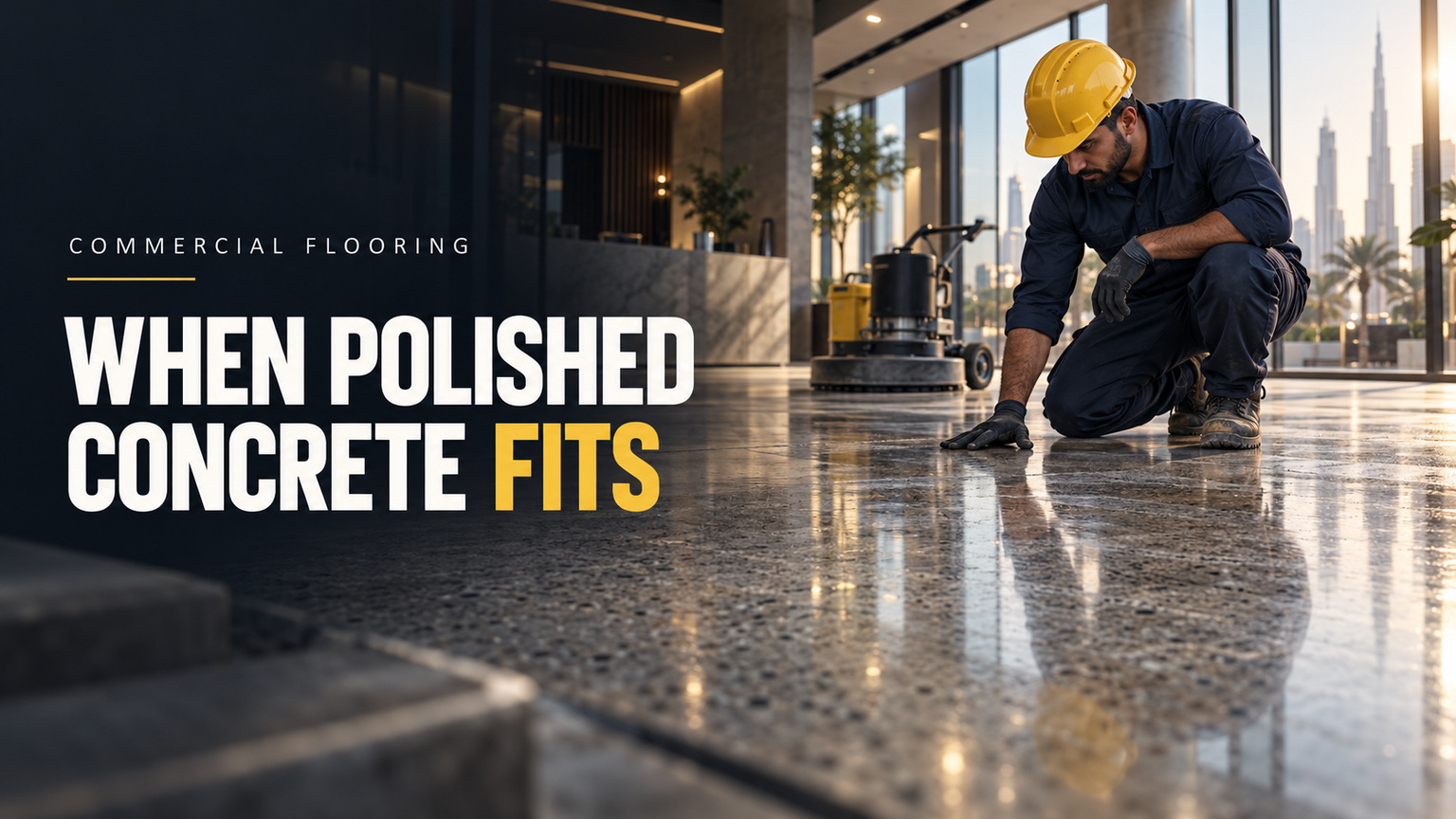

Commercial Polished Concrete in Dubai: Finishes, Suitability and Specifications
Quick Answer
Commercial polished concrete is a mechanically finished concrete floor suitable for Dubai commercial spaces when the slab, appearance and safety needs align. Check the existing concrete, choose the required finish and confirm slip resistance before work begins. Where chemical exposure or a continuous protective coating matters more, consider epoxy flooring instead.
Key Takeaways
- The condition of an existing concrete slab affects polishing costs, repair needs and the final appearance.
- Concrete Polishing Council Classes A, B and C describe different levels of aggregate exposure, not increasing grades of quality.
- Specify the finished appearance and an approved sample rather than relying only on grinding steps or grit numbers.
- Dubai projects need slip-resistance criteria suited to each floor location, with the applicable test method confirmed before acceptance.
- Epoxy may suit areas needing a continuous resin coating or specific chemical resistance better than polished concrete.
- Floor repairs, aggregate exposure, edge work and site access affect quotations; no single verified Dubai market rate covers every project.
- Commercial polished concrete needs routine cleaning, protection during construction and a clear maintenance plan after handover.
Choose Polished Concrete Only When the Floor and Use Case Fit
Commercial polished concrete works best when the concrete itself can serve as the finished floor. It offers an exposed concrete look without the need for a separate decorative floor covering. But the slab must suit the planned use.
Polishing uses mechanical grinding, honing and polishing steps. These steps change the concrete surface and create the required finish. The final look can range from a soft sheen to a clearer reflection. Some finishes show little stone. Others expose much more of the aggregate within the slab.
The Concrete Polishing Council glossary explains the difference between grinding, honing and polishing. It also distinguishes mechanically polished finishes from burnished or hybrid systems.
The American Concrete Institute’s ACI SPEC-310.1-20 provides a reference specification for polished concrete slab finishes. It covers construction, testing, evaluation and acceptance. It applies to slabs on the ground and suspended slabs.
That gives commercial buyers a sound starting point: define the finished result before choosing a work method.
Commercial spaces where polished concrete can work
Polished concrete may suit showrooms, offices, retail stores and indoor circulation areas. Some warehouses can also use it. Each space needs its own floor assessment.
A showroom may favour a consistent sheen and exposed stone pattern. An office may place more weight on comfort, cleaning and appearance. A warehouse may need closer checks of floor strength, traffic, joints and wheel loads.
The same finish is not right for every room.
Wet entrances, loading areas, kitchens and ramps need extra care. Water, oil, cleaning chemicals and footwear can change the slip risk. Heavy traffic can also affect maintenance needs.
Choose the floor for its real use, not just a photo of a finished project.
When another floor may be a better choice
Polished concrete may be a poor fit when the slab has widespread damage. Deep oil stains, weak concrete or uneven repair patches can also limit the result.
Some sites need a continuous protective coating. Others need a specific level of chemical resistance. In those cases, an engineered resin floor may be more suitable.
A concrete floor also has joints. Polishing does not turn it into a joint-free surface or remove the need to maintain those joints.
Before approving polished concrete, check four things: the slab, the expected finish, the site conditions and the planned upkeep.
Check the Existing Concrete Before Choosing a Finish
Inspect the existing slab before agreeing on a finish or price. Grinding cannot repair every defect or hide every mark in the concrete.
The Concrete Polishing Council’s pre-construction checklists call for checks of curing, flatness, strength and surface hardness. They also stress coordination between the trades involved.
A floor may look sound from a distance but have a weak top layer. Another may contain hard and soft areas that polish at different rates.
Inspect strength, cracks and old coatings
Look for cracks, worn joints, loose patches, surface dusting and signs of past repairs. Check for coatings, adhesive residue and oil stains.
Old floor coverings can hide problems. Once they are removed, the slab may need more work than planned.
The ACI-published CPC guidance on weak concrete surfaces warns about aggregate rollout and reduced gloss. It also discusses surface hardness testing and possible densifier treatment.
A densifier is a chemical treatment that can help harden suitable concrete surfaces. It is not a cure for every weak slab. The cause and depth of any damage still need assessment.
Crown Edge lists floor grinding, surface preparation and crack repair among its related flooring services. These tasks can form part of the preparation needed before a finish is approved.
Check flatness and visible variation
An uneven slab can produce patchy aggregate exposure. High areas may reveal more stone. Low areas may retain more cement paste.
Concrete placed at different times may also look different. Past repairs can remain visible after polishing.
Think of a large retail space with several repaired floor sections. Polishing may produce a clean, usable surface. Yet the patches may still stand out in bright light.
A representative sample helps show what the finished area may look like. For large or varied floors, sample more than one condition.
Existing-Slab Readiness Scorecard
| Slab condition | Initial decision | Next action |
|---|---|---|
| Sound, clean and reasonably even. | Proceed to a sample. | Check hardness and finish expectations. |
| Hairline cracks or small surface repairs. | Investigate. | Plan joint and repair treatment. |
| Old coatings or adhesive residue. | Prepare. | Check removal and surface condition. |
| Oil stains or deep contamination. | Investigate. | Assess the depth and suitable treatment. |
| Weak or dusty top layer. | Investigate or repair. | Test hardness and find the cause. |
| Large height changes or severe curling. | Reconsider the finish. | Review levelness and cutting limits. |
| Widespread damage or structural concerns. | Stop for assessment. | Seek qualified technical advice. |
This is a planning tool, not a structural assessment. It helps identify where more evidence is needed before work starts.
Select the Aggregate Exposure and Finished Appearance
Specify two things separately: how much aggregate should show and how refined the surface should look. They are different decisions.
The Concrete Polishing Council uses three current aggregate-exposure classes. Its February 2024 chart gives visual guides for each class.
CPC Classes A, B and C
| Class | Finished appearance | CPC guide values | Buyer consideration |
|---|---|---|---|
| A | Cement fines or cream finish. | 85–95% cement fines; 5–15% fine aggregate. | Slab finishing consistency is critical. |
| B | Fine aggregate or salt-and-pepper finish. | 85–95% fine aggregate. | Small stones become more visible. |
| C | Full or coarse aggregate exposure. | 80–90% full aggregate. | Deeper cutting reveals more stone and variation. |
Source: CPC Aggregate Exposure Chart, February 2024. The percentages are visual guides, not guaranteed results or legal limits.
Class A keeps more of the original cement-rich surface. Class B exposes small stones, while Class C reveals more of the larger aggregate.
Class C is not automatically better than Class A. It is a different design choice. The right finish depends on the concrete and the appearance the buyer wants.
A deeper cut may expose more variation than expected. The concrete mix, placement and flatness all play a role.
Specify the finish, not just the grinding steps
A contractor may describe polishing with a series of grit numbers. Those numbers explain part of the work method. They do not fully define the final appearance.
The CPC’s 2024 guidance on classes and appearance levels describes three exposure classes and four appearance levels. It recommends checking the finished refinement rather than relying on grit count alone.
Gloss is the amount of light reflected in a particular way. Distinctness of image, or DOI, describes how clear a reflected image appears. Haze describes a loss of that clarity.
A floor may look shiny without having a well-refined surface.
ASTM D5767-18(2023) describes DOI measurement for applicable surfaces. Its scale runs from 0 to 100. A value of 100 represents perfect image clarity under that method.
That does not create a universal DOI target for polished concrete. The project must choose a suitable measurement method and acceptance value when required.
Approve a sample before full production
A representative mockup gives the buyer and contractor a common reference. It should show the chosen exposure, sheen and repair treatment.
Place the sample where the slab reflects actual site conditions. Review it under lighting close to the planned use. Include edges or joints when these are part of the finished look.
Agree on the sample in writing. Record which appearance features are acceptable and what will be checked at handover.
For an existing floor, a small sample cannot guarantee that every area will look identical. It can still prevent a major mismatch in expectations.
Specify Slip Resistance for the Actual Dubai Location
A polished floor needs slip resistance suited to its use. Shine alone does not show whether a floor is safe or unsafe.
Dry office circulation, wet entrances and sloped routes face different risks. The test and acceptance criteria should match the actual location.
Separate dry interiors from wet and sloped areas
A dry showroom floor may have different needs from a loading entrance. Rainwater, cleaning work and tracked-in moisture can affect traction.
The official PCFC/Trakhees document library lists the Dubai Building Code, English 2021 Edition. A searchable copy of the code describes pendulum testing under BS EN 13036-4 for accessible floor surfaces.
The official code PDF could not be accessed during the source research. Its exact numerical slip limits were therefore not independently confirmed. Use the current code accepted by the project’s authority before setting binding values.
Dubai Commercial Floor Slip-Resistance Planner
| Floor location | Main exposure | What the specification should establish |
|---|---|---|
| Indoor office or retail route. | Normally dry. | Applicable dry-use test and acceptance criteria. |
| Indoor ramp. | Slope and footwear. | Requirements for the slope and expected conditions. |
| Building entrance. | Possible tracked-in water. | Wet-use risk and any transition treatment. |
| Outdoor commercial walkway. | Weather and water. | Applicable wet-use slip criteria. |
| Shower or pool-side area. | Frequent water and possible bare feet. | Area-specific test and surface requirements. |
| Service area with oil or spills. | Liquid contamination. | Suitable floor system and cleaning controls. |
The table is a planning aid. It does not replace the applicable code or approval process.
Why DCOF results cannot replace PTV testing
A 2017 CPC slip-resistance position statement reports tests on 48 concrete sections. The study produced 576 wet measurements using a BOT-3000E device.
Its reported averages exceeded the study’s referenced dynamic coefficient of friction, or DCOF, threshold of 0.42. Group averages ranged from about 0.490 to 0.582.
Those findings challenge the idea that a glossy concrete surface must always lack traction. They do not prove that any given Dubai floor meets local requirements.
DCOF and pendulum test values, or PTV, come from different test methods. They cannot be treated as the same number.
The ASTM E303-22 pendulum-test standard also cautions against assuming direct agreement between different friction methods.
Ask the project designer or approving authority which test applies. Then make the required result part of the floor acceptance plan.
Polished Concrete vs Epoxy for Commercial Floors
Choose polished concrete for an exposed concrete finish when the slab and use allow it. Consider epoxy when a continuous resin coating or defined chemical resistance is central to the brief.
Crown Edge describes commercial epoxy flooring as a resin-based system applied over concrete. Its stated applications include commercial and industrial floors.
Compare the two systems by actual use
| Decision factor | Polished concrete | Epoxy flooring |
|---|---|---|
| Appearance. | Shows the concrete and its aggregate. | Can provide a more uniform coated finish. |
| Existing repairs. | Repairs may remain visible. | A suitable system may cover visual differences. |
| Chemical exposure. | Needs case-specific stain and chemical assessment. | Can be designed around specified chemical resistance. |
| Slip resistance. | Requires suitable finish and testing. | Requires suitable texture, system and testing. |
| Protective barrier. | Not a continuous resin coating. | Can form a continuous protective coating. |
| Maintenance. | Cleaning and possible repolishing. | Cleaning and possible coating repair or renewal. |
| Substrate needs. | Slab appearance and condition remain central. | Surface preparation and coating compatibility remain vital. |
A retail showroom may prefer the look of exposed aggregate. A workshop handling chemicals may need an epoxy system with documented resistance.
Neither choice is always cheaper or longer lasting. Product selection, site use and maintenance determine the result.
Floor levelling solves a different problem
Polished concrete should not be confused with a self-levelling compound. Many levelling products create a smooth base for another floor finish.
Crown Edge’s self-levelling flooring services include cement-based levelling and floor preparation. These products have their own intended uses.
A floor that needs major levelling may require a separate technical solution. Not every levelling layer is suitable as an exposed polished wear surface.
Check the product data and proposed complete floor system before combining these methods.
Plan New Commercial Slabs for Polishing Early
If a new concrete floor will be polished, plan the finish before the slab is poured. The mix, placement, curing and finishing work affect what polishing can achieve.
This is especially important on large commercial floors. Differences between pours may become visible after grinding.
Coordinate flatness and floor construction
Good floor construction helps create a more predictable finished surface. It also reduces the chance of unwanted deep cutting in high spots.
Crown Edge offers floor screeding and laser screed works for floor construction and levelling needs. Laser screeding may help achieve the required slab profile.
Yet a level slab does not guarantee uniform aggregate exposure. Mix design and concrete finishing still matter.
The concrete contractor and polishing team should agree on the target finish before placement. Record curing, construction access and the planned date for polishing.
Protect joints, edges and finished surfaces
Joints remain part of a concrete floor. They need suitable treatment for the intended traffic.
Edges and corners can also need different equipment and more labour. Confirm how these areas will be finished before work starts.
Later trades may damage a newly polished floor. Paint spills, dragged equipment and grit can affect the surface. Assign clear responsibility for temporary protection.
The handover plan should say who removes protective material and who checks the floor afterward.
What Determines Commercial Polished Concrete Cost in Dubai?
Commercial polished concrete cost depends on the slab and the required work. A simple price per square metre cannot describe every project.
The available research did not establish a reliable, comparable Dubai market average in AED/m². An honest quotation needs a defined scope and, where appropriate, a site survey.
Main cost drivers
| Cost factor | Why it affects the quote |
|---|---|
| Floor area and layout. | Large open areas differ from many small rooms. |
| Existing slab condition. | Damage may need repair before polishing. |
| Old coating removal. | Adhesive and coatings add preparation work. |
| Aggregate exposure. | Deeper cutting may need more work. |
| Appearance level. | Refinement and quality checks affect the scope. |
| Edges and corners. | Restricted areas need extra attention. |
| Dyes and protection. | Selected materials change the work package. |
| Site access. | Restricted hours and live operations affect planning. |
| Testing and mockups. | Agreed acceptance work adds defined tasks. |
| Floor protection. | Other trades may need to be managed after polishing. |
A large clear slab may be easier to plan than a small floor split into many rooms. Likewise, a damaged floor may need more prep than a sound new slab.
But area alone does not determine the cost.
Ask for an itemised quotation
A useful quotation should identify the floor area, measured in m², and the intended finish. It should also state the known substrate condition.
Ask contractors to separate the base scope from possible extra repairs. Confirm whether edges, joints, mockups, densifiers and protective treatments are included.
Working hours matter too. A site that must remain open may require phased work and extra coordination.
If two quotes differ widely, compare what they include before comparing the final totals.
Commercial Polished Concrete Specification and Quotation Checklist
A sound specification defines what the buyer expects and how the result will be accepted. It should cover more than the polishing process.
Use this checklist when preparing a request for quotation. It follows the core scope found in ACI and CPC technical guidance.
Project and floor details
- [ ] Record the Dubai project location and the authority responsible for approval.
- [ ] State each room’s commercial use and expected traffic.
- [ ] Record the floor area in m² and identify restricted work zones.
- [ ] Confirm whether the slab is new, existing or partly repaired.
- [ ] Provide available drawings and concrete floor records.
Existing slab assessment
- [ ] Inspect cracks, joints, spalls and past surface repairs.
- [ ] Check surface hardness and signs of weak concrete.
- [ ] Record old coatings, stains, adhesive residue and contamination.
- [ ] Check flatness and identify high or low areas.
- [ ] Agree which repairs must be priced before polishing.
Finish and materials
- [ ] Select the intended CPC aggregate-exposure class.
- [ ] Define the finished appearance and agreed acceptance method.
- [ ] Approve a representative sample before full work begins.
- [ ] Identify any dyes, densifiers, guards or sealers.
- [ ] Confirm how edges, corners and joints will be treated.
Performance and approval
- [ ] Identify dry, wet, sloped and other special-use zones.
- [ ] Confirm the applicable slip-test method and acceptance criteria.
- [ ] Set any project-specific floor traffic or chemical-resistance needs.
- [ ] Record inspection responsibilities and approval stages.
- [ ] Agree how appearance differences and defects will be assessed.
Construction and handover
- [ ] Confirm work access, hours and coordination with other trades.
- [ ] Assign responsibility for protecting the finished floor.
- [ ] Require product data for all site-applied treatments.
- [ ] Obtain test records and final acceptance documents where required.
- [ ] Request a cleaning and maintenance plan for the completed floor.
The checklist helps contractors price the same work. It also gives buyers a clear record of what has been agreed.
For complex projects, the design team should turn these fields into a formal project specification. The checklist is not a replacement for engineering advice or authority approval.
Five acceptance gates
A commercial floor can move through five simple gates.
Assess: Confirm the slab’s condition and suitability.
Specify: Agree on the finish, site use, materials and required tests.
Sample: Review and approve a representative area.
Check: Inspect the completed work against the agreed acceptance plan.
Handover: Receive cleaning guidance, product records and any required test results.
Do not skip the sample because a contractor has shown photos of another project. Concrete slabs differ, even within the same building.
Maintain the Floor and Check Applied Materials
Commercial polished concrete needs routine care. The cleaning method should suit the finish and the products used on it.
The CPC technical resource library includes guidance on polished concrete maintenance and related surface issues.
Cleaning and restoration
Remove grit before it is dragged across the floor. Use suitable cleaning products and equipment. Deal with spills before they remain on the surface for long periods.
The correct cleaning plan depends on traffic, contaminants and the floor treatment. Avoid assuming that one cleaning product or pad works for all polished concrete systems.
Over time, a floor may need more than routine cleaning. Some surfaces can be restored through a planned polishing or maintenance process.
Ask for care instructions at handover. The operator should know what to use, what to avoid and when the floor needs review.
Low-emitting materials and Dubai green-building rules
Mechanically polishing concrete may reduce the need for a separate floor covering. That can be useful for projects assessing indoor material emissions.
The USGBC low-emitting materials guidance treats suitable concrete as inherently non-emitting under its stated conditions. Applied coatings, sealers and other chemical products may need separate assessment.
Dubai also has its own green-building framework. Dubai Municipality’s Al Sa’fat information explains the development of the city’s green-building rules.
The municipality also provides guidance on green-building materials and products.
None of this makes every polished concrete system automatically approved or certified. Check the actual materials and the project requirements.
FAQs About Commercial Polished Concrete in Dubai
1. Is polished concrete suitable for commercial buildings?
Yes, polished concrete can suit commercial buildings with sound, suitable slabs. Offices, showrooms, retail spaces and selected industrial areas are possible uses. The floor must still meet traffic, safety and maintenance needs. Wet or chemical-heavy areas may require a different system.
2. Can an existing concrete floor be polished?
Many existing slabs can be considered for polishing. The result depends on surface strength, repairs, contamination, flatness and the required appearance. A site survey and sample help reveal those limits. Some slabs need repair first. Others may be unsuitable.
3. Is polished concrete slippery when wet?
A polished appearance does not prove a floor is slippery or safe. Slip performance depends on the surface, footwear, contaminants and test conditions. Dubai projects should use the test and acceptance criteria required for the specific area. Do not replace a required PTV result with a DCOF figure.
4. What is the difference between polished concrete and epoxy?
Polished concrete uses the concrete slab as the finished surface. Epoxy forms a separate resin coating over a prepared base. Epoxy may better suit work areas needing a specified protective coating or chemical resistance. The choice depends on actual use and product data.
5. How much does commercial polished concrete cost in Dubai?
There is no verified single Dubai rate that suits every project. Cost depends on slab condition, area, preparation, repairs, aggregate exposure, edges, materials and site access. Ask for an itemised quote based on the required finish and a floor survey.
6. How long does polished concrete last?
There is no sound universal lifespan for all commercial polished concrete floors. Concrete quality, traffic, contamination, cleaning and upkeep affect the outcome. Repair needs and future restoration also matter. Request a maintenance plan suited to the site rather than relying on an unsupported lifespan promise.
7. Does polished concrete need a sealer?
Not every mechanically polished floor uses the same surface treatment. A densifier, stain protection or guard may be specified for a particular result. These products serve different purposes. Review their product data, appearance effects and maintenance needs before approval.
8. Can polished concrete earn green-building credits?
Concrete may meet some low-emitting material criteria under schemes such as LEED, depending on the full floor system. It does not automatically earn certification or credits. Applied products and local project rules still need review. Dubai’s Al Sa’fat requirements should be checked separately.
Final Selection: Approve the Slab, Finish and Performance Together
Commercial polished concrete is a sound option when the slab and planned use support it. Start with the site conditions, not the level of shine.
Proceed when the concrete is suitable, the sample is accepted and the floor can meet its required tests. Where faults remain unclear, assess or repair the slab first. If the space needs a continuous protective resin coating, compare epoxy or another specified system.
A good quotation should make the result clear. It should also define preparation, repairs, acceptance tests and maintenance responsibilities.
For Dubai projects that need floor grinding, preparation, levelling or other related work, Crown Edge’s flooring services provide a starting point for discussing site needs and available options. Confirm the exact proposed floor system and scope before placing an order.
SEO Title: Commercial Polished Concrete Dubai | Finishes & Specifications
Meta Description: Explore commercial polished concrete in Dubai. Compare finishes, assess slab suitability, check slip resistance and plan specifications before choosing a floor.