

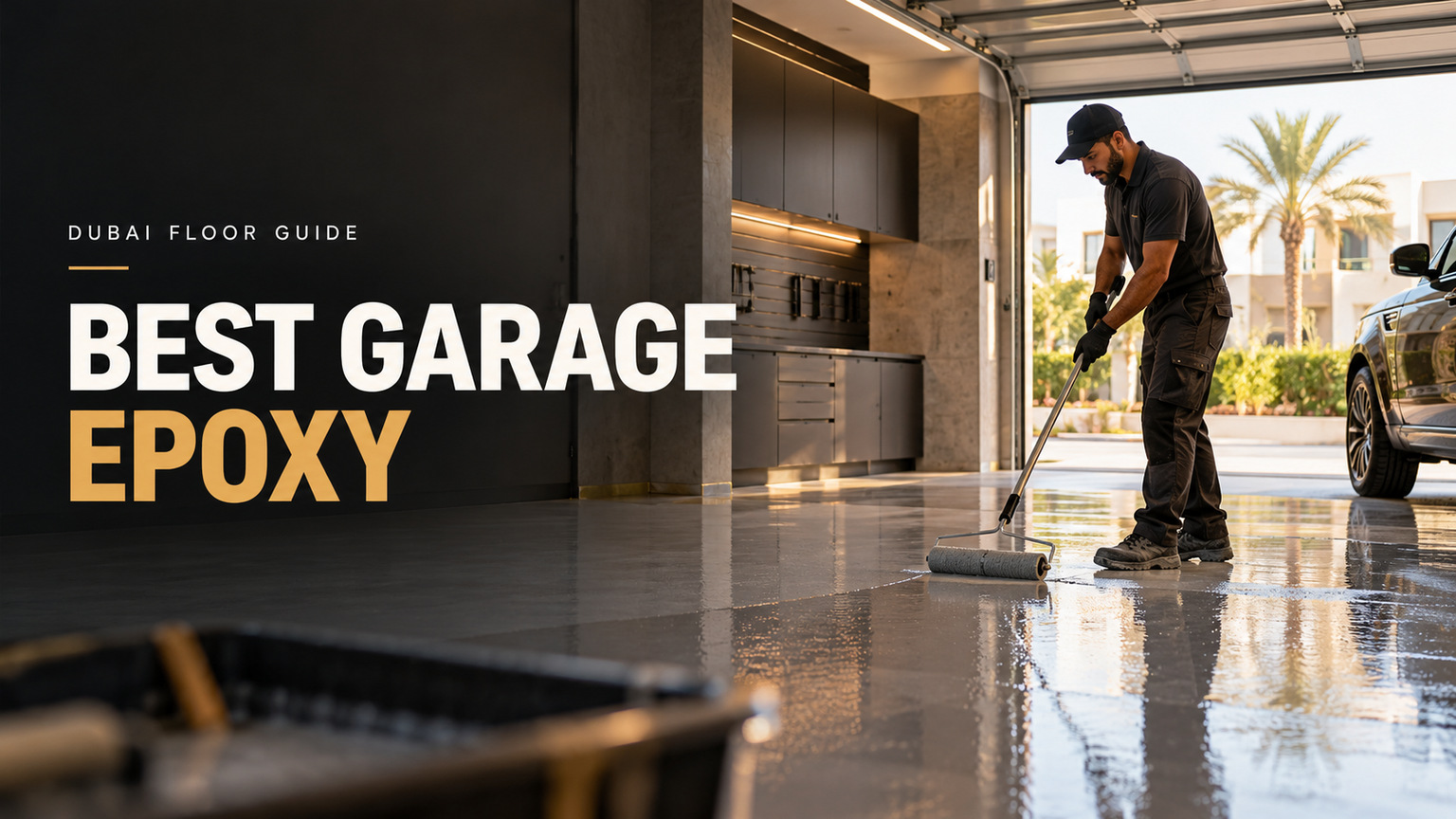

Best Epoxy for Garage Floors in Dubai: Types, Costs and Selection
Quick Answer
The best garage floor epoxy in Dubai is a manufacturer-approved system suited to the concrete, traffic and sunlight exposure. A sound, sheltered residential garage may suit an epoxy coating, while sunlit areas need proven UV protection. Surface preparation, moisture limits and the required parking date should guide the final choice.
Key Takeaways
- A compatible epoxy coating is a practical starting choice for a sheltered Dubai residential garage with sound, prepared concrete.
- Direct sunlight makes documented UV resistance important, especially where owners want the floor colour to remain stable.
- Grinding, oil removal, crack repairs and moisture checks can matter more than the coating’s advertised brand or appearance.
- Concrete moisture limits depend on the exact product and test method; a universal 4% rule is not justified.
- Advertised Dubai solid-colour epoxy rates include AED 65–110/m², but actual quotes depend on preparation and project scope.
- Foot traffic, light traffic, vehicle parking and full cure are different milestones that need written confirmation.
- A sound quotation should name every coating layer, its preparation method, surface finish, UV protection, warranty and parking conditions.
Choose the Best Garage Floor Coating for Your Conditions
For most sheltered villa garages, start by assessing a complete epoxy system. For floors exposed to sunlight, give more weight to UV protection. For outdoor parking decks, assess traffic and waterproofing needs first.
There is no single best epoxy product for every garage in Dubai. A covered villa garage faces different demands from an open carport. A home workshop also needs a different review from a space used only for parking.
Use this decision matrix to choose the first system worth assessing.
| Garage condition | System to consider first | Essential check |
|---|---|---|
| Sheltered residential garage | Compatible roller-applied epoxy system. | Concrete condition and expected vehicle use. |
| Sunlit garage entrance | Epoxy with an approved UV-resistant finish. | Sun exposure and topcoat compatibility. |
| Decorative villa garage | Compatible epoxy flake or aggregate system. | Texture, cleaning and intended appearance. |
| Workshop with oils and fluids | Chemically suitable industrial epoxy system. | Exact chemicals and contact duration. |
| Exposed parking deck or ramp | Purpose-designed traffic coating and waterproofing system where needed. | Movement, drainage and waterproofing design. |
These are starting choices, not product rankings. The final system must match its manufacturer’s approved use.
Sheltered residential garages
A two-component epoxy is a reasonable option for sound indoor concrete. It can form a protective surface that is easier to clean than bare, dusty concrete.
The correct product still depends on traffic and exposure. A garage used by two family cars is not the same as a repair workshop.
As one technical example, Sika’s Sikafloor Garage product is a water-based, two-component epoxy. Its stated uses include light-to-medium-traffic garages and car park decks. The manufacturer also identifies low VOC emissions and water-vapour permeability.
That page describes a South African product version. It does not confirm UAE availability or approval for a Dubai installation.
Crown Edge describes different epoxy flooring systems, including roller-applied, self-leveling and anti-slip options. The final choice should follow the garage inspection and the selected manufacturer’s product data.
Garages with direct sunlight
Sunlight changes the choice. A garage threshold may receive direct sun for hours, even when most of the floor stays covered.
For these areas, request evidence of UV resistance in the complete coating system. Colour stability should not be assumed from the word epoxy alone.
A documented GCC example is Sikafloor MultiDur EB-16 UV (G). It combines epoxy primer and body layers with a polyurethane finish. Its published nominal thickness is about 1.0 mm.
The manufacturer describes the combined system as UV-resistant and slip-resistant. These characteristics belong to the stated system and its approved application conditions.
This gives buyers a documented system to compare. It does not establish automatic suitability for every villa slab, ramp or outdoor parking area.
Decorative garages and workshops
A decorative garage may need a smooth-looking finish. A workshop needs more focus on fluids, cleaning and wear.
Flakes can create colour variation and help disguise minor visual marks. But decorative flakes do not prove wet slip resistance.
For work areas, check the actual chemicals used. Oil, fuel, cleaners and brake fluid should not be treated as one exposure category.
The manufacturer must confirm resistance to the relevant substance, concentration and contact time.
Outdoor decks are a separate case
An exposed parking deck may need waterproofing, crack movement control and a suitable traffic surface. Ordinary indoor epoxy is not a direct substitute.
For instance, Sikafloor TC 257 is a UV-resistant polyurethane traffic coating described for indoor and outdoor car parks in hot climates.
Even that product must be used within an approved system. A suspended deck needs its own design review where waterproofing and movement are involved.
Compare Epoxy, Flake Epoxy and UV-Resistant Topcoats
Choose by exposure, surface texture and verified system data. A more expensive resin is not automatically the better floor.
The coating layers matter as much as the name on the tin.
| System category | Main use | UV and texture considerations | Key limitation |
|---|---|---|---|
| Roller-applied epoxy | Sheltered, compatible concrete floors. | Smooth or specified textured finish. | Requires suitable slab and product-specific conditions. |
| Aggregate or flake epoxy | Decorative or textured garage floors. | Texture depends on the full finish. | Flakes alone do not prove slip resistance. |
| Epoxy with polyurethane topcoat | Areas needing documented UV protection. | Compatible UV-resistant finish; texture may be specified. | Layers must form an approved system. |
| Polyurethane traffic coating | Suitable car parks, ramps and traffic areas. | Some products have documented outdoor UV use. | Not every product provides waterproofing. |
| Polyaspartic or polyurea system | Possible alternative where approved data fit the project. | Performance depends on the formulation. | No universal speed or durability ranking is established. |
Epoxy coating versus a complete resin system
A single coat of floor paint and a multi-layer resin system are not equivalent proposals.
A full system may include a primer, a body coat, an aggregate layer and a topcoat. Each part has a role. The manufacturer must confirm that the layers work together.
A proposed epoxy body coat may provide the required wear surface. The topcoat may supply the specified UV protection or texture.
Do not compare bids using coat count alone. Ask about the dry-film thickness, material use and approved layer schedule.
The 1.0 mm nominal thickness stated for MultiDur EB-16 UV (G) is one documented example. It is not a minimum thickness rule for all garage floors.
Chemical resistance and surface grip
Garage floors meet tyres, water and cleaning products. Some also receive regular oil or lubricant spills.
Sikafloor-1205 product data identifies resistance to common oils, greases and lubricants. It also describes an aggregate-broadcast method for a slip-resistant surface.
That method uses about 0.6–1.0 kg/m² of aggregate in the specified procedure. This is a product instruction, not a general application rate for other coatings.
A heavily textured finish may help provide grip for its intended use. It may also trap more dirt and need more care when cleaning.
Ask for the proposed surface texture and relevant slip-test evidence. A glossy showroom look should not override safe wet use.
Check the UV evidence
UV-resistant is not a standard feature of every polyurethane or polyaspartic product.
The GCC-listed Sikafloor-359 AE polyurethane topcoat is described as non-yellowing. Its manufacturer reports a pass under 500 hours of ASTM G154 accelerated weathering.
That is laboratory exposure evidence. It does not establish a five-year or ten-year service life in Dubai sunlight.
Ask what the test covers and which exact finish will be fitted. A proposed substitute should have its own evidence.
Dubai Garage Epoxy Cost: Compare Like-for-Like Quotes
Published Dubai garage-flooring rates offer a rough budget. They are not a reliable quote for an uninspected slab.
Two commercial suppliers advertise the following ranges.
| Advertised source | Flooring category | Indicative installed rate |
|---|---|---|
| Urban Flooring | Solid-colour epoxy. | AED 65–110/m². |
| Urban Flooring | Epoxy flake. | AED 90–150/m². |
| Urban Flooring | Polyurethane or polyaspartic. | AED 120–200/m². |
| Garageflooring.ae | Epoxy. | AED 65–250/m². |
| Garageflooring.ae | Polyurethane. | AED 95–200/m². |
| Garageflooring.ae | Polyurea. | AED 120–280/m². |
These figures come from Urban Flooring’s garage-flooring price information and Garageflooring.ae’s published epoxy-flooring estimates. They are seller-advertised figures recorded in research dated 18 October 2026, not audited transaction data. They are not Crown Edge prices.
The suppliers use different category descriptions. Their figures should not be combined into one claimed Dubai market average.
Worked cost example: a 30 m² garage
Suppose a villa garage has 30 m² of floor area. Apply Urban Flooring’s advertised solid-colour epoxy range solely as an illustration.
Estimated base cost = garage area × advertised rate.
- Low illustration: 30 m² × AED 65/m² = AED 1,950.
- High illustration: 30 m² × AED 110/m² = AED 3,300.
The resulting illustrative range is AED 1,950–3,300.
This is arithmetic based on one seller’s published rate. It is not an installation offer. The actual amount may change after a site inspection and full scope review.
Why garage epoxy quotes differ
A clean, sound slab may need less repair work than an oil-stained garage with cracks and loose paint.
Price can also change with system thickness, texture, extra layers and UV protection. Small projects may carry minimum charges.
Ask contractors to separate these costs where possible:
- Floor preparation, including grinding and removal of old coatings.
- Oil treatment, crack repair and necessary concrete repairs.
- Primer, body coat, aggregate and topcoat materials.
- Moisture testing and any required remedial work.
- Access, edge details, protection and waste removal.
- Warranty scope, handover work and project exclusions.
A low rate with missing preparation is not necessarily a lower total cost.
Five Checks Before Applying Epoxy to Concrete
The slab must meet the proposed system’s acceptance conditions. Concrete that looks dry and clean may still need testing or repair.
Use five inspection gates before work begins.
| Gate | Evidence to request | Decision |
|---|---|---|
| 1. Surface condition | Concrete soundness, contamination review and preparation plan. | Fix or remove weak material before coating. |
| 2. Moisture | Test method, results and exact product limits. | Hold work if results fail acceptance. |
| 3. Cracks and joints | Repair plan and movement-joint details. | Repair defects without hiding moving joints. |
| 4. Site conditions | Air temperature, slab temperature, humidity and dew point. | Apply only within approved limits. |
| 5. Coating system | Named materials, layer sequence, thickness and current product data. | Approve only a compatible assembly. |
Gate 1: Surface condition and preparation
Old paint, oil and weak concrete can all affect adhesion. A coating needs a sound surface and the right profile.
ASTM D4259-24 addresses preparing concrete by abrasion before coating. The method helps remove weak surface material and create a suitable profile.
It does not prescribe the same grinding depth or surface profile for every coating.
The contractor should state the actual preparation method. Ask how old paint, oil and loose concrete will be handled.
Crown Edge lists surface preparation and concrete repair among its supporting services. Those steps should be specified where the garage slab needs them.
Gate 2: Check concrete moisture
Moisture can cause adhesion problems when a slab exceeds the selected coating’s limits.
Different tests answer different questions.
ASTM D4263-24 covers a plastic-sheet method for indicating capillary moisture. It can show a moisture concern, but it does not measure internal relative humidity.
ASTM F2170 covers in-situ relative-humidity measurement within concrete slabs. Results reflect the tested points and conditions.
Neither method creates one universal acceptance figure for all epoxy products.
As a product-specific example, Sikafloor-381 data states substrate moisture below 4% by weight and no rising moisture.
That 4% condition is not a universal rule. A percentage by weight is not interchangeable with an in-situ RH reading.
Ask which test the coating maker requires. Record the result before approving work.
Gate 3: Cracks, joints and floor levels
A resin coat does not make damaged concrete structurally sound. Cracks and moving joints need their own treatment plan.
The contractor should distinguish stable surface cracks from joints that must move. Covering a moving joint without proper detailing can lead to cracks in the finish.
An uneven slab may need separate leveling work. Self-levelling flooring can be relevant to floor correction, but a leveling layer is not automatically the final epoxy wear surface.
Confirm how the proposed leveling material will bond to the coating system.
Gate 4: Dubai heat, humidity and dew point
A warm garage does not always help coating work. High temperatures may reduce the time available to mix, spread and finish a product.
The actual slab temperature matters, not just the weather forecast.
For example, Sikafloor-2430 GCC product data lists application temperatures from +10°C to +35°C for air and substrate. It also states a maximum relative humidity of 80%. The substrate must remain at least 3°C above the dew point.
Those limits belong to that product. Another epoxy may have a different working window.
The contractor should measure site conditions before application. If they exceed the product’s limits, work should be held and reassessed.
Gate 5: Confirm the complete system
Ask for the manufacturer’s current local product data before accepting the job.
The proposal should list each material and the order of application. It should state mixing rules, layer thickness, overcoating times and any required aggregate.
A garage with poor airflow needs careful ventilation planning. Follow the product’s safety instructions and site controls during application and curing.
If a contractor proposes a substitute primer or topcoat, request written compatibility evidence. Similar-sounding products may not work as one approved system.
Curing Time: When Can You Park on the Floor?
A coating that can take foot traffic may still be unfit for parked cars. Vehicle access needs a separate written milestone.
Cure times depend on the product and the temperature during work. The table below uses two documented systems at 30°C.
| Documented product | Foot traffic | Light traffic | Full cure |
|---|---|---|---|
| Sika Garage, South African version | About 10 hours. | About 2 days. | About 5 days. |
| Sikafloor MultiFlex PS-32 UV, GCC indoor polyurethane system | About 12 hours. | About 18 hours. | About 3 days. |
The Sikafloor MultiFlex PS-32 UV system data provides the polyurethane comparison. The Sika Garage times come from the South African product data cited earlier.
These figures do not create a general parking rule. The systems serve different uses. Light traffic may not mean unrestricted vehicle parking.
Temperature affects the schedule
The South African Sika Garage product also lists slower readiness at 20°C. Its approximate times are 20 hours for foot traffic, three days for light traffic and seven days for full cure.
Its stated maximum application temperature is 30°C. That matters for hot Dubai garages, where the slab may exceed a product’s allowed range.
Cure time is not the same as overcoating time. The earlier Sikafloor-2430 data gives an overcoat interval of about 16–24 hours at 30°C. That interval does not grant parking permission.
Agree on a written handover
Before work begins, confirm four distinct milestones:
- Walking: State when ordinary foot traffic can resume.
- Light use: Define when specified light traffic or equipment is allowed.
- Parking: Confirm when the intended vehicles may return under stated conditions.
- Full cure: Record when the manufacturer considers the system fully cured under the stated conditions.
Cleaning and chemical exposure may also have separate limits.
The contractor should issue a return-to-service plan based on the installed product and site conditions. Do not assume a generic 24-hour promise applies to your garage.
Prevent Common Garage Floor Failures
A sound slab, suitable materials and controlled application reduce avoidable risks. Resin choice alone cannot prevent every problem.
Use these checks when reviewing a proposal or investigating a concern.
| Buyer concern | What to investigate | What the quotation should address |
|---|---|---|
| Peeling or lifting | Weak concrete, contamination, moisture and surface profile. | Preparation plan and slab acceptance records. |
| Yellowing or colour change | Sun exposure and documented topcoat UV resistance. | Named UV-protective finish and product evidence. |
| Slippery wet patches | Texture, drainage and completed-system grip. | Surface finish and appropriate slip evidence. |
| Oil or chemical marks | Fluid type, contact time and cleaning method. | Manufacturer resistance data and care instructions. |
| Early tyre or traffic damage | Cure conditions, surface preparation and system rating. | Written vehicle-return conditions and exclusions. |
Peeling is not always a product defect
Loss of adhesion can have several causes. Poor grinding, weak concrete or excess moisture may play a part.
A proper review needs site evidence. Without test results and records, blaming one factor is guesswork.
Fresh concrete, previously coated slabs and oil-stained floors deserve special care. Removing loose paint alone may not solve all problems.
Colour change needs a system-level review
A sunlit entrance is a common point of concern in Dubai garages. Ask for the exact protective finish and its test data.
The UV resistance of one topcoat does not transfer to every product in the same resin family. Laboratory weathering results cannot promise a fixed lifespan.
Hot tyres and chemicals need specific evidence
Tyres can place heat and repeated stress on a coated surface. Garage chemicals create a separate exposure problem.
Do not accept a blanket claim that every epoxy resists hot-tyre pickup, petrol or brake fluid. Ask for data covering the proposed system and relevant exposure.
Cleaning guidance matters too. A compatible floor may still stain if spills remain or harsh cleaners are used outside product instructions.
Surface texture is a trade-off
A smooth coating may look attractive and be easy to wipe. A textured finish may help provide grip in suitable conditions.
The right balance depends on wet use, footwear, vehicles and cleaning needs. Ask for the installed texture, not just a small glossy sample.
What a Reliable Garage Epoxy Quotation Must Include
A useful quote names the complete system, slab work and finished-floor acceptance conditions.
Two contractors can offer the same price per square metre while supplying different work. Compare written scope before comparing totals.
Use this quotation acceptance checklist.
- Floor area: State measured square metres and the parts included or excluded.
- Product identity: Name the manufacturer, product version and complete coating system.
- Layer schedule: List the primer, body coat, aggregate and topcoat where required.
- Thickness: State the manufacturer’s applicable thickness target and how it will be checked.
- Preparation: Describe grinding, coating removal, cleaning and repair methods.
- Moisture: Record the test method, result and manufacturer’s allowed limit.
- Cracks and joints: Explain repairs and how moving joints will remain functional.
- UV protection: Identify the exact finish where sunlight exposure requires it.
- Slip resistance: Define the texture and any required test evidence.
- Site conditions: State allowed temperature, humidity, ventilation and dew-point controls.
- Schedule: Separate application, overcoating, walking, parking and full-cure milestones.
- Warranty: Specify covered defects, duration, exclusions and claim conditions.
- Maintenance: Provide cleaning and spill-response instructions for the finished system.
- Cost scope: Disclose minimum charges, optional work and change-order rules.
This is a practical buyer checklist, not an official ASTM form.
Compare two quotes fairly
Suppose one bid says only ‘two coats of epoxy’. Another names its primer, body coat, topcoat, thickness and preparation method.
The second bid is easier to check against manufacturer data. It also gives the owner a clearer way to judge completion.
That does not automatically make it the better contractor. Both still need suitable products, sound work methods and achievable handover dates.
Before paying a deposit, ask each bidder to put missing details in writing. The site inspection may also show why the scope must change.
Arrange a site-specific assessment
For a Dubai villa garage, collect the floor area, photos, vehicle-use details and preferred parking date. Record visible cracks, oil patches and direct sunlight.
You can then request an epoxy flooring assessment from Crown Edge. Ask for a written proposal that identifies the complete system and slab checks.
No exact Crown Edge garage-system brand, installed rate, dry-film thickness or warranty is established by the sources used here. These details need confirmation in the project quotation.
Garage Epoxy FAQs
Is epoxy or polyurethane better for a sunny Dubai garage?
A documented UV-resistant polyurethane finish deserves closer attention where sunlight reaches the floor. An approved epoxy system with a compatible protective topcoat may also suit the project.
Judge the full assembly and its tested use. Neither resin name alone proves suitability.
Does garage concrete need grinding before epoxy?
Many resin systems require mechanical preparation to create the correct surface profile and remove weak material. Grinding is one possible method.
The exact process depends on the slab and product instructions. The abrasion-preparation standard discussed earlier does not set one universal profile for every system.
Can epoxy be installed over old floor paint?
Only when the existing coating and proposed system are assessed and approved as compatible. Loose, weak or contaminated coatings may need removal.
A sound-looking painted floor still needs an adhesion and preparation review. Do not assume coating directly over old paint is suitable.
How long does a garage epoxy floor last?
No verified service life applies to every garage epoxy system in Dubai. Traffic, sunlight, slab moisture, workmanship and maintenance all affect durability.
Ask for the manufacturer’s performance data and the contractor’s written warranty. Advertised lifespan figures are not substitutes for those documents.
Can I park my car after 24 hours?
A 24-hour parking promise cannot be made for epoxy as a whole. Some product schedules allow foot use well before vehicle use or full cure.
The proposed system’s data must state the correct traffic milestone. Confirm the parking date and conditions with the installer.
Does decorative flake epoxy improve grip?
A flake finish can be designed with texture, but flakes alone do not establish safe wet grip. The final topcoat and surface profile also matter.
Ask for the intended finish and suitable slip-test evidence. A rougher surface may need more cleaning.
What does garage epoxy cost in Dubai?
One Dubai supplier advertises solid-colour epoxy at AED 65–110/m². Another publishes a broader epoxy range of AED 65–250/m². Both are commercial estimates, not a verified market average.
Your quote should account for preparation, repairs, layers, texture, UV protection and project size.
Can epoxy be applied during very hot weather?
Only if air and slab conditions remain within the selected product’s stated limits. Hot concrete can shorten working time. Humidity and dew point also affect coating conditions.
Ask the contractor to measure actual site conditions. A weather forecast alone is not enough.
Final Selection Checklist
For a sheltered residential garage, begin with a manufacturer-approved epoxy system. Give sunlit areas more attention to UV protection. Check chemical exposure in workshops. Assess outdoor decks for traffic and waterproofing needs.
Compare the complete system, slab test results and written quotation before choosing. Confirm the parking date and warranty terms before work starts.
SEO Title: Best Garage Floor Epoxy in Dubai: Types & Costs
Meta Description: Find the best garage floor epoxy for Dubai conditions. Compare coating types, UV protection, installed cost ranges, surface preparation and curing times.