

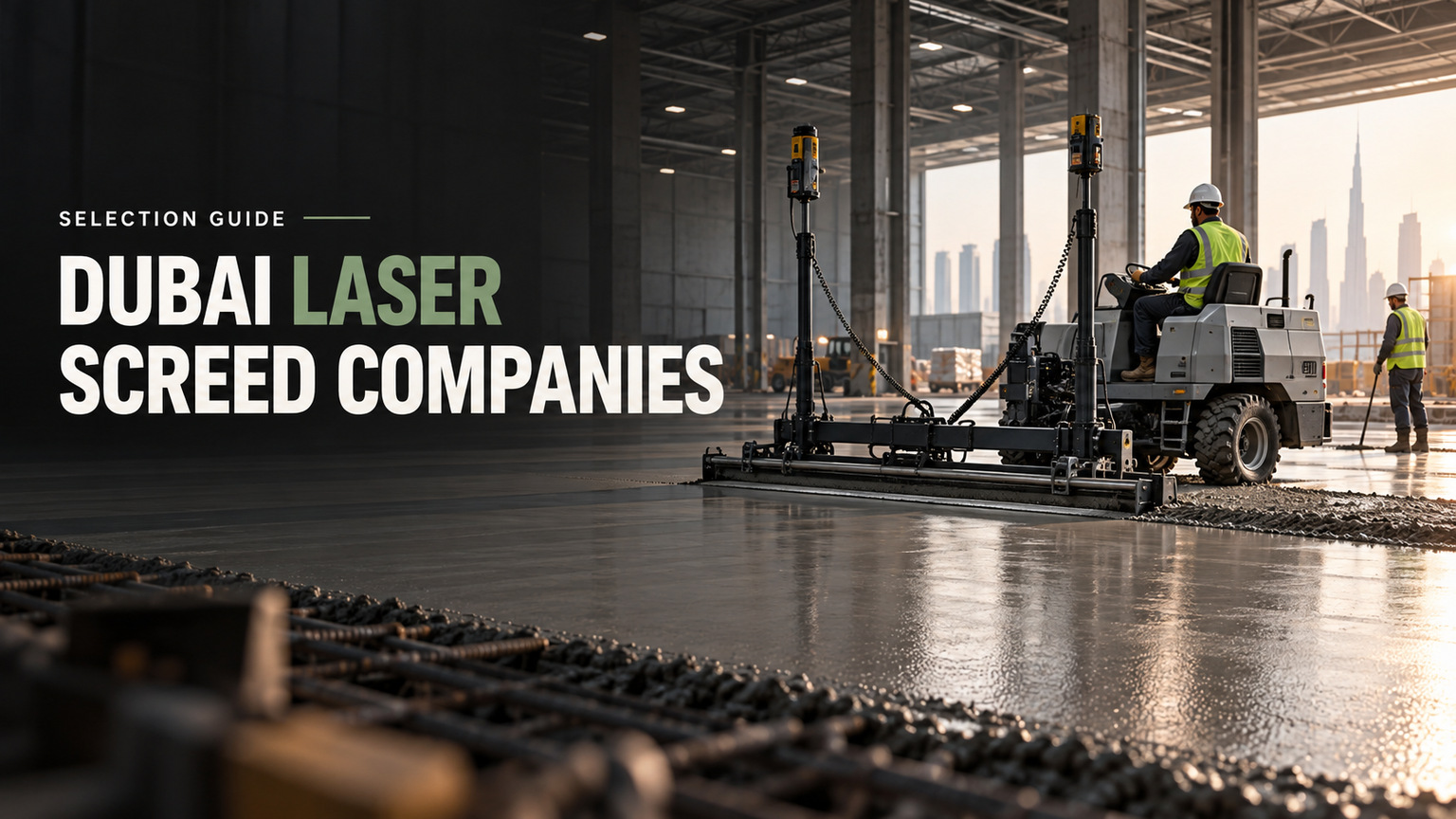

Laser Screed Companies in Dubai: Provider Comparison and Selection Guide
Quick Answer
Dubai has several companies with documented laser-screed capability, including specialist flooring contractors, general contractors, and equipment suppliers. These providers serve different roles and should not be compared on machinery alone. Choose a company based on your floor’s traffic needs, required tolerance, proven project results, and clear responsibility for construction and testing.
Key Takeaways
Choosing a laser-screed company starts with understanding the work each provider can deliver. The following findings help Dubai buyers compare services, technical claims, and contract risks.
- Dubai laser-screed providers include specialist industrial-floor contractors, general building contractors, equipment suppliers, and technical-service firms.
- Crown Edge offers Laser Screed Works for warehouses, factories, industrial facilities, and logistics centers in the UAE.
- CoGri Middle East and FAMP Contracting publicly document specialist industrial-flooring services, including laser-screed technology and high-tolerance work.
- ASTM E1155/E1155M FF/FL measurements suit specified random-traffic floors, not contract acceptance of fixed-path warehouse traffic.
- Owning a laser screed does not prove that a contractor can meet a project’s floor tolerance or quality needs.
- CoGri reports about 1,500 m² per day for its FM2 Superflat Fastrack workflow, not as a general Dubai production benchmark.
- Before award, require comparable test reports, a clear slab-design scope, suitable equipment, a pour and curing plan, and agreed repair responsibilities.
The first decision is which type of provider the project needs. The second is whether that provider can meet the specified floor standard and prove it through suitable testing.
Laser Screed Companies in Dubai and the UAE
Seven companies have relevant public evidence of laser-screed services, equipment, or technical support in Dubai and the wider UAE. They are not seven interchangeable flooring contractors.
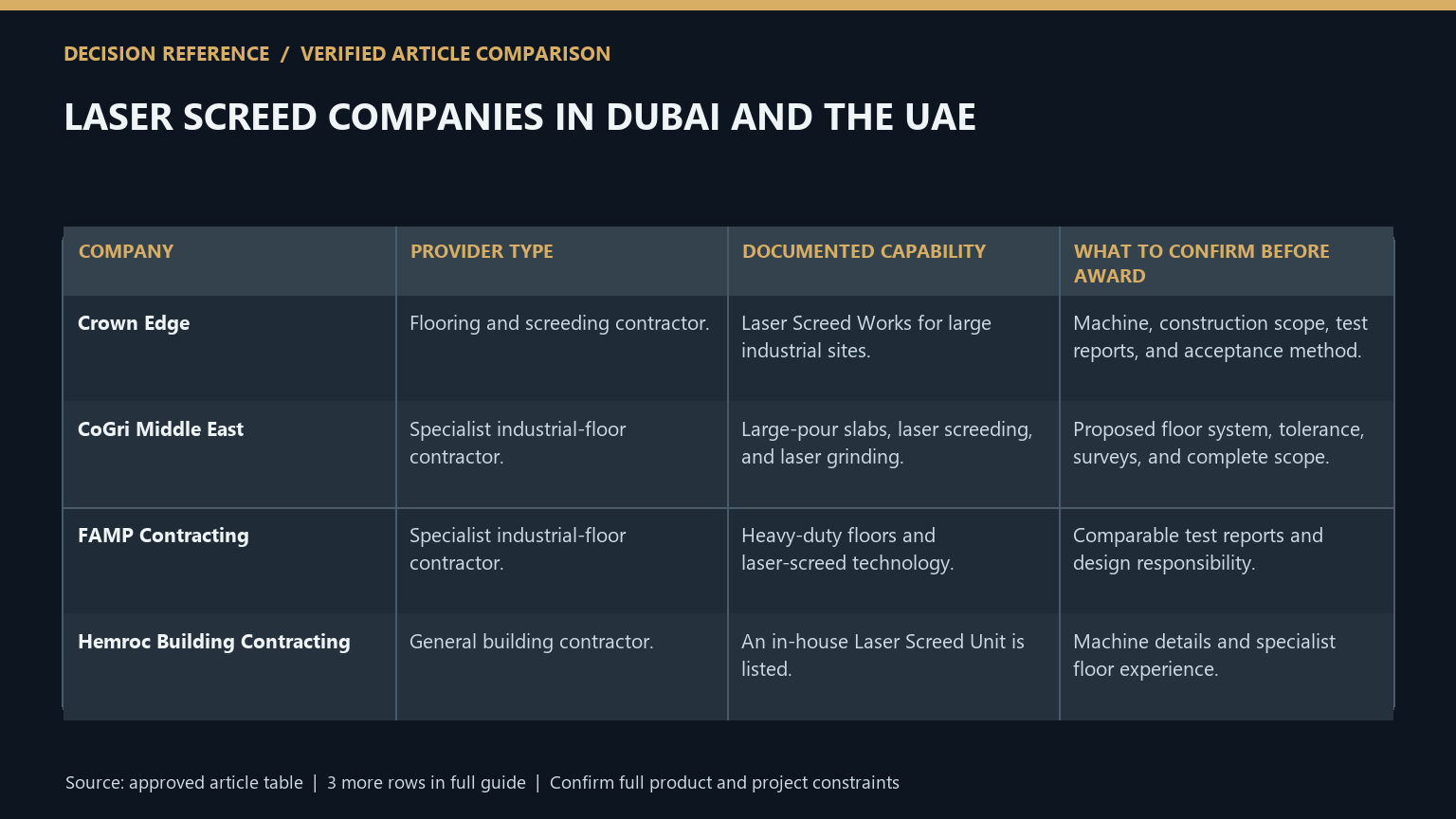
The comparison groups each company by its documented role. It is a provider directory, not a quality ranking. Public claims show the services a company offers. They do not replace completed project records or independent floor surveys.
| Company | Provider type | Documented capability | High-tolerance evidence | What to confirm before award |
|---|---|---|---|---|
| Crown Edge | Flooring and screeding contractor. | Laser Screed Works for large industrial sites. | No numerical tolerance guarantee was verified. | Machine, construction scope, test reports, and acceptance method. |
| CoGri Middle East | Specialist industrial-floor contractor. | Large-pour slabs, laser screeding, and laser grinding. | Superflat Fastrack and FM2 work are described. | Proposed floor system, tolerance, surveys, and complete scope. |
| FAMP Contracting | Specialist industrial-floor contractor. | Heavy-duty floors and laser-screed technology. | TR34, ACI, ASTM, and DIN are referenced. | Comparable test reports and design responsibility. |
| Hemroc Building Contracting | General building contractor. | An in-house Laser Screed Unit is listed. | Quantified tolerance results were not verified. | Machine details and specialist floor experience. |
| Mahraj Constructions | General concrete contractor. | Laser-guided screeding for industrial slabs. | FM1, FM2, and FM3 are referenced. | Achieved results and supporting project reports. |
| CanTec Concrete Solutions | Equipment and technical-services provider. | Somero distribution, floor surveys, grinding, and consulting. | VNA grinding and survey services are described. | Whether placement and final tolerance responsibility are included. |
| ACE Centro Enterprises | Equipment and rental supplier. | Laser-screed rental and equipment supply. | Turnkey floor-tolerance responsibility was not established. | Machine availability, operator support, and rental terms. |
The main difference is contractual responsibility. A specialist may offer a broad floor package. A rental supplier may provide only equipment. Comparing their headline prices without checking scope can produce a misleading result.
An absence of published tolerance figures does not prove a company lacks technical skill. It shows where the buyer needs stronger project evidence.
Crown Edge
Crown Edge is a UAE flooring contractor with a dedicated Floor Screeding service that includes Laser Screed Works.
Its stated applications include warehouses, factories, logistics centers, and large industrial facilities. The service covers laser-guided leveling of fresh concrete across broad floor areas.
For a Dubai warehouse project, Crown Edge is a relevant flooring-contractor enquiry option. Buyers should confirm its proposed machine, concrete-work scope, target tolerance, and survey arrangements. The public service page does not establish a specific machine model, daily production guarantee, or numerical FF/FL result.
A project proposal should resolve those details. It should also state whether Crown Edge provides the full concrete-floor package or works under a main contractor responsible for other stages.
CoGri Middle East
CoGri Middle East provides a dedicated Laser Screed Flooring service for large industrial concrete floors.
Its stated work includes large-pour slabs on ground, steel-fibre-reinforced slabs on piles, and high-tolerance floors. The company also describes laser grinding within certain floor systems.
This scope is relevant to facilities where surface regularity affects daily operations. A high-bay warehouse, for instance, may need both controlled placement and later surface correction. The approved system and test method should determine that work.
CoGri’s Superflat Fastrack system provides a specific production example. The company reports about 1,500 m² per day for an FM2 ground-supported floor using its described workflow.
This is a company-published capability for a defined method. It should not become a production target for unrelated projects without a separate site assessment.
FAMP Contracting
FAMP Contracting describes itself as a specialist in heavy-duty, high-tolerance industrial concrete floors.
Its published services include laser-screed technology and work referencing TR34, ACI, ASTM, and DIN frameworks. FAMP also states that its completed high-tolerance flooring portfolio exceeds 5 million m² across several countries.
That portfolio figure is self-reported, not independently audited in the reviewed research. Buyers should treat it as background rather than proof that a specific proposed floor will meet its tolerance.
FAMP also lists a Dubai contact location. For a new contract, request recent projects with comparable slab design, traffic conditions, and test results. One relevant warehouse survey may be more useful than a large total project-area claim.
Hemroc Building Contracting
Hemroc lists an in-house Laser Screed Unit among its construction capabilities.
The company works across several building and infrastructure sectors. Its Dubai presence and stated equipment capability make it relevant when screeding forms part of a wider construction package.
Its public equipment listing does not establish the specific screed model or a measured high-tolerance track record. Ask for both, along with details of the crew that would carry out the work.
A general contractor may have strong site management systems. Yet demanding warehouse floors need specific placing, finishing, joint, and survey experience. The proposed team should show evidence that matches the floor’s intended use.
Mahraj Constructions
Mahraj describes laser-screeded industrial concrete floors within its wider concrete-work services.
Its public material refers to a Somero S-840 or equivalent laser-guided screed. It also mentions FM1, FM2, and FM3 classes and industrial work in UAE locations such as JAFZA and Dubai Investment Park.
These are published service claims. They do not independently establish the measured outcome of any particular project.
A buyer should request the proposed equipment model, target FM class, survey method, and recent reports. The contract should state who accepts the final test results and who pays for correction if a measured area fails.
CanTec Concrete Solutions
CanTec Concrete Solutions serves the industrial-floor sector through equipment, technical services, and consulting.
The company describes itself as a factory-appointed Middle East distributor for Somero laser screeds. Its services also include floor surveys, VNA aisle grinding, repairs, training, and technical advice.
CanTec can be relevant during both construction and later correction work. A flooring contractor may need equipment support. A warehouse owner may instead need an existing surface surveyed or ground to the specified tolerance.
The reviewed public evidence does not establish a directly comparable turnkey floor-placement package. Buyers should confirm whether CanTec supplies equipment, labour, surveys, or a wider contracted service.
ACE Centro Enterprises
ACE Centro advertises laser-screed equipment rental and supply across Dubai, Abu Dhabi, and Sharjah.
Its role may suit a contractor with an existing concrete team that needs access to a laser screed. This can be a reasonable procurement route when the contractor already manages slab design, concrete delivery, placing, finishing, and quality control.
Rental does not automatically include those tasks. Confirm the equipment, operator support, service response, rental period, and breakdown terms. Assign final floor-tolerance responsibility to the appropriate construction party rather than assuming the equipment supplier carries it.
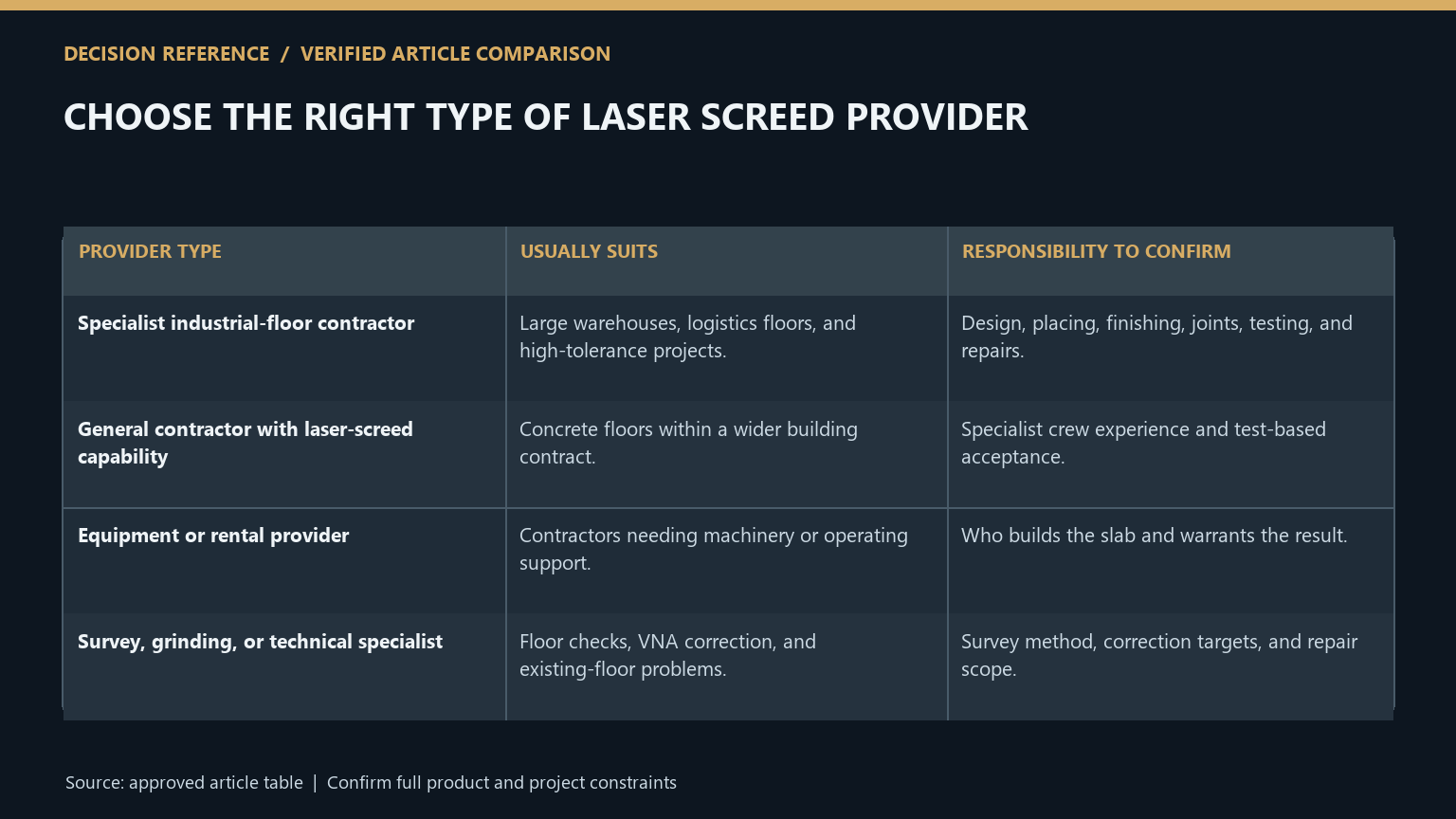
Choose the Right Type of Laser Screed Provider
Choose the service model before choosing the company. The correct provider depends on the work package and who controls the finished-floor result.
An industrial floor can involve several firms. One may design the slab. Another may supply concrete and place it. A third may survey the result. The buyer needs a clear division of responsibility across those stages.
The following comparison helps match the provider type to that responsibility.
| Provider type | Usually suits | Responsibility to confirm |
|---|---|---|
| Specialist industrial-floor contractor | Large warehouses, logistics floors, and high-tolerance projects. | Design, placing, finishing, joints, testing, and repairs. |
| General contractor with laser-screed capability | Concrete floors within a wider building contract. | Specialist crew experience and test-based acceptance. |
| Equipment or rental provider | Contractors needing machinery or operating support. | Who builds the slab and warrants the result. |
| Survey, grinding, or technical specialist | Floor checks, VNA correction, and existing-floor problems. | Survey method, correction targets, and repair scope. |
The categories can overlap. A specialist might also offer surveys. An equipment business might provide technical services. The table describes the roles established by the reviewed evidence, not fixed limits on each company’s operations.
A standard storage warehouse may use trucks moving through open aisles. A VNA facility may use guided trucks on fixed paths at high lift heights. These floors can need different acceptance tests and different levels of construction control.
For demanding work, specialist floor experience deserves greater weight. For an ordinary concrete package, an experienced general contractor may be suitable. Neither company type should receive automatic preference without comparable evidence.
Define the Floor Before Requesting Prices
A useful laser-screed quotation begins with the floor’s use, loads, and tolerance. A price per square metre says little until those details are known.
Consider a hypothetical 12,000 m² warehouse. Most of its floor may serve general storage. One part could contain high-lift racking and fixed truck routes. Treating all 12,000 m² as one uniform tolerance package could hide major differences in cost and testing.
Start with the traffic system
Tell each bidder which vehicles will use the floor and how they travel.
The Concrete Society’s floor surface regularity guidance explains why floor use affects the needed surface quality. High-lift materials-handling equipment can need tighter control than ordinary low-level warehouse operations.
The design team should use the actual vehicle and racking needs to define the floor. Useful inputs include vehicle type, wheel routes, lift height, rack position, and operating zones.
Some details may still be under review at tender stage. In that case, identify them as design decisions requiring confirmation before final acceptance values are agreed.
State the tolerance system
Ask the designer to name the standard, class, and numerical acceptance values.
A project may use FF/FL numbers, FM classes under TR34, or a defined-traffic system. These terms describe different approaches. They should not be substituted for one another in a quotation.
The Concrete Society’s construction tolerance guidance stresses that tolerances should suit the intended use and be achievable.
A very tight target can increase construction and correction costs without improving the intended operation. A target that is too loose may leave the floor unsuitable for its planned trucks.
No single TR34, ASTM, ACI, or DIN system automatically governs all Dubai floors. The project documents must identify the applicable basis and required results.
Assign slab-design responsibility
A laser screed controls part of the concrete placing process. It does not replace structural slab design.
The American Concrete Institute’s ACI PRC-360-10 slab-on-ground guide covers soil support, loads, joints, reinforcement, shrinkage, and curling.
Before tender, identify the slab designer and the approved design basis. The drawings should address thickness, support, reinforcement or fibres, and joint layout. Concrete mix and placement plans must align with that design.
A screeding subcontractor should not inherit an unstated design obligation. Nor should a designer assume the site crew can resolve a poor joint layout during the pour.
FF/FL, FM, or VNA: Match the Test to the Traffic
Use the acceptance method that fits the floor’s traffic system. Random-traffic and fixed-path floors must not be assessed as though they were identical.
ASTM E1155/E1155M-23 provides a method for obtaining FF and FL numbers. It also says those results should not enforce contract tolerances for fixed-path vehicle systems, including narrow-aisle warehouse floors.
The following decision table separates three common specification cases.
| Floor use | Potential acceptance approach | Buyer decision |
|---|---|---|
| Random-traffic warehouse | ASTM E1155/E1155M FF/FL, where specified. | Agree on overall and local criteria, test timing, and survey scope. |
| Industrial floor specified to an FM class | Project-selected TR34 surface-regularity regime. | Confirm class, measurement rules, and acceptance values. |
| Fixed-path or VNA warehouse | Direct assessment of the specified vehicle paths. | Use project-defined tests and values, not random FF/FL sampling alone. |
The main risk is a mismatch between the test and the truck operation. A floor may satisfy its random-traffic FF/FL target yet fail a separate fixed-path requirement. Set the acceptance regime before placing concrete, not after a survey reveals a problem.
What FF and FL measure
FF describes floor flatness over short distances. FL describes floor levelness over longer distances.
An ACI technical article on F-number classifications provides these examples of specified overall FF/FL classifications.
| Floor description | Overall FF | Overall FL |
|---|---|---|
| Conventional | 20 | 15 |
| Moderately flat | 25 | 20 |
| Flat | 35 | 25 |
| Very flat | 45 | 35 |
| Super flat | 60 | 40 |
These values explain the scale of the F-number system. They are not default requirements for Dubai warehouses. The project must state its own specified overall and local minimum values where applicable.
A satisfactory overall result can still leave local areas that need attention. The acceptance plan should explain how those areas will be assessed and corrected.
Why VNA floors need a different check
A fixed-path truck follows the same tracks on each journey. Variations along those tracks can affect vehicle movement, especially at greater lift heights.
Random measurements across a wider slab may miss a problem along a critical wheel path. A good overall FF/FL result cannot prove that every VNA aisle meets its specified tolerance.
The designer and truck supplier should help establish the required path geometry and acceptance rules. The survey firm must then use the agreed method.
Grinding may be part of a planned VNA floor system. If so, describe it as planned work in the tender. Do not leave buyers to assume that all grinding is a repair for failed screeding.
What a Laser Screed Contractor Must Prove Before Award
Require evidence of the proposed method and the finished-floor obligation. A company brochure cannot replace a complete technical bid.
Prequalification should test how the contractor will deliver the floor. It should also show what happens if the result fails the agreed tolerance. This is especially useful when concrete supply, screeding, surveys, and design sit under separate contracts.
Laser Screed Contractor Prequalification Checklist
Ask each bidder to submit written evidence for these 15 items. Record whether each task is included, excluded, or assigned to another named party. An unclear responsibility should be resolved before award.
- Traffic use: Identify random traffic, fixed-path traffic, or VNA use.
- Tolerance: State the governing standard and exact acceptance values.
- Slab design: Name the responsible designer and approved design basis.
- Concrete supply: Provide the mix, delivery, pumping, and placing plan.
- Reinforcement: State the specified rebar, mesh, or fibre system.
- Joints: Provide the joint layout and assign joint-system responsibility.
- Equipment: Name the screed model, operators, and backup arrangements.
- Finishing: Describe the finish and any dry-shake hardener work.
- Curing: Submit the curing method and its timing.
- Dubai weather: Explain controls for heat, wind, and concrete handling.
- Floor testing: Define the survey method and test timing.
- Independent checks: Name the survey party and reporting process.
- Past results: Supply reports from projects with comparable floor needs.
- Repairs: Agree on the method and cost responsibility for failed areas.
- Warranty: Define defects, exclusions, and the responsible contractor.
The contractor need not perform every task itself. But the full package needs clear ownership. A main contractor may supply concrete while a specialist finishes the slab. An independent firm may then survey the result.
That arrangement can work when coordination is written into the contract. Problems arise when the survey finds a failed area and no party accepts responsibility for correction.
Ask for proof from similar jobs
Comparable work matters more than a large project count alone.
For a distribution centre, request a recent warehouse floor report. Review the traffic system, test method, tolerance, surveyed area, project date, and any correction work.
A random-traffic warehouse report offers limited evidence for strict VNA work. Even another VNA report needs context. The slab design, truck system, and site conditions may differ.
Look for the connection between the contractor’s claimed skill and measured work. A clear account of a past repair can also be useful. It shows how the contractor handled a real floor issue rather than relying on a broad quality claim.
Laser Screed Equipment: What Matters and What Does Not
The machine affects the placing method, access needs, and work sequence. It does not guarantee the finished-floor tolerance.
As a manufacturer example, Somero publishes the following values for its S-22EZ Advanced Laser Screed. These figures describe that model only.
| Machine detail | Manufacturer-published value |
|---|---|
| Standard screed-head width | 4.44 m (14 ft 7 in). |
| Optional screed-head width | 5.02 m (16 ft 6 in). |
| Approximate machine weight | 6,668 kg (14,700 lb). |
| Laser-control system | OASIS. |
A wider screed head may suit an open floor area. Yet columns, access routes, reinforcement, and pour boundaries can limit where a machine can work. Its weight also matters when planning movement and setup on site.
None of these values proves that the contractor will meet a particular FF/FL, FM, or VNA tolerance. The whole process still matters, from concrete supply through finishing and curing.
Ask every bidder to identify its actual machine and configuration. Require a setup plan, crew details, service support, and a practical backup method.
If concrete delivery stops or the screed fails during a pour, the team needs an agreed response. Leaving that decision until the slab is partly placed creates avoidable risk.
Compare Daily Production Claims Carefully
Use daily production figures to test the proposed programme, not to rank companies on one published number.
CoGri reports about 1,500 m² per day for its FM2 Superflat Fastrack method. That is useful evidence for the described system. It does not establish a universal Dubai rate.
Output changes with concrete supply, pumping, reinforcement, slab layout, joints, finishing, site access, and crew size. Dubai’s hot and windy conditions can also affect concrete work. The bidder should address weather controls without relying on an invented fixed productivity penalty.
A worked schedule gives a clearer basis for review. The following example uses hypothetical figures rather than a claimed market average.
| Planning input | Illustrative project value |
|---|---|
| Net industrial-floor area | 9,000 m². |
| Proposed active pour output | 750 m² per day. |
| Calculated active pour days | 12 days. |
| Concrete supply | Capacity must support each planned pour. |
| Pour boundaries | Agreed with the slab and joint design. |
| Equipment and crew | Sized for the proposed daily work. |
| Weather response | Hot-weather and delay controls required. |
| Other work stages | Preparation, curing, testing, and repairs scheduled separately. |
Estimated active pour days = net slab area ÷ planned daily pour area.
For this illustration, 9,000 ÷ 750 gives 12 active pour days. The assumed 750 m² per day is not a verified Dubai production rate.
The full project will need more time than those 12 pour days if other stages fall outside the active placing period. The bidder should show the sequence, dependencies, and contingency measures rather than presenting the result as the complete project duration.
A credible programme links each planned pour to concrete delivery, machinery, finishing capacity, and site access. That evidence is more valuable than a large peak-output claim without supporting logistics.
Laser Screeding Does Not Guarantee Crack-Free Concrete
Laser screeding helps control fresh concrete elevation. It cannot prevent every crack, curled edge, or moving joint.
The American Concrete Institute’s slab-on-ground guidance abstract explains that completely crack-free and curl-free slabs are not a realistic expectation, even with sound design and construction.
Concrete changes as it cures and dries. Support conditions, restraint, joints, reinforcement, shrinkage, and curing all affect the final slab. A good screeding process controls only part of that system.
Buyers should therefore ask how the contractor and designer will manage cracking and curling risks. The contract should also explain which defects require correction and who will handle them.
A broad promise of a perfectly crack-free floor is less useful than a clear design basis, quality plan, and agreed response to defects that affect the intended operation.
Laser Screed vs Self-Levelling Flooring vs Epoxy
Laser screeding, self-levelling compounds, and epoxy flooring serve different purposes. They can form parts of one project, but they are not direct substitutes.
The distinction matters when comparing quotations. One price may cover construction of a new concrete slab. Another may cover surface preparation or a protective finish applied after the slab is built.
| Method or system | Main purpose | Typical project stage |
|---|---|---|
| Laser screeding | Controls fresh concrete elevation over large slab areas. | Concrete placing. |
| Self-levelling flooring | Smooths or levels a suitable prepared base. | Surface preparation or correction. |
| Epoxy flooring | Provides a specified protective or finished surface. | After substrate preparation and acceptance. |
Crown Edge’s Self-Levelling Flooring service describes cement-based and polymer-modified levelling systems. These use separate materials and methods from a laser screed working fresh concrete.
A self-levelling layer may help prepare a floor for a chosen finish. It does not automatically correct a structural slab defect or make a VNA aisle compliant.
Crown Edge also offers Epoxy Flooring systems for commercial and industrial use. An epoxy system may provide a protective surface where the project specifies one.
Before selecting a coating, check moisture limits, base condition, surface preparation, and expected traffic. A finish should not conceal unresolved structural or surface-regularity issues.
Laser Screed Contractor RFQ: A Worked Tender Comparison
Send every shortlisted company the same project brief. Then compare the work each bidder accepts, not just the quoted price.
Consider a hypothetical Dubai logistics floor. The building has 9,000 m² of slab area, including a VNA operating zone. The designer has issued slab drawings and a defined-traffic test requirement for the fixed truck paths.
Three fictional bid arrangements illustrate common scope gaps. They are not quotations from the companies listed earlier. No prices or performance results are assumed.
| Evaluation item | Bid A: Floor specialist | Bid B: Main contractor | Bid C: Equipment rental |
|---|---|---|---|
| Offered scope | Placing, finishing, curing, and coordination of surveys. | Concrete supply, placing, and finishing. | Laser screed and agreed equipment support. |
| Slab design | Uses owner-approved drawings. | Uses owner-approved drawings. | Outside rental scope. |
| VNA acceptance | Direct path test is included in proposed scope. | Survey and acceptance responsibility are unclear. | Outside rental scope. |
| Equipment | Named machine and backup plan. | Machine identified; backup not stated. | Machine model and rental terms stated. |
| Concrete supply | Assigned to the main contractor. | Included in proposed package. | Outside rental scope. |
| Curing | Included and described. | Included; method needs review. | Outside rental scope. |
| Failed tolerance | Correction process proposed. | Repair responsibility not yet assigned. | No finished-floor obligation. |
| Initial decision | Advance to technical review. | Clarify exclusions before commercial comparison. | Consider only within a separately managed construction package. |
Bid A may appear more complete, but it still needs proof of past results and acceptance of the final contract terms. Bid B could become comparable once its survey, backup, and repair obligations are settled. Bid C serves a different procurement need and should not be judged as a failed turnkey offer.
The example shows why a low machine-rental price cannot be compared directly with a complete floor-construction package. The underlying work and risks are different.
Prepare a consistent RFQ package
For a real tender, include the project location, net area, zones, operating equipment, racking, slab drawings, and agreed traffic system. Attach the governing tolerance specification and test rules.
The package should also address reinforcement, concrete supply, joints, finish, curing, and Dubai hot-weather controls. Ask each bidder for its machine model, operators, backup arrangements, pour sequence, and proposed daily output.
Finally, require comparable project reports, survey responsibility, repair terms, programme milestones, and warranty conditions.
These fields can form a separate reusable RFQ document. Within the article, the worked comparison shows how those details affect the actual award decision.
Compare commercial offers only after scope alignment
Start by identifying exclusions. One contractor may include the concrete supply and survey. Another may offer screeding labour while others handle those tasks.
Next, resolve tolerance commitments and acceptance rules. A bidder should either accept the defined regime or identify conflicts before contract award.
Review past test results and site methods after that. Confirm how the finished floor will be checked, how failed areas will be corrected, and who bears each cost.
Only then does a commercial price comparison provide a useful basis for selection.
Final Selection Framework
Select the provider that can deliver the specified floor under a clear and testable contract. The largest machine, highest output claim, or lowest headline price is not sufficient evidence.
Use the following gates at the final technical review. Each gate calls for a concrete decision, not a subjective brand score.
| Selection gate | Evidence needed | Reason to hold award |
|---|---|---|
| Service fit | Scope matches the required flooring work. | Rental-only offer where complete floor construction is needed. |
| Traffic and tolerance | Correct regime and target values are accepted. | Fixed-path VNA acceptance is based only on random FF/FL sampling. |
| Design and joints | Named designer and approved drawings. | Important slab decisions remain unassigned. |
| Project proof | Comparable completed work and test reports. | Relevant claims lack supporting records. |
| Equipment and crew | Proposed machine, people, and backup method. | Placing method or contingency is unclear. |
| Pour and curing plan | Credible supply, finishing, and weather controls. | Daily output has no workable site plan. |
| Testing and repairs | Written survey, acceptance, and remedy terms. | Responsibility for failed tolerance is unresolved. |
A strong portfolio cannot compensate for unclear acceptance rules. Nor should a capable machine replace a credible construction and curing plan.
For a standard random-traffic warehouse, a contractor with the correct method and strong survey records may offer suitable value. For a demanding VNA facility, direct traffic-path testing and specialist experience may carry greater weight.
A buyer considering Crown Edge or any other listed provider should send the same project-specific requirements. The final choice should rest on accepted scope, comparable evidence, and responsibility for the finished floor.
Frequently Asked Questions
These answers address common questions that arise when Dubai buyers compare laser-screed services. They complement the technical and contract checks covered above.
Which laser screed companies operate in Dubai?
The researched options include Crown Edge, CoGri Middle East, FAMP Contracting, Hemroc Building Contracting, and Mahraj Constructions. CanTec and ACE Centro offer relevant equipment or technical services. Their roles differ, so confirm the precise construction or supply scope before seeking comparable bids.
Is a specialist industrial-floor contractor always better than a general contractor?
A general contractor can be suitable when it has relevant crews, sound methods, and proven floor results. A specialist may be better placed for complex industrial or high-tolerance work. Compare actual evidence and contract responsibility rather than company labels.
Does laser screeding guarantee a superflat warehouse floor?
A laser screed alone cannot guarantee that result. The contract must define the tolerance and test method. Slab design, concrete supply, crew skill, finishing, curing, and possible grinding also affect the finished surface.
Should every Dubai warehouse specify FF/FL numbers?
No. FF/FL may suit specified random-traffic floors. Fixed-path and VNA floors need acceptance methods suited to their vehicle routes. The designer should define the applicable method before bidding.
How much concrete can a laser-screed company place per day?
There is no verified universal Dubai production rate in the supplied evidence. CoGri publishes about 1,500 m² per day for one FM2 Superflat Fastrack workflow. Each bidder should provide a rate based on the actual slab, site, supply plan, and crew.
Is laser screeding the same as self-levelling flooring?
They are different processes. Laser screeding controls fresh concrete during slab construction. Self-levelling compounds are separate materials used to smooth or level suitable prepared surfaces.
Can a laser-screeded floor still crack?
Concrete may crack or curl even with sound construction. Laser screeding does not eliminate shrinkage or joint movement. Review the slab design, curing method, joint plan, and defects terms before award.
What documents should I request before hiring a laser screed contractor?
Request slab drawings, the proposed scope, target tolerance, machine details, concrete and pour plan, curing method, test procedure, and comparable reports. Confirm repair responsibility, retesting costs, and warranty coverage.