

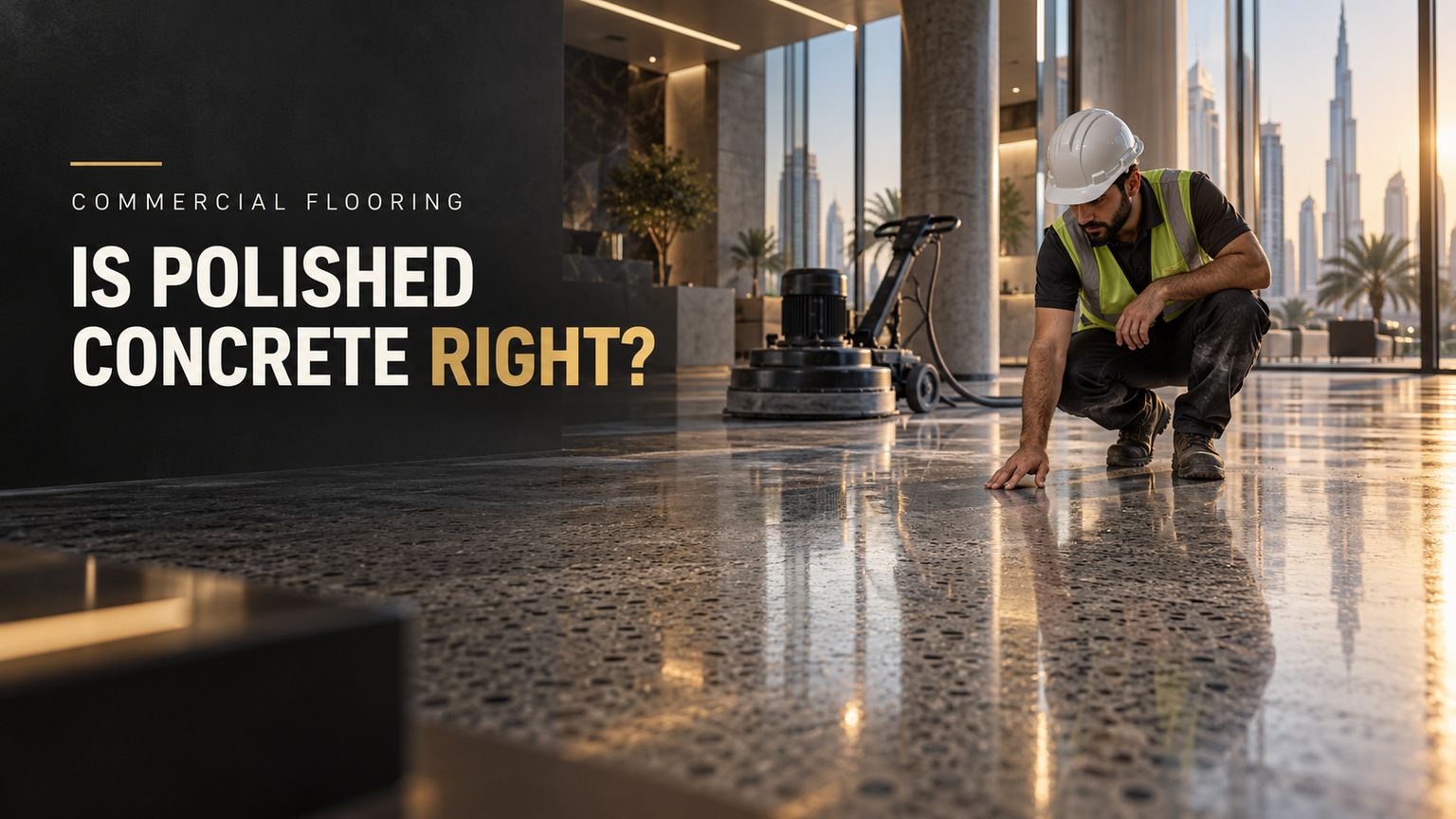

Commercial Polished Concrete Floors in Dubai: Suitability, Finishes and Specifications
Quick Answer
Commercial polished concrete floors are mechanically refined concrete surfaces suited to many Dubai offices, showrooms, retail spaces, and selected industrial sites. The slab must be fit for polishing, and its appearance must suit the project. Choose aggregate exposure, finish level, and slip criteria before work starts. Consider epoxy or micro-topping when needs differ.
Key Takeaways
A successful commercial floor starts with the right system choice. These seven findings help owners, designers, and project teams decide what to check before work begins.
- Mechanical polishing refines the concrete slab itself instead of relying on a film-forming coating for its finished appearance.
- Existing coatings, cracks, patches, surface strength, and aggregate distribution can affect whether a commercial slab is worth polishing.
- Epoxy may suit stronger protection needs, while micro-topping can offer more control over a decorative concrete-look finish.
- The Concrete Polishing Council defines three current aggregate exposure classes: A for cream, B for fine aggregate, and C for coarse aggregate.
- CPC appearance Levels 1–4 use measurable distinctness-of-image ranges, rather than vague descriptions such as matte or high gloss.
- Dubai’s accessibility code gives different Pendulum Test Value criteria for applicable dry, wet, level, and sloped surfaces.
- An approved slab mock-up, clear acceptance tests, repair details, and a maintenance plan help prevent disputes after handover.
The main decision is simple. First check the slab and how the space will be used. Then choose the flooring system, finish, and tests that suit those conditions.
Choose the Right Commercial Flooring System First
Polished concrete works best when the slab itself can become the finished floor. The concrete must be sound enough for the work. Its natural color, stones, joints, and repairs must also suit the design.
Mechanical polishing is not the same as applying a shiny coating. Workers grind, hone, and polish concrete with abrasive tools. Each stage refines the surface. The American Concrete Institute’s guide to polished concrete explains this process and separates it from bonded decorative overlays.
An existing slab may offer the look a designer wants. Yet a space with heavy chemical use or frequent wet cleaning may need a different system. That choice should come before any debate about gloss or exposed stone.
Polished Concrete vs Epoxy vs Micro-Topping
These four floor systems can look similar in photos. Their construction and care needs are quite different. The table shows when each option deserves a closer look.
| Floor system | How it works | Main advantage | Main limitation |
|---|---|---|---|
| Mechanically polished concrete | Grinds and refines the slab itself. | Uses natural concrete as the finish. | Existing slab character remains visible. |
| Grind-and-seal | Grinds concrete and applies a topical sealer. | Creates a concrete-look surface. | Coating wear depends on the product. |
| Epoxy or other resin | Adds a protective resin system over a prepared base. | Can provide tailored protection and texture. | Product choice and floor prep are critical. |
| Micro-topping | Adds a thin decorative cement-based layer. | Gives more control over the visible face. | Needs a suitable base and overlay system. |
The Concrete Polishing Council’s technical glossary draws a firm line between bonded-abrasive polishing and surface-coated concrete. A coated floor serves a different purpose. It should not be sold as the same process.
For a dry showroom, visible stone and a refined surface may be ideal. A commercial kitchen faces other demands. Oils, chemical exposure, hygiene, and frequent washing may favor a purpose-designed resin floor.
Crownedge’s commercial epoxy flooring systems are one option to assess. For a more uniform decorative face, its micro-topping works offer another route.
A Flowcrete Middle East comparison of polished concrete and resin flooring also examines function, design, budget, and site needs. This is a manufacturer publication, so its product comparisons should be read in that context.
Where Polished Concrete May Fit
Offices, retail units, lobbies, showrooms, and selected warehouses may suit polished concrete. The right choice depends on how the floor will be used.
An office lobby may benefit from a calm, natural finish. A showroom may place more value on visible aggregate and clear reflections. Warehouse managers often focus on traffic, cleaning, repairs, and the loads placed on the floor.
Dubai has published commercial examples. Contractor Duphill’s project portfolio lists polished concrete at Time Out Market and MENA Legal offices. Its reported project areas are 2,800 m² and 150 m², respectively. These are contractor-reported examples, not independent tests of floor performance.
Such projects show the range of possible uses. They do not prove that the same finish will work on every commercial slab.
Check Whether the Existing Concrete Can Be Polished
Start with the slab, not a finish sample. The existing concrete controls much of the final result. Grinding may reveal old stains, repairs, and changes in stone distribution. It cannot make those features vanish.
A survey should look at both surface condition and floor use. Weak concrete may need repair. Old coatings may need removal. The team must also decide how much natural variation the client will accept.
Five Checks Before Quotation
A contractor needs more than floor area to price the work. These five checks help identify defects and site needs that could change the flooring choice.
| Check | What to inspect | Why it matters |
|---|---|---|
| Previous coverings | Paint, resin, tile adhesive, and coatings. | Removal may expose stains or uneven areas. |
| Surface condition | Weak, dusty, damaged, or stained concrete. | Repairs or another system may be needed. |
| Cracks and joints | Open cracks, patches, and planned joints. | These features may stay visible. |
| Flatness and aggregate | Surface levels and stone distribution. | Grinding depth and exposure may vary. |
| Intended use | Traffic, water, oil, and chemical contact. | A protective system may be a better fit. |
The survey findings should shape the work brief. A minor patch may only need a visual agreement. Large weak areas or deep contamination may change the project scope entirely.
Crownedge lists floor grinding, surface preparation, and repair services. These steps are relevant when assessing an existing floor. For new projects, floor screeding may form part of the wider floor build-up. A screed should not be treated as polishable without checking its product data.
Use a Real Slab Mock-Up
A trial area on the actual slab gives the most useful appearance evidence. A sample made with different concrete cannot show what grinding will expose on site.
The mock-up should represent normal floor conditions. If joints, patches, or cracks are common, include them in the trial where practical. Record the grinding depth, exposed aggregate, appearance level, and any surface treatment.
Review the result under lighting close to the final space. Strong daylight may reveal marks that are less clear in a dim work area. A showroom with glass walls deserves particular care during this review.
Both the contractor and client should approve the result before full work begins. Keep photos and the agreed finish details for later checks.
A Simple Suitability Decision
The findings can now guide a preliminary system choice. This matrix helps prevent a decorative preference from overruling a major floor defect or use need.
| Site finding | Preliminary decision |
|---|---|
| Sound slab with acceptable natural character. | Assess mechanical polishing. |
| Repairs or uneven aggregate exposure. | Test repairs and an actual-slab mock-up. |
| Uniform new decorative appearance is essential. | Assess a suitable overlay. |
| Strong chemical or wet-use needs dominate. | Assess a suitable protective resin. |
| Slab condition remains unknown. | Hold the choice until inspection. |
These are screening decisions, not structural approvals. A sound slab with a poor visual match may still be wrong for the project. Equally, a marked floor may be acceptable where the owner wants an industrial look.
Specify Aggregate Exposure and Appearance Separately
A polished-concrete finish needs two clear choices: stone exposure and appearance level. Stone exposure describes how much aggregate is visible. Appearance level describes how clearly the surface reflects an image.
These two features are not interchangeable. A cream finish can be highly polished. A floor with large exposed stones can have a lower appearance level. The specification must address both.
CPC Aggregate Classes A, B, and C
The Concrete Polishing Council’s 2024 aggregate exposure chart describes three current classes. Each represents a different visual result.
| CPC class | Finish description | CPC guide proportions |
|---|---|---|
| A | Cream or cement-fines finish. | 85–95% cement fines; 5–15% fine aggregate. |
| B | Fine aggregate or salt-and-pepper finish. | 85–95% fine aggregate; 5–15% blend of cement fines and coarse aggregate. |
| C | Coarse or full aggregate exposure. | 80–90% full aggregate; 10–20% blend of cement fines and fine aggregate. |
These proportions guide the intended appearance. They are not guaranteed outcomes for every slab.
Class A keeps more of the surface paste visible. Class B brings smaller stones into view. Class C exposes more of the coarse aggregate and often needs deeper grinding.
The result depends on the concrete mix and how the slab was placed and finished. Uneven stone distribution may stop a contractor from achieving a consistent Class C surface. Grinding alone cannot create aggregate where little exists.
Older CPC material sometimes refers to a fourth class. The current chart uses A, B, and C.
CPC Appearance Levels 1–4
Appearance is measured separately from exposed stone. The CPC’s appearance chart and test guidance uses distinctness of image, or DOI. This describes how clearly a reflected image appears on the floor.
DOI differs from gloss. Gloss measures reflected light. A surface may reflect plenty of light without forming a sharp image.
| CPC level | Surface description | DOI range | Optional gloss guide |
|---|---|---|---|
| Level 1 | Ground or flat. | 0–9. | Below 10. |
| Level 2 | Honed or satin. | 10–39. | 5–25. |
| Level 3 | Polished. | 40–69. | Above 35. |
| Level 4 | Highly polished. | Above 70. | Above 50. |
The CPC chart also gives a haze criterion below 12 for these levels. Haze describes the cloudy spread around a reflected image. The chart names ASTM D5767 for DOI and ASTM D4039 for haze measurement.
These are industry appearance measures, not Dubai legal finish ratings. A client requesting Level 4 should expect an agreed test result, not merely a floor that looks shiny in a photo.
Decide How the Finish Will Be Checked
A clear finish target needs a test plan. The CPC chart calls for at least three tests in an area up to 1,000 ft². Add one test for each further 1,000 ft², or part of that area. The first area equals about 92.9 m².
The chart also advises testing within 72 hours of polish completion, before other trades enter the area and before post-polish surface treatments. Agree on test timing, locations, and who will record the results.
For a dry commercial showroom, an example finish brief could read:
Existing commercial concrete floor. Target CPC Class B fine aggregate exposure and Level 3 polished appearance. Confirm the achievable result through an approved actual-slab mock-up. Record DOI results, repair and joint appearance, and the proposed surface treatment before full production.
This describes a proposed finish, not a guaranteed result. The slab survey and mock-up must support the target. A measured finish gives both parties a sound basis for acceptance.
Check Dubai Slip-Resistance Requirements
A polished appearance does not prove slip safety. For applicable accessible surfaces in Dubai, the project must identify the right Pendulum Test Value, or PTV. Floor use, wet conditions, and slope can change the criterion.
The Dubai Universal Design Code provides the city’s accessibility framework. The relevant project consultant should confirm which areas and rules apply.
Dubai PTV Criteria for Accessible Surfaces
The published Dubai Universal Design Code slip-resistance table gives these values for the stated conditions. Use the table as a planning reference alongside the approved project design.
| Surface condition | Published PTV criterion |
|---|---|
| Dry indoor level surface. | 15–35. |
| Dry indoor surface with slope of at least 5%. | 35 or higher. |
| Wet or outdoor level surface. | 35–45. |
| Wet or outdoor surface with slope of at least 5%. | 45 or higher. |
| Street paving, pools, and showers. | 45 or higher. |
These are the published bands and thresholds, not automatic approval ratings for polished concrete. The table applies within the code’s accessibility scope. Other project or authority rules may also affect acceptance.
A level, dry office route differs from a wet entrance ramp. Before selecting a finish, confirm the real service conditions. A glossy sample viewed in a showroom cannot answer that question.
How to Check Slip Performance
The code’s PTV definition and test reference identifies EN 13036-4. The method uses a pendulum device to assess surface slip resistance.
A project test plan should name the areas to be checked, expected dry or wet conditions, floor slope, and required acceptance values. It should also state who performs the test and when it takes place.
If the floor needs a protective treatment, consider its effect on the final surface. Testing must reflect the method and condition required by the approved project documents.
Does High Gloss Mean Poor Slip Resistance?
Not by itself. Surface texture, water, oil, soil, and cleaning conditions all affect slip risk. Gloss alone cannot show how a floor will behave.
A Concrete Polishing Council slip-resistance position statement describes a 2015 laboratory study. It covered 48 polished-concrete sections and 576 wet dynamic coefficient of friction measurements. Reported averages exceeded 0.42 for the tested surfaces, including high-gloss specimens.
That study used a modified U.S. DCOF test method. Dubai’s cited accessibility method uses PTV. DCOF results cannot be treated as direct evidence of PTV compliance.
For a Dubai commercial project, judge slip performance using the approved local test method and criteria.
Plan Surface Preparation and Quality Control
A good finish starts with a defined work scope and ends with tested results. The contractor should know which coatings need removal, where repairs are needed, and which finish must be achieved. The owner needs clear evidence of acceptance.
These decisions matter most on existing floors. Grinding can expose hidden defects. Repairs may change the appearance. A densifier or stain protector can also affect the treatment plan. The work brief should separate each step rather than describe everything as polishing.
Floor Preparation Comes First
Old resin, paint, or tile adhesive may need removal before grinding starts. The contractor should inspect the base after removal. A surface that looked sound beneath a coating may have cracks, stains, or weak patches.
Cracks and joints need their own repair plan. Some joints must continue to function. Filling them without regard to movement may cause new defects. Repairs should also be checked for visual contrast with the surrounding concrete.
Floor flatness can change the finished pattern. High areas may receive more grinding and expose larger stones. Low areas may retain more surface paste. This variation may be acceptable in an industrial space but unwelcome in a premium retail interior.
Where the base needs correction, self-levelling flooring may be worth assessing. Yet not every levelling compound can serve as a polished wearing surface. Check the chosen product and its intended use before treating it as the final floor.
Grinding, Honing, and Polishing
Mechanical polishing moves through stages of abrasion. Early grinding shapes or opens the concrete surface. Honing reduces coarse marks. Later polishing steps refine the appearance.
The sequence should fit the slab and target finish. A fixed number of passes cannot guarantee the same result on every project. Hardness, aggregate, previous repairs, and surface condition can all change the work needed.
A densifier may form part of the selected system. It reacts within suitable concrete and can help harden the surface. This differs from a film-forming coating placed over the slab.
A penetrating stain protector may also be used. Record the product and its purpose. If a topical sealer supplies the main finished appearance, the work should be described as a coated or grind-and-seal system rather than conventional bonded-abrasive polished concrete.
Test the Result, Not Just the Work Method
The ACI 310.1-20 reference specification for polished concrete slab finishes covers products, construction, testing, evaluation, and acceptance. It offers a useful technical framework, though it is not automatically mandatory under Dubai law.
A finished-floor review should compare the work with the approved mock-up. Check aggregate exposure, DOI results, repairs, joints, and any surface treatment. Include PTV testing where the project calls for it.
Keep records tied to the actual floor. Photos can help document repairs and stone exposure. Measured results provide better evidence for appearance and slip criteria.
Agree on who checks each result before work begins. The contractor may perform routine quality checks, while the consultant or owner may need to witness final acceptance. A clear plan avoids disputes over a vague instruction to make the floor shinier.
Budget for the Real Floor, Not a Generic Rate
A reliable Dubai quotation needs an inspected slab and an agreed finish. A single advertised rate per square metre rarely explains the full work scope. Preparation, repairs, finish level, testing, and site access can change the price.
Consider two floors of the same size. One is an open showroom with a clean slab. The other is an occupied office with old adhesive, partitions, and night-work limits. Their polishing costs may differ greatly, even before the finish level is chosen.
Commercial Floor Quote Checklist
Ask each contractor to price the same work brief. The table shows which cost inputs need clear descriptions before offers can be compared.
| Cost input | What the quote should state |
|---|---|
| Measured area | Net treated area in m². |
| Existing surface | Coatings, adhesive, cracks, and contamination. |
| Floor preparation | Removal, grinding, and repair scope. |
| Target finish | Aggregate class and appearance level. |
| Mock-up | Trial area, location, and approval method. |
| Surface products | Proposed densifier or protector, if used. |
| Testing | Appearance and applicable slip tests. |
| Site access | Working hours, access, and protection needs. |
| Exclusions | Extra repairs and excluded tasks. |
The cheapest headline rate may leave out the most difficult work. A fair comparison needs the same quantities, finish target, and testing scope. Check who pays if the slab reveals defects after coating removal.
The cost framework is straightforward:
Total quoted cost = preparation + repairs + polishing + treatments + testing + site logistics.
This is a scope model, not a market price formula. Each part needs its own quantity and rate. For a repair-heavy project, separate allowances can make later changes easier to judge.
The verified research did not establish a dependable Dubai-wide rate per m². Published prices vary in scope and are not suitable as a common benchmark. Request site-specific quotations instead of relying on an unsupported average.
Maintain the Floor After Handover
Polished concrete needs planned care, even when routine cleaning is simple. Grit can scratch a finished surface. Spills may stain. Unsuitable cleaning chemicals may affect the floor or its treatment.
The care plan should match both the surface system and how the space is used. A busy retail entrance will collect different soil from a dry office meeting room. The same cleaner or cleaning schedule may not suit both.
Set a Cleaning Method That Suits the Floor
Use a cleaner approved for the installed concrete and treatment system. Remove loose grit before it is worked into the surface by shoes or cleaning machines. Deal with spills according to the supplier’s guidance.
PROSOCO’s concrete-floor cleaning guidance explains why cleaning methods and products should suit the surface treatment. It is manufacturer advice. The installed system’s own product data must guide the final care plan.
Before handover, facilities staff should know which products to use. They should also know which pads, brushes, and cleaning machines are suitable. Keep this information with the floor’s maintenance records.
Protect the Approved Appearance
Traffic can change a polished floor’s appearance over time. Entrances, corridors, and loading routes often face greater wear. Compare these areas with the approved finish during routine checks.
Do not assume that high gloss lasts without care. Some floors may need suitable restoration or further polishing. The method should match the original system and avoid damage to joints, repairs, or surface treatments.
A useful handover pack includes the installed product details, cleaning instructions, spill response, and a plan for periodic review. It should also identify who approves any later restoration work.
Commercial Polished Concrete Specification and Suitability Builder
Use this practical builder before requesting a final quote or approving a finish. It turns the main project choices into a clear path. Instead of an empty worksheet, the worked example below shows how the same facts lead to different flooring decisions.
The builder is a planning aid, not a live calculator or compliance certificate. Unknown slab conditions or code needs must trigger further review rather than an assumed pass.
Step 1: Assess a Worked Commercial Project
Consider a hypothetical 500 m² Dubai showroom. The existing concrete is firm, but it has small patches and visible joints. The client accepts natural stone variation and wants a refined finish. The main sales area is normally dry. A separate entrance may become wet.
The assessment below shows what is known and what still needs checking.
| Project factor | Hypothetical finding | Planning consequence |
|---|---|---|
| Floor area | 500 m² showroom. | Measure the net treatment area. |
| Slab status | Existing concrete. | Arrange a surface survey. |
| Visible defects | Small patches and joints. | Include them in the mock-up. |
| Desired appearance | Natural aggregate is acceptable. | Assess CPC Class B. |
| Target finish | Refined surface with clear reflections. | Assess CPC Level 3. |
| Main floor use | Normally dry retail space. | Review the applicable slip criteria. |
| Entrance conditions | May become wet. | Confirm a separate PTV test scope. |
| Chemical exposure | No special exposure assumed. | Confirm actual cleaning and use. |
This project is only a worked planning example. It does not describe a real Crownedge client or an inspected slab. Its main uncertainty is whether the existing concrete can produce the selected finish.
Step 2: Choose the Preliminary Floor Path
The next choice depends on the survey findings. A sound base with acceptable visual variation may support polishing. Other findings can lead to an overlay or protective resin instead.
| Finding after inspection | Preliminary choice | Reason |
|---|---|---|
| Sound slab; acceptable stone and repair appearance. | Assess mechanical polishing. | The base can remain the visible finish. |
| Sound slab; uneven exposure or local patches. | Polish only after an approved mock-up. | The appearance needs confirmation. |
| Sound base; client needs a uniform decorative face. | Assess micro-topping. | A new visible layer offers more control. |
| Frequent wet cleaning or chemical protection dominates. | Assess a suitable resin system. | Protective function leads the choice. |
| Slab remains untested or weak. | Hold the system decision. | The base needs further checks. |
For the hypothetical showroom, polishing remains a possible choice. Yet the trial area must show that patches and exposed aggregate meet the visual brief. The entrance also needs its own slip review.
Step 3: Build the Finish and Acceptance Brief
Once polishing remains viable, set measurable targets. The following example records the proposed finish and the tests needed before approval.
| Brief item | Worked example |
|---|---|
| Aggregate exposure | Target CPC Class B. |
| Appearance | Target CPC Level 3. |
| DOI acceptance | CPC Level 3 range of 40–69. |
| Mock-up | Representative area of the existing slab. |
| Repairs and joints | Include typical defects for visual approval. |
| Surface treatment | Name the product after system selection. |
| Appearance testing | Use agreed CPC methods and sampling. |
| Slip testing | Confirm applicable Dubai PTV criteria. |
| Handover | Supply test records and cleaning guidance. |
For the hypothetical 500 m² showroom, the area is about 5,382 ft². Under the CPC chart’s sampling rule, at least eight appearance tests are needed. The first 1,000 ft² calls for three tests. The remaining 4,382 ft² spans five further 1,000 ft² portions or fractions, adding five tests. The total is eight, subject to the agreed project specification.
The project team must confirm suitable test locations and timing. The wet entrance cannot be approved from the DOI result. Appearance and slip resistance are separate checks. Confirm the applicable PTV criterion before selecting the final treatment.
Step 4: Agree on Acceptance and Handover
The owner, contractor, and relevant consultant should approve the sample and test plan before full work begins. Mark the test area on a drawing. Record the finish class, appearance target, repair limits, and any required surface treatment.
The Concrete Polishing Council’s guidance on classes and levels supports specifying exposed aggregate and measured appearance as separate choices. It also stresses checking the polished result before later surface treatments.
A complete procurement pack should contain the site survey, floor area, proposed system, approved mock-up, repair scope, appearance tests, applicable slip tests, and maintenance plan. This makes quotations easier to compare and gives the facilities team a useful handover record.
For Dubai projects, Crownedge can be approached about its documented flooring preparation and related services. Supply the slab details and intended finish when seeking a site-specific assessment.
Commercial Polished Concrete FAQs
Commercial buyers often have a few final questions after reviewing the floor options. The answers depend on the slab, the room’s use, and the agreed finish. A polished sample cannot prove how an old warehouse floor will look. Nor can gloss alone show slip safety. The following answers address those common points before a contractor is asked to price or carry out the work.
Can an Existing Warehouse Floor Be Polished?
Yes, when the slab condition and use support polishing. Inspect old coatings, contamination, repairs, and traffic needs. A trial area may be needed before approval. Where chemical protection or other special needs dominate, compare suitable resin systems.
Is Polished Concrete Suitable for Dubai Offices and Retail Spaces?
It can suit offices, retail units, and showrooms where natural concrete fits the design. Confirm surface condition, the required appearance, and applicable slip criteria. A floor that works in a dry showroom may not suit a wet service area.
Is Polished Concrete the Same as Micro-Topping?
No. Mechanical polishing refines the concrete slab itself. Micro-topping adds a bonded decorative layer over a suitable base. Both can create a concrete-look floor, but their materials, finish control, and work methods differ.
Will Polishing Hide Cracks and Patches?
Polishing does not erase the slab’s history. Cracks, joints, and repaired areas may remain visible. Agree on repair methods and appearance limits through an actual-slab mock-up. A sound repair may still have a different color or texture.
Can Polished Concrete Meet Dubai Slip-Resistance Rules?
It may meet the relevant criteria if correctly specified and tested. The applicable PTV depends on the floor’s condition, slope, and project scope. Approval must follow the required test method and authority-approved design, not the surface’s gloss alone.
How Much Does Commercial Polished Concrete Cost per m² in Dubai?
The price depends on slab condition, repairs, area, grinding depth, finish level, testing, and site access. No dependable Dubai-wide rate was established by the verified research. Compare itemized quotations based on the same inspected floor and approved finish.
Does Polished Concrete Need Ongoing Maintenance?
Yes. Remove grit and spills, use suitable cleaning products, and follow the installed system’s care instructions. Busy areas may need closer review. The goal is to preserve the approved finish without damaging its surface treatments.
Is a High-Gloss Floor Better Than a Satin Finish?
Not for every project. A high-gloss surface may suit a premium showroom, while a satin finish may better match another design. Choose the CPC appearance level by project need. Slip resistance still requires the correct test; shine alone is not proof.