

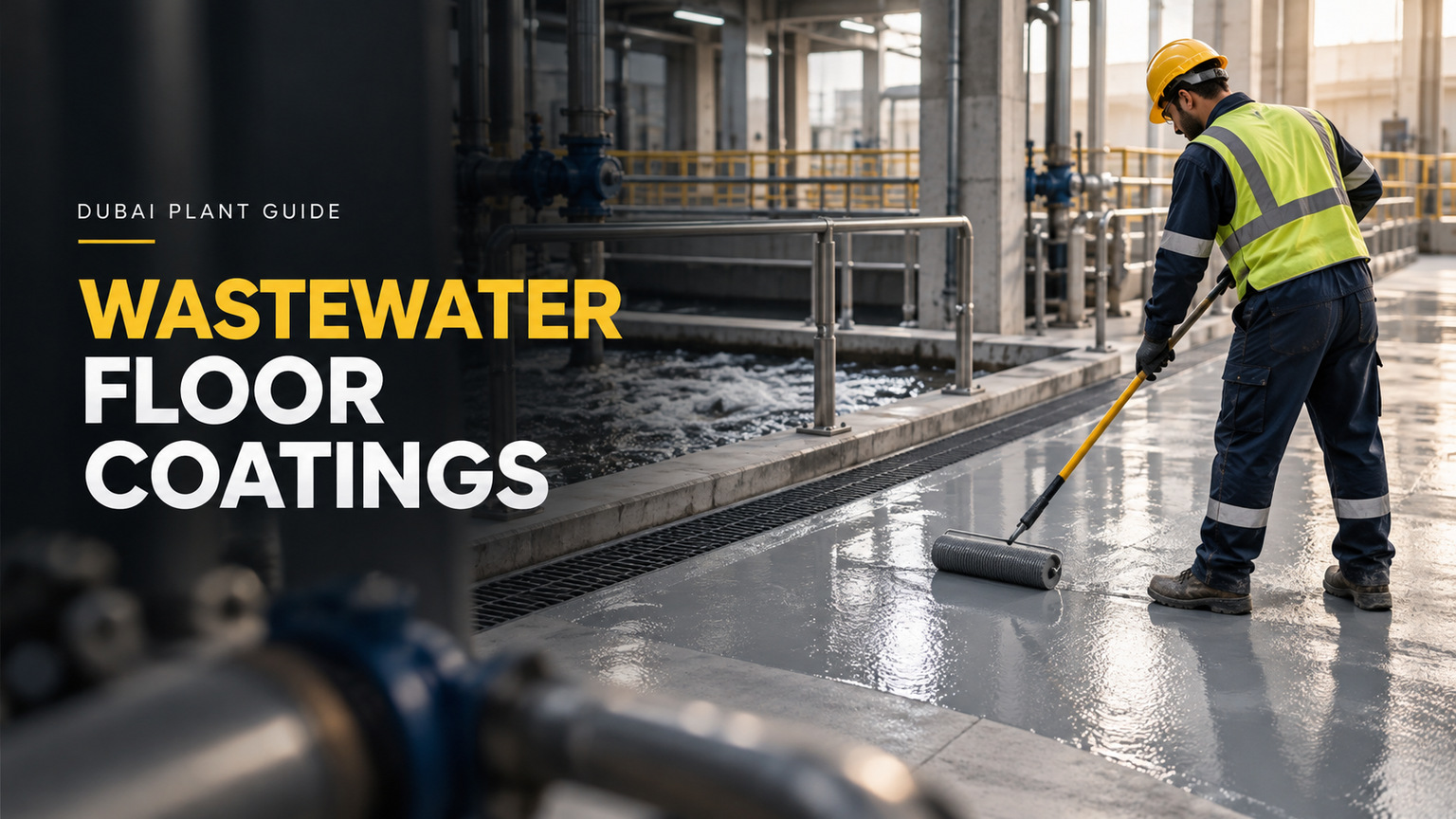

Industrial Floor Coatings for Water & Wastewater Facilities in Dubai: How to Choose the Right System
Quick Answer
Industrial floor coatings for water and wastewater facilities in Dubai should be chosen by exposure, not resin type alone. Dry service floors, wet process areas, chemical containment zones, submerged structures, and H2S-exposed headspaces may need different systems. Check chemical resistance, concrete moisture, surface preparation, coating thickness, and quality controls before approving a product.
Key Takeaways
A treatment plant contains several types of working space. These findings help owners and contractors avoid using one coating specification across areas with different risks.
- Define each floor’s exposure to traffic, water, chemicals, and wastewater before choosing epoxy, polyurethane, or another coating system.
- Humid wastewater headspaces can develop biogenic sulfuric acid, so they need a separate corrosion assessment from ordinary wet floors.
- Chemical resistance depends on the exact coating product, chemical concentration, temperature, and length of contact.
- Concrete strength, cracks, contamination, and moisture can affect coating adhesion and must be checked before work starts.
- Surface cleaning alone is not adequate preparation for severe immersion or mechanically demanding coating service.
- A 2018 Jebel Ali wastewater project used 3 mm elastomeric coatings, but that thickness is not a universal Dubai requirement.
- Coating quality plans should define surface acceptance, system thickness, adhesion testing, defect checks, and curing before application begins.
The first decision is not which resin to buy. It is which risks each surface must withstand. That choice shapes the coating system, floor preparation, inspection plan, and final price.
Start With the Exposure Zone, Not the Resin Name
The best coating depends on what the surface faces each day. A dry pump room needs different protection from a sewage channel. A chemical dosing floor has its own risks. So does the space above wastewater in a covered tank.
Start by dividing the facility into exposure zones. Record the work done in each area, along with its contact with water, chemicals, and traffic. The American Concrete Institute’s guidance on protective treatments supports this method. ACI PRC-515.2-24 considers exposure to water, acids, alkalis, salts, and other chemicals. The type and severity of exposure guide the choice of protection.
Exposure-Zone Coating Selection Matrix
Use this matrix before choosing a product or asking for prices. It separates common plant conditions and shows the evidence needed for each one. A surface may fit more than one row. For example, a wet process floor may also face chemical spills and heavy traffic.
| Facility zone | Main risks | What to check before choosing |
|---|---|---|
| Dry equipment and service floors | Foot traffic, wear, impacts, occasional spills. | Traffic loads, cleaning products, spills, and concrete condition. |
| Wet process floors | Washdown, standing water, slipping, and wear. | Drainage, wet grip, substrate moisture, and cleaning chemicals. |
| Chemical dosing and containment | Acids, alkalis, oxidizers, and concentrated spills. | Exact chemicals, concentrations, temperatures, and contact times. |
| Wastewater splash areas | Intermittent wastewater, cleaning, and abrasion. | Product suitability for intermittent exposure and required coating build. |
| Submerged tanks and channels | Continuous liquid contact and chemical exposure. | Full-system immersion suitability, concrete condition, and joint details. |
| H2S-exposed headspaces | Moisture, sewer gases, and biogenic sulfuric acid. | Severe wastewater corrosion resistance and relevant test evidence. |
| Cracked or moving concrete | Crack growth, movement, and possible bond failure. | Joint design, crack repair, and system movement tolerance. |
The matrix is a first screening tool, not an approved coating schedule. The crucial split is between normal traffic floors and surfaces needing a chemical barrier. A coating suited to washdown may not survive long-term immersion or acid attack.
Consider a plant with three work areas. Its dry electrical room may suit a standard industrial floor system. The washdown area needs wet grip and resistance to cleaning. The covered sewage channel may require a specialist corrosion lining. Using one finish across all three would ignore those differences.
Where Ordinary Industrial Flooring Stops Being Enough
Standard industrial coatings can suit service floors, but severe wastewater exposure needs more specific protection. The word epoxy does not tell you enough about a product’s limits. Epoxy is a resin family, not a complete coating specification.
Some epoxy products focus on floor wear, cleaning, and occasional spills. Others are made for constant immersion or harsh wastewater fumes. Crown Edge’s industrial epoxy flooring services include industrial epoxy, PU, and anti-slip flooring systems. These categories are relevant to many plant floors. They do not, by themselves, prove suitability for severe wastewater immersion or H2S exposure.
Industrial Floor Coating vs Wastewater Lining
Both types of protection may use epoxy chemistry. Their main jobs still differ. Use the comparison below to decide when an ordinary floor-coating schedule needs a separate lining review. The distinction affects product approval, preparation, quality checks, and future repairs.
| Selection factor | Ordinary industrial floor coating | Specialist wastewater lining |
|---|---|---|
| Main job | Resist traffic, wear, cleaning, and relevant spills. | Protect concrete from defined wastewater or corrosive exposure. |
| Typical location | Plant rooms, service corridors, and dry work areas. | Wet wells, tanks, channels, and aggressive headspaces. |
| Chemical needs | Product-specific spill resistance. | Documented resistance to the actual liquid or fumes. |
| Immersion | Cannot be assumed. | Must be expressly supported where needed. |
| Coating thickness | Based on the selected floor system. | Based on the approved lining system and exposure. |
| Main checks | Surface condition, slip, wear, cure, and bond. | Chemical suitability, barrier quality, preparation, bond, and defects. |
A specialist lining may need more demanding preparation and inspection because a failure could expose concrete to sustained chemical attack. That does not mean every wastewater plant floor needs a thick lining. The product must match its actual job.
For instance, Tnemec Series G434 Perma-Shield H2S is a 100%-solids epoxy mortar. Its stated uses include severe wastewater conditions, H2S, and sulfuric acid. Sherwin-Williams Dura-Plate 6100 is a high-build epoxy marketed for municipal and industrial wastewater service, including elevated H2S conditions.
These manufacturer examples show the range of products within epoxy chemistry. They are not automatic recommendations for a Dubai project. Request the full system details, including the primer, repair layers, lining, finish, and approved thickness.
H2S and Biogenic Sulfuric Acid Need Separate Attention
Humid wastewater headspaces can face acid attack even when they are not submerged. A covered sewage structure can therefore need more protection than an ordinary wet floor. The risk comes from what happens above the liquid, not only from contact with wastewater itself.
Wastewater can release hydrogen sulfide gas, known as H2S. On moist surfaces above the water, biological activity can help form sulfuric acid. The acid attacks concrete and may cause ongoing material loss. This process is described in U.S. EPA research on sewer corrosion. It helps explain why covered wastewater structures require a separate exposure review.
The ASTM G210 wastewater headspace test also addresses this harsh setting. ASTM G210-13(2023) uses conditions linked to sewer gases and biogenic sulfuric acid. It helps assess the barrier qualities of protective systems. The test is accelerated, so its results do not guarantee field service life.
Where H2S Exposure Should Be Checked
Covered channels, wet wells, sewer chambers, manholes, and similar structures deserve a headspace review. The concrete above a tank’s liquid level may face a different exposure from the submerged walls below it. A coating schedule should show that distinction rather than treating the whole structure as one wet area.
A useful assessment should answer three site questions before the lining is approved:
- Can the area contain H2S or other corrosive sewer gases?
- Are the exposed concrete surfaces often damp or subject to condensation?
- Does the proposed lining have evidence for the expected headspace conditions?
If these facts are unknown, keep the product choice on hold. The owner may need process information, past inspection records, or a specialist corrosion assessment. A lining rated for clean-water immersion is not automatically suitable for severe wastewater headspace corrosion.
For a project with both submerged and exposed concrete, ask the designer to confirm the protection required in each zone. Details near the waterline, joints, and penetrations also need care. A strong lining film cannot compensate for an untreated route through which aggressive water or gases can reach the substrate.
Match Chemical Resistance to the Actual Exposure
A chemical-resistant coating must resist the chemicals used at the plant, at their real concentrations and temperatures. A broad acid-resistant label is not enough. A dosing room may face concentrated process chemicals, while a walkway may contact only diluted cleaning products. Their coating needs can differ even when both floors are wet.
Manufacturers publish chemical-resistance data for specific products. The results may depend on contact time, concentration, temperature, and test conditions. For example, Sika Sikagard-170 CR is a 100%-solids epoxy marketed for chemical-resistant floors and wastewater containment. Its manufacturer states resistance including 98% sulfuric acid under its documented product conditions. That figure cannot be applied to epoxy products as a group.
Build a Chemical Schedule Before Requesting Prices
Give each bidder the same exposure information. A chemical name alone leaves too much room for different assumptions. The schedule should show how strong the chemical may be, how hot it gets, and how long it remains on the floor. Use the fields below to prepare that information.
| Data field | What the project should establish |
|---|---|
| Chemical name | Exact product or substance handled on site. |
| Concentration | Normal and worst-case strength, where known. |
| Temperature | Usual and highest expected contact temperature. |
| Exposure type | Splash, intermittent contact, or continuous contact. |
| Contact time | Time before the liquid is removed or rinsed. |
| Cleaning method | Rinsing, detergents, and cleaning frequency. |
| Product evidence | Manufacturer confirmation for the full exposure. |
The schedule allows suppliers to assess one shared set of conditions. It also exposes missing information before a contract is placed. If a chemical is mixed, heated, or changed during use, obtain a review of those conditions. A resistance table for a pure chemical may not cover a mixture.
Spill management matters as well. A floor with quick drainage and prompt cleaning may face shorter contact than a bund that holds a spill. Those are different service conditions. Do not assume that a coating which survives brief splash contact is suitable for long-term containment.
Concrete Preparation Is Part of the Coating System
A sound coating needs a sound concrete base. Dirt, weak concrete, moisture, old paint, and cracks can all cause trouble before chemical attack begins. The substrate must be checked before final product approval. Otherwise, the coating price may exclude repair work needed for a lasting bond.
The AMPP SSPC-SP 13/NACE No. 6 concrete preparation standard addresses concrete prepared for protective coatings and linings. Its scope covers cleanliness, strength, surface profile, and dryness. A surface profile is the texture left after preparation. It helps the chosen coating bond to the concrete.
The ICRI 310.2R-2013 guide provides benchmark concrete surface profiles. It does not set one profile for every resin system. The correct surface condition depends on the selected manufacturer’s instructions and the service demands.
Cleaning Alone May Not Be Enough
A clean-looking floor can still have a weak top layer. Laitance is a fragile layer of fine cement material. If a coating bonds to this weak material, the layer may fail before the coating itself does. Old floors can also hide oil, chemical damage, loose paint, or cracks.
ASTM D4258-23 covers cleaning concrete before coating. Its scope distinguishes light-duty cleaning from the preparation needed for certain demanding uses. Cleaning alone is not sufficient for some immersion, mechanical loading, and high-bond systems. The standard does not prescribe one mechanical preparation method for all coatings.
Before approving preparation, the project team should check the following conditions. Each one can affect the new system’s bond or service life.
- Remove old coatings where the proposed system requires a bare or suitable prepared substrate.
- Repair weak, damaged, or contaminated concrete before coating.
- Remove oil, chemicals, dust, and loose surface material.
- Confirm that the specified concrete surface profile has been achieved.
- Approve crack, movement-joint, edge, and drain details.
- Confirm that the concrete has passed the selected system’s moisture checks.
These checks belong in the work scope, not in a vague note asking the installer to prepare the floor. The ACI guidance on concrete surface preparation, PRC-515.3-20, also covers assessment and acceptance before protective systems are applied.
For existing floors, Crown Edge’s additional floor services offer a relevant starting point for discussing preparation work. A full wastewater lining still needs its own approved technical scope, repair details, and acceptance criteria.
Treat Concrete Moisture as a Go-or-Hold Check
Test the concrete’s moisture condition before coating. Compare the results with the chosen system’s limits. A damp slab can harm products that need a dry base, even when the coating has good chemical resistance. Moisture from below may also create problems after the surface appears ready.
Water can reach concrete through cleaning, leaks, groundwater, or nearby process areas. An older plant may have several sources at once. A visible dry patch does not prove the whole slab is suitable. The ASTM D4263 plastic-sheet method can indicate capillary moisture. It is not a complete moisture assessment or a universal pass test.
The coating supplier must state the allowed conditions and suitable test methods. Some products tolerate more moisture than others. A moisture barrier or another repair method may be needed, but only when compatible with the whole system.
A Wastewater Project With 98–100% RH
A 2026 Sherwin-Williams wastewater infrastructure case study reported floor relative humidity readings of 98–100%. The project team used a urethane-cement moisture-mitigation layer before the wastewater lining. This was a project-specific response to the measured condition.
The case shows why moisture must be part of system design. It does not create a universal moisture limit or require urethane-cement on every wet floor. If measured results exceed the proposed system’s limits, stop before application. Confirm the cause, choose a suitable remedy, and obtain the supplier’s agreement before coating proceeds.
Also distinguish surface dampness from water pressure behind the concrete. A product that tolerates a damp surface may still be unsuitable where water pressure acts from the back of a slab or wall. That condition needs a separate design review.
Coating Thickness: What the Dubai Evidence Shows
No single coating thickness is proven suitable for every Dubai wastewater facility. The selected product, exposure, concrete condition, and complete system design set the required build. Copying a thickness from another project does not prove that the same system will work elsewhere.
Dry-film thickness, or DFT, is the thickness of a coating after curing. Some systems have several layers. Their total build can differ from the thickness of one coat. High-build wastewater linings may be thicker than ordinary floor finishes. Yet extra thickness cannot fix poor adhesion, cracked concrete, or the wrong chemical resistance.
Dubai Project Example: Jebel Ali Sewage Treatment Plant Phase II
Dubai has a useful documented project precedent. Delta Coatings published two references for work associated with Jebel Ali Sewage Treatment Plant Phase II, completed in 2018. The company identifies Dubai Municipality as the client and describes elastomeric coating systems in the reported areas.
| Reported project area | Reported coated area | Reported system thickness |
|---|---|---|
| Primary sedimentation tanks | About 40,000 m². | 3 mm. |
| Tunnels and channels | About 11,000 m². | 3 mm. |
The figures come from the manufacturer’s primary sedimentation tank project reference and its separate tunnels and channels project reference.
The two areas together show that substantial protective coating work has been reported at a Dubai wastewater plant. They do not establish a citywide thickness standard. The same manufacturer describes an earlier 6 mm GRP lining concept for part of the work. The change to an elastomeric approach reflected that project’s design review. It does not prove GRP is unsuitable for other projects.
For a new facility, specify the approved layer schedule and application method. The submittal should identify each coat, the required system thickness, substrate preparation, curing, and inspection method. The nominal number alone is not a complete lining design.
Waterproofing, Screeding, and Lining Have Different Jobs
Waterproofing, screeding, leveling, and chemical-resistant lining solve different problems. A wastewater floor may need more than one of them, but they are not substitutes. Start with the concrete and drainage layout. Then assess water ingress, surface levels, and chemical exposure. Only after those needs are clear should the project team confirm the final protective system and its compatibility with each underlying layer.
Waterproofing Controls Water Ingress
A waterproofing system can help control leakage or water entry. Yet resistance to water alone does not prove resistance to sewage fumes, acids, oxidizers, or constant wastewater immersion. Chemical containment may need a lining with documented resistance to the substances held in that area.
The distinction also works in reverse. A chemically resistant topcoat is not automatically a complete answer to water entering from beneath the slab. The project may need a separate moisture or waterproofing design. Check each product’s intended use and confirm that the layers can work together.
Screeding Helps Set Levels and Drainage Falls
Water that sits on a floor creates extra exposure and may affect safe access. A poorly sloped floor can leave pools near equipment, joints, and doorways. These conditions should be reviewed before the final coating is chosen.
Floor screeding may help create the required base or fall toward drains when designed for the site. The screed must suit the expected loads and the coating placed above it. Check its strength, bond, cure, and moisture condition. Applying a protective finish over a weak screed will not create a sound base.
Self-Leveling Has a Different Purpose
Self-levelling flooring can help create a smoother, more even surface. It does not automatically provide the chemical protection needed in a wet well or sewage channel. Nor should it be used without thought where the floor needs a planned fall toward a drain.
The final surface texture needs its own review. A smooth finish may be easy to clean, but wet work areas also need safe grip. Rougher textures can change cleaning needs, so the designer should balance use, washdown, and the applicable project safety criteria. No universal Dubai wastewater-floor slip coefficient was established by the reviewed evidence.
Where several systems are proposed, ask for a single layer schedule. It should show the base, repair material, screed, waterproofing or moisture-control layer, primer, and final coating where each is needed. This helps expose compatibility gaps before work begins.
Define Coating Quality Checks Before Work Starts
A coating should not be accepted on appearance alone. Surface condition, bond, thickness, defects, and cure all need agreed checks. An attractive finish may still hide weak adhesion or thin spots. Such faults can become more serious under immersion or chemical attack.
The quality plan should be approved before workers start preparing the concrete. That gives the contractor clear targets and gives the owner defined points to inspect. Later testing cannot always recover a missed preparation step, especially after the work is covered by new coating layers.
Coating QA Hold-Point Checklist
Use hold points to prevent the next stage from covering unfinished or rejected work. The contractor should record the result, and the named reviewer should accept it where the project requires approval. The sequence below is a planning framework for concrete coating work.
| Hold point | Required check |
|---|---|
| 1. Existing finish | Confirm the required coating removal is complete. |
| 2. Concrete repairs | Accept repairs to weak or damaged concrete. |
| 3. Surface condition | Check cleanliness, strength, and required profile. |
| 4. Moisture | Compare measured conditions with product limits. |
| 5. Cracks and joints | Accept repair and movement details. |
| 6. Work conditions | Check temperature, humidity, and product limits. |
| 7. Primer | Check coverage, cure, and recoat window. |
| 8. Coating build | Confirm the required layers and thickness. |
| 9. Adhesion | Complete the specified bond tests. |
| 10. Defects | Inspect and repair flaws using the agreed method. |
| 11. Final cure | Confirm readiness for the intended service. |
| 12. Handover | Keep test results, repair records, and product data. |
The most useful hold points occur before defects become hidden. Surface acceptance must happen before the primer conceals the concrete. Primer and recoat checks must take place before later layers cover the first coat. Final records should make future repairs easier to plan.
Adhesion and Defect Testing on Concrete
ASTM D7234-22 provides a pull-off test for coatings on concrete. The test measures force applied perpendicular to the surface. It also records where the failure occurs. That can help distinguish failure within concrete from failure at the bond or coating layer.
The method does not set one passing adhesion value for every system. The engineer and coating supplier must define the required test locations and acceptance criteria. Results should be judged against those agreed rules, not against an invented universal figure.
Some lining systems also need discontinuity checks. These look for holes or breaks in a protective film. The method must suit both the lining and the substrate. AMPP SP0188-2024 concerns non-conductive coatings on conductive substrates. It should not be applied automatically to ordinary concrete without a compatible test arrangement and approved procedure.
Agree on defect repairs and retesting before work begins. A repaired area may need further cure time or another inspection before the plant returns to use.
Specify Before You Price: Compare the Work, Not Just the Area
A useful wastewater-coating quote needs more than floor area. The contractor must know what each surface faces, what shape the concrete is in, and when the plant must return to service. The same number of square metres can represent very different work.
The worked comparison below is hypothetical. Both areas are assumed to cover 500 m². No site survey, test result, chemical concentration, or quoted price is being claimed. The purpose is to show which scope items can change the choice of system and the cost of work.
Worked Comparison: Two Hypothetical 500 m² Areas
Two contractors may receive requests to coat 500 m², yet price different jobs because their assumptions differ. This diagnostic shows the questions that must be settled before either quote can be compared fairly.
| Decision item | Area A: dry service floor | Area B: wet process floor |
|---|---|---|
| Area | Assumed 500 m². | Assumed 500 m². |
| Main exposure | Foot traffic and occasional cleaning. | Frequent washdown and possible chemical splash. |
| Existing surface | Assumed sound for illustration. | Existing condition remains unknown. |
| Moisture decision | Test against the proposed floor system. | Check moisture and possible water entry. |
| Surface preparation | Match the product and site inspection. | Assess removal, repairs, and preparation. |
| Chemical evidence | Confirm cleaning and spill resistance. | Obtain the plant chemical schedule. |
| Drainage and grip | Check normal use and cleaning needs. | Review falls, ponding, and wet grip. |
| Coating choice | Industrial floor system may be suitable. | Exposure-specific system review is needed. |
| Quality checks | Define the required floor-coating tests. | Include any extra lining checks that apply. |
| Quote status | Ready only after site checks and product review. | Hold until exposure and concrete data are known. |
Equal area does not mean equal scope. Area B may need more preparation, drainage work, or a different resin system. Those needs must be established by inspection and product data. They are not costs that can be assumed from the floor area alone.
Information to Include in the Enquiry
A good request for pricing should group its facts so contractors can see both the surface condition and the intended service. The same information should go to each bidder. Missing fields should be marked as unknown rather than filled with guesses.
For each area, provide the asset ID, surface type, measured area, existing coating, cracks, repairs, and available moisture results. Record chemicals, concentrations, temperatures, contact times, H2S risk, traffic, wet grip, and drainage needs. Include the shutdown window and any approved project specification.
Ask each bidder to return a complete layer schedule. It should identify the primer, repair layers, lining or finish, system thickness, curing time, tests, repairs, and required approvals. The offer should also state its exclusions. An apparently low coating price may leave out access, surface repairs, or plant shutdown work.
Dubai Project and Approval Checks
Check the actual project rules before ordering a wastewater coating in Dubai. Do not assume all products follow one approval path. The owner, engineer, operator, and relevant authority may each have project needs that affect the coating choice.
Dubai Local Order No. 8 of 2002 covers sewerage, irrigation, and water drainage. It defines wastewater treatment infrastructure and addresses leakage and corrosion resistance for septic tanks. The order does not establish one coating chemistry or thickness for all industrial floors.
Dubai Municipality has separate services for relevant product checks. Its Product Certification service concerns conformity with applicable rules and standards. The Technical Approval service can apply to certain non-standard products. Neither page proves that every wastewater floor coating must follow either route.
A current, official Dubai Municipality sewerage corrosion-protection clause for the exact proposed project was not confirmed in the upstream research. Request the applicable tender specification and current authority requirements rather than relying on an unverified secondary copy.
International standards can support coating design and testing. They are not automatically Dubai legal requirements. The project documents must identify which standards apply and who accepts the results.
Drinking-water contact is also a separate issue. A product suited to wastewater does not automatically meet potable-water approval needs. Any coating that will contact drinking water requires a distinct compliance review.
Final Selection: Seven Checks Before Approval
Approve a coating system only after the exposure, concrete, product data, and quality plan fit the project. The following seven checks create a useful go-or-hold review. Each should have an identified source of evidence and a person responsible for acceptance.
- Exposure: Define whether the area faces dry use, washdown, chemical splash, immersion, containment, or wastewater headspace.
- Chemicals: Record relevant substances, concentrations, temperatures, and contact times.
- Concrete: Assess strength, cracks, contamination, existing coatings, and repair needs.
- Moisture: Test the substrate and accept the results against the selected system’s limits.
- System: Obtain approval for the primer, repair layers, lining, finish, and required thickness.
- Quality: Agree on preparation checks, bond tests, defect inspections, and acceptance rules.
- Operations: Confirm drainage, slip needs, access, shutdown time, cleaning, and future repairs.
If a critical check is missing, hold approval until the needed result or decision is available. The review can also prevent excessive work. A dry service floor should not receive a severe wastewater lining merely because it is inside a sewage treatment plant.
A passed check must have meaning. For example, marking moisture as accepted requires measured conditions and the proposed system’s limits. Writing that the floor looks dry is not enough. The same applies to chemical resistance and coating thickness.
This framework supports procurement and project review. It does not replace engineering design, authority approval, or manufacturer confirmation for the actual exposure.
Frequently Asked Questions
These answers address the most common choices facing owners and contractors. The exact coating system still depends on the site and the approved project documents.
1. Is epoxy flooring suitable for wastewater treatment plants?
Yes, in some areas. Epoxy products vary widely. An ordinary traffic-floor epoxy may suit a dry plant room. A specialist high-build epoxy may be designed for immersion or severe wastewater exposure. Match the exact system to the area before approving it.
2. What coating is best for sewage treatment plant floors?
The best choice follows the exposure. Dry service zones may suit industrial floor systems. Chemical dosing areas need proven chemical resistance. Submerged and H2S-exposed structures may need specialist linings. The exposure matrix should guide the first review.
3. Is a 3 mm coating required for wastewater facilities in Dubai?
No universal 3 mm requirement was established by the reviewed evidence. A 2018 Jebel Ali STP project used reported 3 mm elastomeric systems in specific areas. That is a project precedent, not a citywide rule. New projects need their own approved system thickness.
4. Why is H2S harmful to wastewater concrete?
Hydrogen sulfide can escape from wastewater. On moist surfaces, microbial activity can help form sulfuric acid. That acid can damage concrete. Covered channels, wet wells, and similar headspaces may therefore need specialist corrosion protection.
5. Can a waterproofing membrane replace a wastewater lining?
Only if the chosen system has evidence for the full service conditions. Waterproofing may help stop water movement. Wastewater linings must also resist the stated chemicals, immersion, or corrosive fumes. Water resistance alone is not enough proof.
6. How dry should concrete be before epoxy coating?
Use the moisture limit stated for the selected system. There is no single limit for all epoxy products. Test the concrete using the required method. If the result is outside the allowed range, review a suitable remedy before coating.
7. How is coating adhesion checked on concrete?
Pull-off testing can measure the bond and show where failure occurs. ASTM D7234 provides a recognized method. The project must also define test locations and pass criteria before work begins. The method alone does not set a universal passing strength.
8. What should a wastewater coating quotation include?
A clear quote should cover preparation, repairs, the full coating system, thickness, application, testing, curing, and site access. It should state exclusions and the expected return-to-service date. Compare bids against one agreed scope, not price per square metre alone.
Planning a Water or Wastewater Flooring Project in Dubai
Start with an area-by-area review of exposure and concrete condition. Before requesting a proposal, gather the location and size of each floor or structure. Record its current finish, visible damage, drainage problems, and any known moisture issues. Add the chemicals used nearby and describe normal cleaning, traffic, and shutdown limits.
Send available drawings, site photographs, product records, and project specifications with the enquiry. These help contractors identify missing surveys and tests. They also make it easier to separate ordinary flooring work from areas needing specialist corrosion protection.
Crown Edge provides industrial flooring and related floor services in Dubai. Its service information is a starting point for discussing epoxy or PU flooring and floor preparation. For severe wastewater immersion, chemical containment, or H2S headspace, obtain a project-specific technical review and documented system approval. Do not assume a general flooring service description establishes specialist lining capability.
An effective proposal should explain the proposed scope, the evidence behind the coating choice, and any conditions that must be resolved before work starts.