

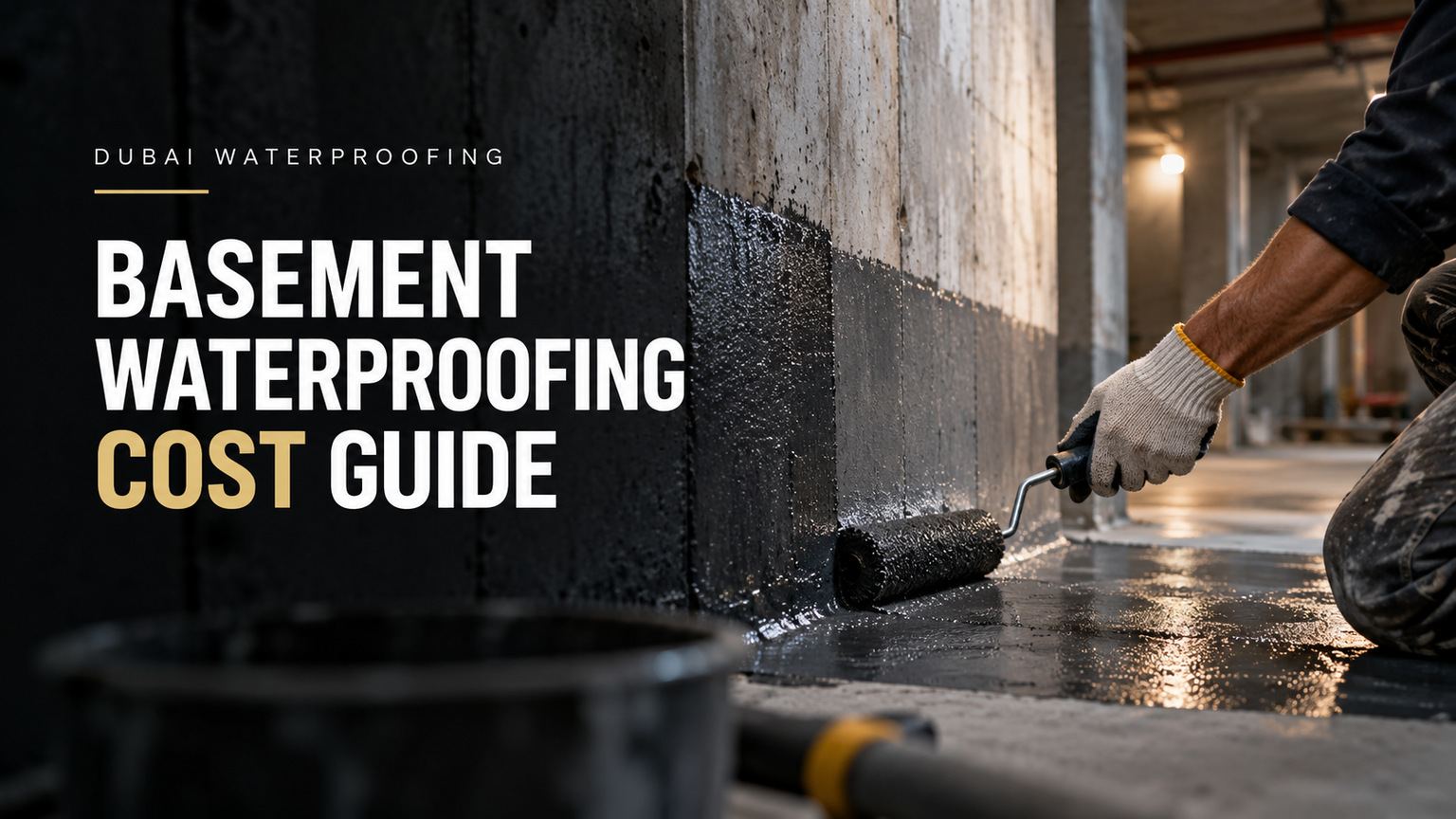

Basement Waterproofing Cost in Dubai: Rates, Methods and Quote Checklist
Quick Answer
Basement waterproofing in Dubai has published planning rates of about AED 40–75/m² for basic coating applications, AED 70–150/m² for some internal treatments, and several hundred dirhams per m² for more complete tanking. These are different work scopes, not one market rate. Actual costs depend on leaks, groundwater, repairs, access, materials, and included work.
Key Takeaways
Dubai basement waterproofing prices vary because quotes often cover different systems and amounts of work. These seven points help you set a budget and spot missing costs.
- Basic cementitious, polyurethane, and bitumen application rates do not represent the full cost of a basement waterproofing system.
- Published Dubai internal basement treatment prices are around AED 70–150/m², with complex leak repairs sometimes costing more.
- More complete basement tanking has published rates near AED 130–300/m², while other UAE and Dubai guides report higher figures.
- New-build basements and existing leaking basements need different access plans, waterproofing methods, and repair allowances.
- Active cracks and construction joints may need injection or sealing charged separately from the waterproofed area.
- Compare prices using the same area units, system scope, excavation work, protection layers, testing, and reinstatement allowances.
- The UAE standard VAT rate is 5%, so each contractor quote should clearly state its applicable tax treatment.
Start by choosing the right waterproofing scope. Then compare the work included in each rate. The lowest price per square metre may not produce the lowest complete project cost.
Basement Waterproofing Cost per m² in Dubai
There is no reliable single basement waterproofing rate for all Dubai projects. Published 2025–2026 prices span several distinct types of work. Basic coatings sit at the lower end. Complete tanking and difficult repairs can cost far more.
The table below separates these scopes. It uses public Dubai and UAE price guides, not an official tariff or audited market survey.
| Waterproofing scope | Published planning rate | Market | Source and main limitation |
|---|---|---|---|
| Basic cementitious, PU, or bitumen application | AED 40–75/m² | Dubai/UAE | Salman Syed application rates. Component work, not complete tanking. |
| Internal basement treatment | AED 70–150/m² | Dubai | DryGuard basement cost guide. Scope and leak conditions vary. |
| Basement or retaining-wall tanking | AED 130–300/m² | Dubai | Abdulla Carpentry tanking guide. Preparation and testing assumptions apply. |
| Higher published basement tanking range | About AED 269–538/m² | UAE | Biddaro 2026 waterproofing costs. Converted from AED 25–50/ft². |
| Higher published foundation and basement tanking range | About AED 323–753/m² | Dubai | Fit Out & Renovation waterproofing rates. Converted from AED 30–70/ft². |
These ranges overlap, but they are not interchangeable. Each publisher uses its own pricing assumptions. None provides enough comparable project data to establish a Dubai-wide average.
For another reference point, the QuotesDone UAE waterproofing cost guide gives AED 40–100/m² for basement and retaining-wall waterproofing. That lower range should not be treated as proof that a complete basement tanking job can be delivered for the same price.
A coating quotation may cover a sound, accessible concrete wall. A complete tanking quotation may cover preparation, membrane fitting, joint sealing, protection, and testing. Both may be valid for their stated work.
Why published waterproofing prices differ
The main price difference is often what the contractor has included. Even two membrane quotations can cover very different tasks.
A contractor may quote a surface coating rate. Another may include repairs, multiple layers, waterproofing at joints, protection boards, and work around pipe openings. An existing basement may also need finishes removed before repairs can begin.
The following comparison shows why a low unit rate can be misleading.
| Cost item | Basic application quote may cover | Complete project scope may require |
|---|---|---|
| Surface preparation | Basic cleaning. | Cleaning, grinding, and concrete repairs. |
| Waterproofing material | Named coating or membrane. | Approved system, primer, layers, and accessories. |
| Cracks and joints | Often separate. | Injection, joint sealing, or waterstops. |
| Membrane protection | May be excluded. | Protection boards or other specified protection. |
| External access | Not usually included. | Excavation, safe access, and backfilling. |
| Final works | Limited application work. | Testing, reinstatement, and agreed handover records. |
These are possible scope differences, not guaranteed inclusions. Read the written quotation rather than relying on its headline rate.
A fair price comparison starts with the same waterproofing method, surface area, and work limits. Only then can unit rates help identify genuine cost differences.
Calculate Your Basement Waterproofing Budget
Calculate a starting budget from the actual surface area that needs treatment. Multiply that area by a rate for the relevant work scope. Add separate costs for defects, access, and other work not covered by the base rate.
Estimated cost before VAT = treated area × scope rate + separately priced repairs + access, protection, excavation, and reinstatement costs.
This is a planning formula. It is not a fixed-price calculator. The public evidence does not support one standard Dubai surcharge for all cracks, repairs, or excavation work.
Worked example: 100 m² of basement treatment
Assume an existing basement has 100 m² of accessible wall and floor surfaces needing internal waterproofing. For this example, use the published Dubai treatment range of AED 70–150/m².
| Calculation | Lower estimate | Upper estimate |
|---|---|---|
| Treated surface area | 100 m² | 100 m² |
| Applied planning rate | AED 70/m² | AED 150/m² |
| Area-based subtotal | AED 7,000 | AED 15,000 |
| Illustrative VAT at 5% | AED 350 | AED 750 |
| Subtotal including VAT | AED 7,350 | AED 15,750 |
The figures show arithmetic only. They assume the base rates exclude VAT and standard VAT applies. No separate allowance has been added for crack injection, major repairs, excavation, drainage, or reinstatement.
The difference between AED 7,000 and AED 15,000 is already large. A leak-heavy site could require more work than this simple model covers.
Measure walls and floors separately
A basement with a 100 m² floor does not necessarily have only 100 m² of waterproofing work. Walls may need treatment too.
Consider a rectangular basement floor measuring 10 m by 10 m. Its floor area is 100 m². If all four walls are 3 m high, their combined gross surface area is 120 m².
Treating both the floor and all four walls would therefore involve 220 m² of gross surface area. That is a geometric example, not a project design. The actual measured area depends on which surfaces need treatment and how the contractor measures openings and details.
Make sure contractors agree on the measurement rules. Floor footprint, treated surface area, and building area are not the same figure.
Unit conversion matters just as much. One square metre equals about 10.7639 square feet. A quote of AED 30/ft² equals about AED 323/m², not AED 30/m².
A small unit misunderstanding can multiply a budget error more than tenfold.
Build a scope-based estimate
For an early budget, separate known quantities from costs that still need inspection. The following method works for both residential and commercial basements.
| Budget component | How to estimate it | What remains uncertain |
|---|---|---|
| Waterproofed surface | Measure treated wall and floor area in m². | Which surfaces need the specified system. |
| Base waterproofing | Area multiplied by a comparable published scope rate. | Exact approved system and included preparation. |
| Crack and joint treatment | Add the contractor’s measured repair quotation. | Number, depth, cause, and repair method. |
| Surface repair | Add a defined concrete repair scope. | Hidden damage after finishes are removed. |
| Access and excavation | Obtain a separate priced work item. | Access method, soil conditions, and site limits. |
| Protection and reinstatement | Request measured quantities and prices. | Drainage needs, finishes, and backfill work. |
| Applicable VAT | Apply the correct VAT treatment to the taxable amount. | Whether quoted amounts already include tax. |
This method makes uncertain costs visible instead of hiding them inside one guessed rate. It also helps a buyer identify which site questions must be answered before approving a budget.
Choose the Right Basement Waterproofing Method
Choose the waterproofing system from the building’s needs, not its lowest advertised price. Construction stage, water exposure, concrete condition, and access determine which methods are suitable.
A new basement can receive waterproofing before the surrounding soil is placed. An occupied basement may only offer access from inside. That change can affect the entire repair plan.
Sika’s below-ground waterproofing systems include sheet membranes, waterproofing mortars, liquid systems, joint sealing, watertight concrete, and drainage solutions. These are different tools for different conditions.
The method matrix below gives a practical starting point.
| Waterproofing approach | Typical use | Main cost factor | Design or access limit |
|---|---|---|---|
| External positive-side membrane | New builds or accessible exterior walls. | Membrane, details, protection, and possible excavation. | Outside face must be accessible. |
| Internal negative-side treatment | Existing basements with limited outside access. | Preparation, coating, and leak repairs. | Product must suit the actual water-pressure conditions. |
| Integral watertight concrete system | Planned structural construction. | Concrete design, joints, and construction control. | Not a simple repair coating. |
| Crack or joint injection | Local water ingress. | Defect size, packers, resin, and access. | Does not protect the whole basement by itself. |
| Combined waterproofing approach | Complex below-ground exposure. | Multiple barriers, joints, drainage, and coordination. | Needs a site-specific design. |
The table is a method guide, not a ranking from cheapest to best. A lower-cost coating may suit limited dampness but fail to meet a more demanding water-ingress design brief.
New-build basement waterproofing
For a new basement, plan the waterproofing before concrete work begins. This allows the designer to coordinate barriers, joints, wall penetrations, and construction stages.
Sika’s basement waterproofing overview distinguishes integral concrete protection, external positive-side barriers, and internal negative-side treatments. The correct choice depends on the structure and water exposure.
An external membrane can protect the concrete on the side facing groundwater. Pre-applied membranes are another option where the build sequence permits them. Waterstops and joint details help protect weak points between concrete pours.
Fosroc’s waterproofing system range shows why a below-ground design may need several compatible components rather than a single surface product.
For budgeting, ask whether the waterproofing sits within the main construction package or a separate specialist package. Missing joint details can become expensive once the basement is enclosed.
Existing basement waterproofing and active leaks
For an existing basement, the first task is finding where water enters. Damp patches, open cracks, leaking joints, and groundwater pressure do not all need the same treatment.
An internal coating may be suitable for some existing concrete surfaces. Other defects need injection or sealing first. Serious or repeated leaks may need a wider design review.
A surface treatment should not be assumed to repair a leaking construction joint. Likewise, a sealed crack does not prove the rest of the basement is watertight.
Crown Edge lists basement waterproofing services in Dubai as part of its waterproofing work. For an existing leaking space, the useful first step is a condition and scope assessment rather than choosing a coating from a price list.
What Increases Basement Waterproofing Cost?
The largest extra costs often come from problems outside the basic waterproofing rate. Groundwater pressure, cracks, restricted access, and removal of failed work can change both the system and the project total.
These costs should be identified before a contractor is asked for a firm quotation. Some affect the waterproofing itself. Others relate to reaching the work area and restoring the building afterward.
Groundwater pressure and basement depth
A basement below ground level may face moisture or water pressure even in Dubai’s dry surface climate. Local groundwater conditions matter more than the weather alone.
Dubai’s Administrative Resolution No. 37 of 2021 addresses matters including groundwater, hydrogeological studies, dewatering, monitoring, and uplift checks for relevant below-ground works.
The regulation does not set waterproofing prices. It does show why groundwater cannot be ignored during basement design.
Water pressure can affect membrane choice, joint treatment, drainage, and repair planning. An internal product used against incoming pressure must be suitable for that condition. A stronger-sounding product name is not enough evidence.
For deep basements or uncertain groundwater conditions, the waterproofing plan may need input from the project engineer or qualified waterproofing designer.
Cracks, joints, and concrete repairs
Active cracks can make a square-metre quotation incomplete. Crack repairs may be priced by packer, defect, length, or a defined repair package.
A packer is a fitting used to inject repair resin into a crack or joint. Its price alone does not cover every part of a repair.
For instance, Salman Syed’s crack injection pricing gives AED 120 per packer. The final cost depends on the number of packers, crack depth, and resin needs.
A separate OFIXO live-leak repair guide describes a typical single-crack basement repair at about AED 1,500–4,500 after inspection.
These figures use different pricing units. They cannot be converted into one dependable price per crack without a defined repair method and quantity.
Concrete repair is another distinct cost. Loose concrete, damaged cover, or a poor surface may need work before any coating can bond well. Significant structural cracks require appropriate technical assessment, not just surface sealing.
Excavation, protection, and reinstatement
Exterior waterproofing can require access to buried walls. In a finished property, reaching those walls may involve excavation and removal of nearby finishes.
That work can cost much more than fitting the membrane alone. Safe access, temporary support where needed, removal of debris, and backfilling all need their own scope.
Protection layers also matter. A membrane can be damaged by later work or backfill if the system lacks the protection it needs. Some designs call for drainage boards or other drainage measures as well.
Ask the contractor to price these tasks as named items. The research does not support a standard Dubai percentage for excavation or reinstatement, so adding a guessed surcharge would make the estimate less reliable.
For an occupied basement car park, working hours and access limits can also affect labor and site costs. The quote should say whether shutdowns, restricted hours, and area protection are included.
Material Price Versus Installed Waterproofing Cost
A membrane roll price is not the installed cost of a basement waterproofing system. Retail products account for only one part of the final job.
Public UAE listings show why this distinction matters. Element Five waterproofing products include a bituminous membrane roll listed at AED 95 for a nominal 10 m². A Sharaby 4 mm SBS membrane listing gives AED 115 for a roll of the same nominal area. Prices can change, and supplier tax terms may differ.
A further Radiant Building Materials membrane listing gives AED 125 for a nominal 10 m² roll. Together, these published UAE examples support an indicative retail range of AED 95–125 per roll, or about AED 9.5–12.5 per gross square metre of material.
It does not mean a contractor can install a complete waterproofing system for that rate.
The comparison below shows why the material figure and installed price measure different things.
| Retail material calculation | Installed basement scope |
|---|---|
| Nominal 10 m² roll costs AED 95–125. | Waterproofed area must be measured and prepared. |
| Gross material rate is AED 9.5–12.5/m². | Overlaps and cuts reduce net material coverage. |
| Roll price covers the named material. | Primer, accessories, corners, joints, and penetrations may be needed. |
| Retail listing excludes installation labor. | Labor, protection, access, testing, and site overhead add cost. |
| Supplier price may change. | Contractor scope and applicable VAT determine the quoted total. |
Membrane laps are a good example. A roll with 10 m² of gross area cannot always cover 10 m² of finished work. Seams and details use some material without increasing the net treated area.
Coatings have similar quantity limits. The Sikalastic-1K product information from Sika Gulf gives a theoretical consumption of about 1.5 kg/m² per millimetre of thickness. Its stated 2 mm system uses at least two layers.
Actual material needs also depend on the surface and application losses. Such product data helps estimate quantities, but cannot establish a complete contractor rate.
Compare Basement Waterproofing Quotes Before Hiring
Choose the quotation with the clearest suitable work scope, not just the smallest headline rate. Each contractor should describe what will be fitted, where it will be fitted, and which costs remain outside the price.
A useful comparison needs matching areas, units, materials, and repair duties. It must also show which contractor is responsible for testing, handover, and any later reinstatement.
Basement waterproofing quote checklist
Use the following scope checklist to prepare a request for quotation or compare offers. Instead of a blank form, it explains what a complete answer should contain.
| Quote item | What the contractor should state |
|---|---|
| Treated area and units | Separate wall and floor quantities, measured in m² or clearly converted units. |
| System and product | Exact product names and the proposed waterproofing approach. |
| Water exposure | Assessed water condition and the system’s intended use. |
| Surface preparation | Cleaning, grinding, removal work, and concrete repairs included. |
| Application method | Primer, number of layers, specified thickness, and membrane laps. |
| Cracks and joints | Injection, waterstops, sealants, and who pays for extra defects. |
| Penetrations and corners | Method for pipes, wall-floor joints, changes of level, and edges. |
| Protection and drainage | Required boards, drainage layers, and related work. |
| Excavation and backfill | Extent, safe access method, and reinstatement duties. |
| Existing finishes | Removal, disposal, and replacement of affected finishes. |
| Testing and acceptance | Applicable tests, inspection points, records, and acceptance criteria. |
| Access and timing | Occupied-space controls, working hours, and any shutdowns. |
| Warranty | Written coverage, exclusions, duration, and claim process. |
| Extra costs | Provisional sums, exclusions, and rates for added work. |
| VAT and final total | Tax treatment and the complete price based on the stated scope. |
A quote does not need every listed activity on every project. For example, an accessible internal repair may not need excavation. It should still state that excavation is excluded or not required, rather than leaving the issue unclear.
This distinction also protects contractors. A defined scope reduces disputes over work that neither side priced or expected.
Warning signs in a waterproofing quotation
Some quotation defects deserve clarification before a deposit or work order is issued. They can hide a large price difference or leave a technical risk unresolved.
- The rate has no clear AED/m² or AED/ft² unit.
- The quoted area matches only the floor footprint, despite walls also needing treatment.
- The proposal says waterproofing without naming a product or system.
- Active leaks are visible, but crack and joint treatment is not addressed.
- Membrane protection, excavation, or reinstatement is unclear.
- The quote promises a dry basement without defining exposure limits or acceptance checks.
- Warranty wording is vague, or major exclusions appear only in small print.
- VAT is not identified as included, excluded, or otherwise treated.
An unclear quote is not always a bad offer. It may be an early budget estimate. Before comparing it with a fixed proposal, ask the contractor to issue a complete written scope.
When to request a site inspection
Request a specialist inspection when water is entering through active cracks, joints, or multiple locations. Repeated dampness after earlier repairs also needs more than a simple coating price.
Inspection becomes especially useful where the basement is deep, groundwater conditions are uncertain, or exterior access is difficult. Major concrete defects and work affecting structural design need qualified technical input.
A site visit should establish the visible problem, likely sources of water, areas needing further checks, and a proposed repair scope. Hidden defects may still remain until finishes are removed.
For procurement, ask for a written assessment that separates confirmed work from provisional repairs. That gives each contractor a clearer basis for pricing.
Basement Waterproofing Standards and Dubai Requirements
Basement waterproofing design should match the expected water exposure and applicable project rules. A recognized technical standard can help set design aims, but it does not replace local approvals or a qualified site assessment.
A standard also cannot turn an unknown leak into a fixed-price repair. Design criteria and cost estimates serve different purposes.
BS 8102:2022 and system selection
BS 8102:2022, published by BSI, is a code of practice for protecting below-ground structures against water ingress. It covers barrier waterproofing, structurally integral watertight construction, and drained-cavity protection.
These broad approaches help designers assess how a building will resist or manage water. Some projects may use combined protection, depending on the design need.
A Fosroc Proofex Engage product example shows a pre-applied membrane intended to bond with poured concrete and limit water tracking. It illustrates one system option, not a universal product requirement.
BS 8102:2022 superseded the 2009 edition. It is a useful technical reference, but should not be described as automatically mandatory for every Dubai basement. The project team must establish the actual local approval and contract needs.
Dubai groundwater and building requirements
Dubai project design may require study of groundwater, dewatering, and below-ground structural conditions. These matters can affect how waterproofing and the wider substructure are planned.
The Dubai Municipality building publications provide an official route to the relevant building documents. Project-specific rules and approvals should be confirmed against the current applicable documents.
For a minor internal repair, not every provision for a new substructure will apply in the same way. For a major basement project, groundwater levels and structural safety may have far wider design effects.
The practical cost question remains the same: does the proposed waterproofing system address the site’s actual water exposure, and does the quotation cover the work needed to build it correctly?
Frequently Asked Questions
The following answers cover common points that can change a Dubai basement waterproofing budget.
How much does basement waterproofing cost per m² in Dubai?
Published prices start near AED 40–75/m² for certain basic applications. Some internal treatments are around AED 70–150/m². Complete or complex tanking can reach several hundred AED/m². The correct budget depends on the defined work scope, not one average rate.
Is internal basement waterproofing cheaper than external tanking?
It can cost less when external excavation is avoided. But internal treatment must suit the actual water exposure. Active leaks, repairs, and limited access may increase the total. No reliable universal savings percentage applies.
Does basement waterproofing cost include crack injection?
Only when the written scope includes it. Injection work may use separate defect, packer, or other repair rates. Ask for a clear quantity and pricing method if cracks or leaking joints are present.
Is a 100 m² basement always 100 m² of waterproofing?
No. A 100 m² floor footprint may have wall surfaces requiring waterproofing too. Measure the actual treated floors and walls. Confirm whether joint and penetration details are included within the area rate.
Is waterproofing more expensive when groundwater is present?
It can be. Groundwater pressure may affect the system, joints, drainage, and repair method. The extra cost depends on actual exposure and design needs. A site assessment is more reliable than applying a fixed groundwater surcharge.
Can an active basement leak be fixed with a coating alone?
Not every leak can. Water entering through cracks or construction joints may need injection or specific sealing before wider surface work. Persistent leaks require their cause to be assessed so the chosen treatment addresses the right problem.
Why is a contractor quote much higher than a membrane roll price?
A retail roll covers only the material sold. Installed waterproofing may need preparation, labor, overlaps, primers, joint details, protection, access, testing, and reinstatement. A retail price cannot be used as the all-in basement rate.
Should basement waterproofing quotations include VAT?
Contractors should clearly show whether applicable VAT is included or excluded. The UAE Federal Tax Authority’s VAT guidance confirms a standard rate of 5%. The correct tax treatment depends on the transaction.
Plan the Scope Before Accepting the Price
A sound basement waterproofing budget starts with three decisions: which surfaces need treatment, which system suits the water exposure, and which repair and site costs sit outside the base rate. Resolve these points before treating a contractor’s price as a final project budget.
First, agree on the measured work area. Record floor and wall quantities separately. Confirm the measuring unit and how corners, openings, and joints are handled. A clear area schedule helps prevent disputes over quantities once work starts.
Next, agree on a suitable waterproofing system. The proposal should name the products, surface preparation, application method, and work at joints and pipe openings. It should also explain how the system will deal with the site’s water conditions. A lower price is of little value if the proposed treatment cannot meet that need.
Separate confirmed work from costs that still depend on inspection. Active cracks, concealed concrete damage, external excavation, and removal of failed materials may need provisional sums. Each allowance should have a clear scope and a rule for pricing extra work. Avoid accepting an undefined allowance as a fixed promise.
Request comparable written quotations using the same scope. Check the full price, tax treatment, exclusions, testing method, and written warranty terms. Ask who will inspect the completed work and what evidence will be provided at handover.
For a basement with active leaks or uncertain groundwater conditions, obtain a technical assessment before committing to a final price. Crown Edge’s blog and project guidance can provide further background, but it cannot replace a site-specific proposal.
The best procurement decision is a suitable, clearly priced system with defined responsibilities. Once the scope is consistent, price differences become easier to assess. Buyers can then compare genuine value rather than competing assumptions.