

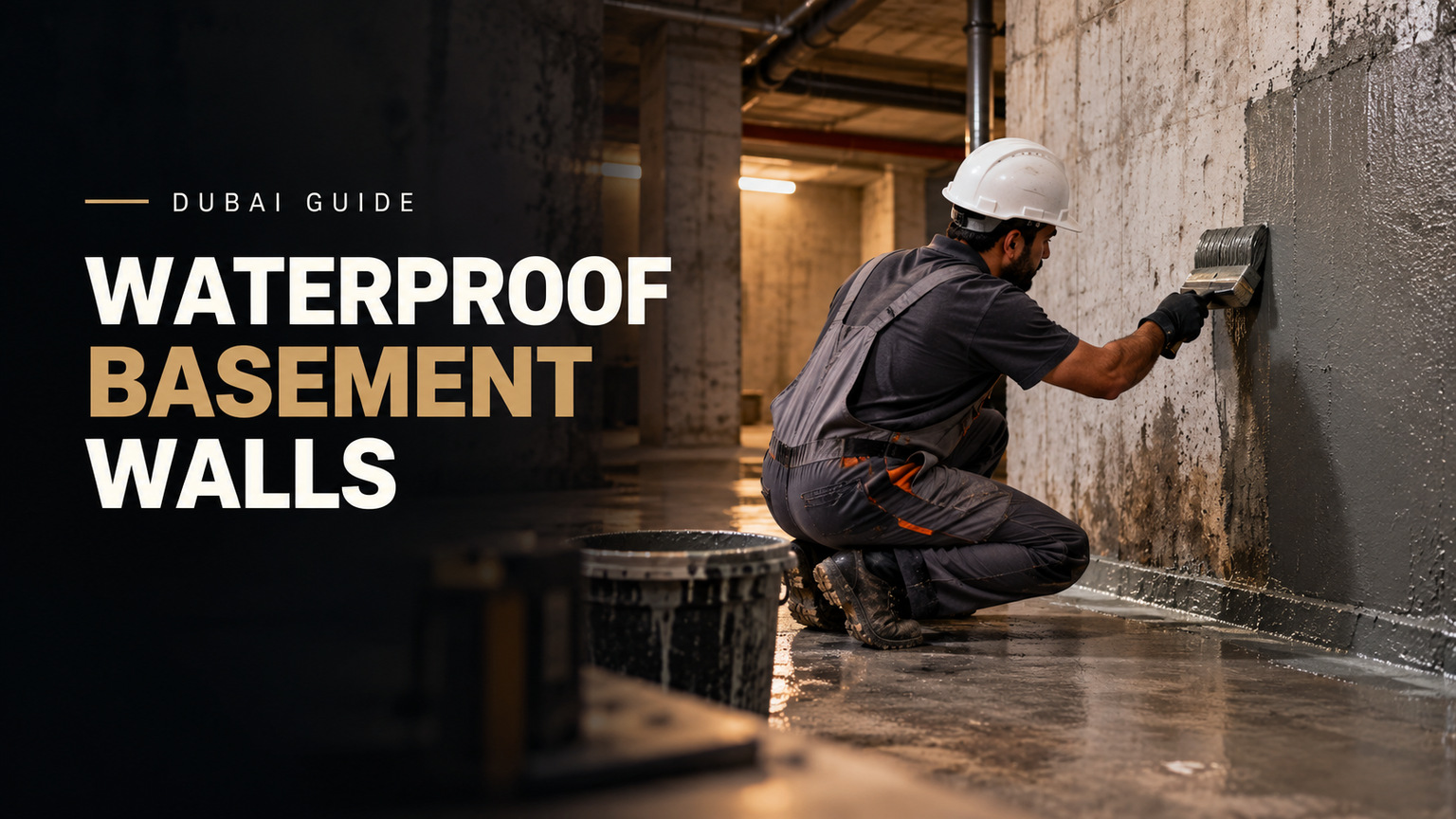

Best Waterproof Paint for Concrete Basement Walls in Dubai: What Actually Works
Quick Answer
The best waterproof paint for concrete basement walls exposed to groundwater is a cementitious waterproof coating rated for below-grade use and negative hydrostatic pressure. For existing basements, it can be a practical internal solution. But active leaks need repair first, while new builds and higher-risk basements often need a full tanking system.
Key Takeaways
The right waterproofing method depends on the source of moisture, the wall’s condition, and whether groundwater creates pressure. These findings help narrow the choice before comparing products or contractor quotes.
- Ordinary masonry paint may resist rain but should not be used as the sole barrier against groundwater pressure.
- A negative-side cementitious coating can suit existing basement walls when the exterior face cannot be reached.
- Active cracks, leaking joints, and wall-floor gaps need repair before the main waterproof layer is applied.
- Exterior tanking protects the concrete itself, while internal waterproofing can leave the wall exposed to groundwater.
- Dubai’s 2021 rules address full tanking and crack control for structural elements exposed to water pressure.
- A manufacturer’s hydrostatic-pressure claim must match the actual wall, exposure, and current UAE product data.
- Persistent seepage, high groundwater pressure, or structural damage may call for an engineered waterproofing system.
- White deposits, peeling paint, and damp patches are clues, not enough evidence to choose a coating.
The first decision is not which brand to buy. Find the water source and assess the wall. Then choose a barrier that suits the pressure, defects, and intended use of the basement.
Choose by Water Pressure, Not the Word Waterproof
For a damp concrete basement wall, choose a coating by its rated use, not its label. Paint that resists rain may fail when groundwater pushes through concrete from behind.
Basement walls face a different type of moisture. Soil surrounds much of the wall. When groundwater rises, it can press against the concrete. That force is called hydrostatic pressure.
Water may find a path through pores, cracks, joints, or service openings. A thin paint film can peel or blister if it was not made for that load.
The word waterproof is not enough. Check whether the product works below ground. Look for proof that it can resist pressure from behind the coated face. It must also bond to the actual wall surface.
A useful contrast comes from Jotun’s Jotashield Tex Ultra AA technical data. The product is an exterior acrylic coating with water and weather resistance. It can be used on suitable concrete surfaces. Yet the cited data does not establish its use against negative-side basement hydrostatic pressure.
That does not make it a poor exterior paint. It makes it a different product for a different job.
Three Levels of Basement Wall Protection
Basement coatings fall into three broad groups. The difference is not just thickness or price. Each group serves a different purpose and handles water exposure differently.
| Product or system | Best use | Pressure resistance | Main limit |
|---|---|---|---|
| Decorative masonry paint | Dry basement walls needing a finish. | Do not assume hydrostatic resistance. | Not a substitute for below-grade waterproofing. |
| Cementitious waterproof coating | Existing walls suited to an internal barrier. | Must have a suitable pressure rating. | Cracks and joints need treatment. |
| Full tanking or membrane system | New builds and higher-risk basements. | Designed for the specified water exposure. | Needs a complete design and joint details. |
A cementitious coating uses cement-based materials. Some products contain polymers to improve flexibility and bond. They may be brushed or rolled onto prepared concrete, much like thick paint.
Tanking is a more complete form of protection. It may combine membranes, waterproof concrete, joint seals, and other parts. Together, these form a water barrier around the structure.
These product classes should not be judged by appearance alone. A smooth painted wall may still have water moving through the concrete behind it.
Which Waterproofing System Fits Your Basement Wall?
Start with the water source, exterior access, and leak condition. Then assess water pressure and the room’s dryness needs.
The matrix gives a first choice for common basement conditions. It helps with planning but does not replace a site-specific design. An active leak always needs attention before a broad waterproof layer is chosen.
| Basement condition | First choice | What to check |
|---|---|---|
| New basement under construction. | Positive-side tanking or bonded membrane system. | Joints, penetrations, and design water level. |
| Existing wall with exterior access. | Repair defects and assess external waterproofing. | Safe excavation and membrane condition. |
| Existing wall without exterior access. | Rated negative-side cementitious system. | Pressure rating, bond, and wall condition. |
| Strong or persistent hydrostatic back pressure. | Engineered internal system or suitable render. | Water head, joints, and dryness target. |
| Active crack or wall-floor leak. | Repair the water path first. | Movement, joint condition, and leak rate. |
| Dry wall needing decoration. | Suitable masonry paint. | Confirm no groundwater ingress. |
This approach follows Sika’s guidance on below-grade waterproofing systems. The manufacturer treats membranes, concrete waterproofing, joint seals, and internal coatings as parts with different jobs.
Consider a basement beside another property. Excavation may be difficult or unsafe. An internal waterproofing system may be the practical path.
A new warehouse basement offers another choice. Its outside walls may still be open before backfilling. The project team can fit an external barrier and plan the joints before the soil is returned.
The intended use also changes the decision. A plant room and a finished occupied space may need different levels of dryness.
A basement with an occasional damp mark is not the same as one with water running through a joint. The first may need moisture testing and a suitable coating. The second needs leak repair and a review of the full water barrier.
The first task is to establish where the water enters. Product choice comes after that finding.
Best Paint-Like Option: Negative-Side Cementitious Coating
For an existing basement wall without exterior access, assess a cementitious coating rated for negative hydrostatic pressure. It is the strongest evidence-backed paint-like category for this use.
Negative-side waterproofing places the barrier opposite the water source. For a basement, that often means coating the inside wall. Groundwater pushes from the soil side toward the coating.
The product must be made for this pressure direction. Normal weather resistance is not proof of suitability.
One relevant example is Fosroc Nitocote CM210. Fosroc describes it as a flexible cementitious waterproof coating for concrete, brick, and blockwork. Its stated uses include below-ground retaining walls and foundations.
The manufacturer also claims resistance to high positive and negative hydrostatic pressure. Listed application methods include brush, roller, trowel, and spray.
Those claims make it a useful product to assess. They do not establish that it suits every basement in Dubai.
The public product page does not give one numeric pressure value for all uses. Ask for the current UAE technical data sheet. The supplier must confirm the design pressure, coat thickness, curing rules, system details, and warranty.
What a Cementitious Coating Needs to Do
A waterproof coating must bond to sound concrete. It must remain intact under the expected water load. Its edges and joints also need a suitable seal.
Some cementitious products allow application to damp but sound concrete. Others impose tighter moisture limits. A damp wall is not ready for coating merely because the product contains cement.
Old paint can cause trouble. Loose coatings, salt deposits, weak concrete, and surface contamination may prevent a sound bond. The preparation method must follow the selected product’s data.
Ask how the coating will meet the floor, columns, service pipes, and construction joints. A well-coated wall face cannot make up for an untreated gap at its edge.
Application skill matters too. A crew should follow the approved mixing, coat spacing, thickness, and curing steps. A product with strong test results may still fail if the applied system differs from the tested one.
When a Waterproof Render Is Better Than a Thin Coating
A higher-build waterproof render may suit a basement needing a more robust internal barrier. The choice still depends on pressure, wall condition, and the complete system design.
A render is a thicker cement-based layer. It may form part of a Type-A waterproofing system. Type A means barrier protection. A waterproof layer is used to resist water entry.
Fosroc Proofex Waterproof Render is one example. Fosroc lists internal waterproofing of basements, lift pits, cellars, and tunnels among its uses. The product is also described as resisting hydrostatic back pressure.
There is a useful manufacturer test figure. In a 21 May 2025 Fosroc UK and Ireland announcement, the company reported resistance to positive and negative hydrostatic pressure at 5 bar for 3 days.
That is a manufacturer-reported test result. It is not a universal safe design pressure or an automatic UAE warranty. The cited announcement concerns the UK and Ireland. A Dubai project needs the current local product data and an assessment of site exposure.
Thickness alone does not prove a better result. A thick render can still fail at a leaking joint. It may also lose bond if the concrete beneath it is weak.
Choose a higher-build system when its tested design fits the job. Ask how it will be placed, cured, joined, and finished. The contractor should also explain how the finished work will be checked.
Repair Cracks and Leaks Before Coating
Stop active water paths before applying a broad waterproof layer. A coating should not be expected to seal every leaking or moving crack.
Basement walls often leak at weak points rather than across the whole face. Common paths include construction joints, wall-floor junctions, pipe sleeves, and cracks.
A wall can appear sound across most of its surface. Yet one narrow joint near the floor may admit water when groundwater rises.
Painting the damp area may hide the stain for a short time. It does not remove the cause.
Some defects call for injection or waterstop repairs. Others need joint details that can handle movement. Structural cracks may require an engineer’s review.
A contractor should identify the defect before choosing a repair. Crown Edge describes surface preparation and crack repair services that are relevant to this work. A sound repair plan treats the leak path and prepares the wall for the chosen waterproof layer.
What Damp-Wall Symptoms Can Tell You
Damp marks can offer clues, but one symptom may have several causes. The table links common signs to the first checks worth making. It is a guide to inspection, not a final diagnosis.
| Visible sign | Possible cause | What to check first |
|---|---|---|
| White powder or crystals. | Salts carried by moisture. | Water path and surface salts. |
| Peeling or blistered paint. | Moisture or pressure behind the film. | Old coating and water source. |
| Wet wall-floor edge. | Possible construction-joint leak. | Joint and waterstop condition. |
| One wet crack. | Direct water path. | Movement, depth, and leak rate. |
| Broad damp patch after groundwater rises. | Water pressure or defects. | Outside water load and barrier condition. |
| Moisture on a cool wall in humid weather. | Possible condensation. | Indoor humidity and wall temperature. |
White salt deposits, called efflorescence, often show that moisture has moved through a material. The visible deposit may not mark the original water-entry point.
Condensation needs a different response. Humid indoor air may release water onto a cool wall. Waterproof coating will not fix poor air control if groundwater is not entering the building.
Watch when each symptom appears. Moisture that follows a groundwater rise calls for different checks from moisture that appears during humid weather. A plumbing leak may also create a wet patch far from its source.
The repair method must match the finding. Treating all damp patches with the same coating risks repeat failure.
Positive-Side vs Negative-Side Waterproofing
Positive-side waterproofing is the preferred starting point when the outside face can be protected. Negative-side systems remain useful when exterior access is not practical.
Positive-side protection sits where water first meets the wall. For a basement, this is usually the soil-facing surface.
Negative-side protection sits on the inside face. It aims to keep water out of the room. Yet the concrete behind the barrier may still become wet.
Sika’s concrete basement waterproofing guidance makes this distinction clear. Internal barriers do not protect the concrete itself from water ingress or aggressive substances. They are often used for repair work when the exposed face cannot be reached.
That difference can affect the building over time. An internal coating may keep the room dry while leaving the outer concrete exposed to groundwater.
Why New Basements Need More Than an Inner Coating
New construction gives the design team more options. The outside wall may be open. Pipe entries and joints can be planned before concrete is poured or soil is returned.
A fully bonded membrane helps limit water tracking between the barrier and the structure. Fosroc Proofex Engage is a pre-applied membrane designed to bond to fresh concrete. It is used as part of below-grade waterproofing systems.
The membrane still needs correct joint, lap, corner, and pipe-entry details. A product alone does not form the whole barrier.
Existing buildings can be harder to treat from outside. Excavation may affect nearby foundations, utilities, access routes, or site safety. Local permits and temporary support may also be needed.
For Dubai projects, the full scope should be assessed before fitting any coating. Crown Edge’s basement waterproofing services provide a relevant local service option. The proposed work should explain how water enters and why the chosen system fits.
What Dubai’s Building Rules Mean for Basement Walls
Dubai’s building rules treat water-exposed foundations and retaining walls as a waterproofing design issue. A decorative paint claim cannot replace the structural design.
A notable local figure is 0.2 mm. Dubai’s Administrative Resolution No. 37 of 2021 identifies this design crack width for relevant foundations and retaining walls exposed to water pressure. It also addresses full waterproof tanking for structural elements exposed to water.
The 0.2 mm value belongs to a stated design and legal context. It is not a homeowner pass-or-fail test. A crack narrower than that figure does not prove the wall is watertight.
The Dubai Building Code 2021 also links crack control to groundwater pressure and wall thickness. It calls for a proprietary waterproofing system for structural elements in contact with water and refers to BS 8102 guidance.
The code describes design crack-width limits that vary with the relevant hydrostatic-pressure-to-wall-thickness relationship. The research identifies values from 0.2 mm under the lower stated ratio to 0.05 mm under the higher ratio.
These are design limits, not coating performance ratings. They must be read with the applicable code provisions and project conditions.
For new projects, the consultant should state the design groundwater level and intended basement use. The design should also define acceptable water entry and the waterproofing system needed to meet that goal.
A plant room may tolerate conditions that would be unsuitable for an occupied room. That difference should shape the waterproofing plan before product selection.
For an existing basement, the responsible team must assess which rules apply to the proposed repair. A suitable coating does not, by itself, prove that the full system meets every relevant authority requirement.
Waterproof Paint, Cementitious Coating, or Tanking: Which Wins?
No single product class wins under every basement condition. Choose the barrier that matches the water load and building design.
The comparison below puts the three main choices side by side. It shows what each one should achieve and what a buyer needs to confirm before approving the work.
| Decision factor | Masonry paint | Cementitious waterproof coating | Full tanking system |
|---|---|---|---|
| Main purpose | Finish and surface protection. | Rated barrier on sound concrete. | Whole-structure water protection. |
| Below-ground use | Must not be assumed. | Check product data. | Designed for stated exposure. |
| Internal negative pressure | Not proven by a water-resistant label. | Requires a suitable rating. | Depends on system design. |
| Cracks and joints | Does not solve active leaks. | Needs separate repair details. | Includes joint and penetration details. |
| Best project fit | Dry, sound walls. | Selected existing-wall retrofits. | New builds or higher-risk work. |
| Main buying check | Substrate and finish suitability. | Pressure, bond, and local product data. | Design, fitting, and inspection. |
For a dry storage wall, decorative paint may be enough. A pressure-rated barrier is not always needed where there is no groundwater ingress, unless the wider design calls for it.
For a damp basement without outside access, a rated cementitious system deserves closer review.
High pressure or repeat joint leakage shifts the focus to a full waterproofing and repair design. The product label is only one part of that decision.
Check Local Product Approval Claims
A local approval notice can help establish a product’s history. Its scope still matters.
Fosroc reported Dubai Civil Defence approval for certain vapour and waterproofing systems in 2018. The announcement concerned façade-related systems and fire-performance needs.
It must not be treated as blanket approval for every basement application. Ask for current UAE product documents and any project-specific approvals needed.
An old notice or international brochure may not cover the exact system proposed for the wall.
Waterproof Coating Product Checklist
Before buying, make the supplier show that the product fits the wall. Use the current technical data sheet, not just the sales description.
A complete product review covers pressure, bond, fitting conditions, and the full waterproof layer. These checks help compare different brands on equal terms.
- Substrate: Confirm suitability for the site’s concrete or masonry.
- Below-grade use: Look for basements, foundations, or retaining walls in the stated uses.
- Pressure direction: Require negative-side use when groundwater pushes from behind the coating.
- Water pressure: Check the system rating against the expected hydrostatic load.
- Surface moisture: Confirm whether the wall must be dry or may remain damp.
- Surface preparation: Follow the stated cleaning and roughening rules.
- Crack treatment: Identify joints, cracks, and pipe entries needing separate repair.
- Layer build: Confirm the number of coats and the required thickness.
- Curing: Check temperature, moisture, and waiting-time rules.
- Topcoat: Confirm that any decorative paint is compatible with the waterproof layer.
- Local support: Obtain the current UAE data sheet, warranty, and fitting guidance.
Do not overlook the edges. A sound coat on the main wall will not stop water entering at an untreated floor joint or pipe sleeve.
The supplier should explain how the finished system will be checked. Suitable checks may include visual inspection, thickness records, bond tests, or leak tests. The method depends on the product and approved design.
Ask for the required coat thickness in measurable terms. A quote that only says two coats may omit the thickness needed for the stated pressure rating.
Also review the preparation scope. Removing old paint, treating salt deposits, and repairing defects can take more work than coating the wall itself.
Two contractors may quote the same wall area but offer very different systems. The lowest price is not a fair comparison unless the work scope matches.
When Paint Should Not Be the Main Solution
Paint alone is not a sound first choice for active leakage or suspected structural damage. These conditions need investigation and repair before broad-area waterproofing.
Several warning signs should change the scope from simple coating work to a fuller review. The following conditions are especially relevant when water pressure or movement may be involved.
- Water runs through a crack or joint during wet periods.
- A wall-floor junction keeps leaking after earlier coating work.
- Concrete is loose, cracked through, or showing signs of movement.
- Large wall areas stay wet under sustained groundwater pressure.
- The basement needs a strict dryness level but the water source is unknown.
- Old coating layers have failed without a clear diagnosis.
A new coating may still form part of the repair. It should follow the findings rather than replace the investigation.
Consider a basement plant room with water entering beside a service pipe. Painting the nearby wall may improve its appearance. The pipe entry remains a direct water path.
A long leaking joint at the foot of a retaining wall creates a similar risk. A coat on the broad wall face may leave that joint exposed to pressure.
Structural movement changes the repair needs again. A rigid coating may not remain intact across a moving crack. The engineer or waterproofing designer must select a detail suited to that movement.
A contractor who only quotes coating area may miss these failure points. Ask for a repair scope that names each defect and the proposed treatment.
A Practical Inspection Plan for Dubai Basements
A useful quotation starts with the water source and proposed repair system, not the paint brand. A sound site review reduces the risk of paying twice for the same leak.
The inspection should move from diagnosis to system choice. Each stage helps rule out an unsuitable coating or an incomplete repair.
- Map the damp areas. Record their location and when moisture becomes worse.
- Check the likely source. Separate groundwater, plumbing leaks, rain entry, and condensation.
- Inspect weak points. Review cracks, joints, wall-floor edges, and pipe sleeves.
- Review exterior access. Decide whether outside repairs are practical and safe.
- Assess the concrete. Check old paint, salts, loose areas, and bond needs.
- Set the dryness goal. Match it to the room’s planned use.
- Choose the complete system. Pair defect repairs with suitable waterproof layers.
- Check local documents. Confirm product data, work scope, warranty, and inspection steps.
Ask the contractor to show the complete scope. It should describe the work beyond square metres of coating.
One quote might cover old-paint removal, crack repairs, joint treatment, surface prep, coating, and final checks. Another may include coating only. Their prices are not directly comparable.
If walls and floors both need work, keep their roles distinct. Epoxy flooring services may address floor wear and finishing needs. That does not prove the same epoxy is suitable for negative-side basement-wall waterproofing.
The Crown Edge blog also provides a starting point for wider reading on the company’s building and surface work. General coating advice should not replace the basement-specific product checks in this guide.
What to Request in a Contractor’s Quotation
A detailed quote should state the area to be treated and the defects found. It should name the proposed product and system layers. It should also cover preparation, joint details, curing, and final checks.
Ask for the pressure condition used in the product choice. If the actual groundwater level is unknown, the scope should state how it will be assessed.
The quote should identify who will approve any structural repair or unusual joint detail. It should also define what the warranty covers and what it excludes.
For occupied basements, ask how the work will affect access and room use. Dust, surface removal, curing, and drying may need a planned work sequence.
A clear scope makes later inspection easier. It also helps the buyer see whether the proposed fix treats the source or merely covers the stain.
Frequently Asked Questions
These questions cover common decisions before a basement waterproofing project. The answers depend on the actual water exposure, substrate condition, and approved system.
Can I Waterproof a Concrete Basement Wall From the Inside?
Yes. An internal system can help when the exterior face cannot be reached. Choose one rated for negative-side pressure. It must suit the concrete and existing defects. Internal waterproofing does not stop groundwater entering the concrete behind it.
Can Waterproof Paint Stop Groundwater Pressure?
Certain specialist coatings can resist stated hydrostatic loads. Ordinary water-resistant paint does not prove that ability. Check the product’s pressure direction, test evidence, and allowed use. Repair active water paths before coating the broad wall area.
Is Epoxy Paint Suitable for Basement Walls?
Not every epoxy is suitable. A floor coating may resist wear and cleaning chemicals yet lack proof for inward groundwater pressure. Use epoxy only when the current technical data supports the wall’s actual exposure and the complete system design.
Can I Paint Over Damp Concrete?
That depends on the chosen system and the cause of dampness. Some cementitious products allow application to prepared damp concrete. Others need stricter moisture conditions. Active leaks, salts, weak concrete, and loose paint must be addressed first.
Do Cracks Need Repair Before Waterproofing?
Water-carrying cracks need proper treatment. Moving cracks and structural damage may need different repairs from fine, stable surface cracks. The repair must match the defect. A coating should not hide an unresolved leak path.
The Right Choice Starts With the Wall
The best waterproof paint is the one that matches the water exposure. For many existing concrete basements, that points to a rated cementitious coating. For active leaks, damaged joints, or high groundwater pressure, a more complete repair and waterproofing plan is needed.
Before approving the work, ask what the contractor found and why the proposed system fits. The answer should cover leak paths, pressure direction, concrete condition, and current UAE product data.
A good proposal also explains where the waterproof layer starts and ends. Look closely at joints, corners, floor edges, and pipe openings. These details often decide whether a basement remains dry after the work is complete.
For Dubai property owners, the best buying decision comes from a clear diagnosis and a defined work scope. Compare contractors on the repair method, system rating, surface prep, and final checks. Do not compare them on paint brand or coating area alone.
A dependable result comes from matching the system to the wall, not trusting the word waterproof on a tin.