

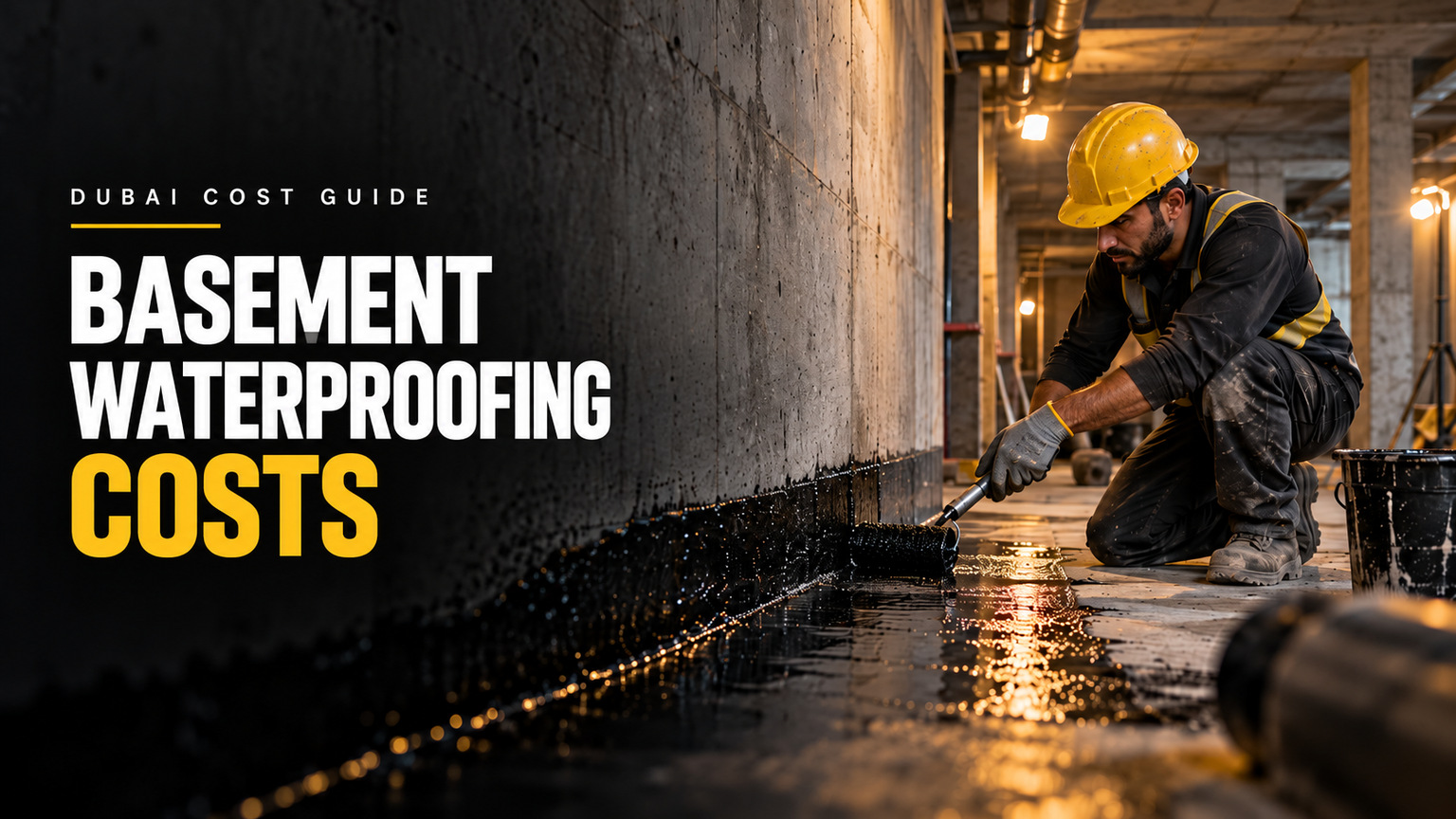

Basement Waterproofing Cost in Dubai: Prices and Key Factors
Quick Answer
Basement waterproofing cost in Dubai varies by system and site conditions. Published 2026 guides place internal treatments around AED 70–150 per m², while one Dubai contractor lists basement tanking at AED 130–300 per m². These are different scopes, not fixed market rates. Water pressure, treated area, access, and repairs determine the final quote.
Key Takeaways
Dubai basement waterproofing prices make more sense when you compare the work behind each rate. These seven points help you set a budget and review quotations.
- Published 2026 UAE and Dubai cost guides show different rates because their systems, work scopes, and pricing units differ.
- Internal cementitious or crystalline treatment is not the same job as full external membrane tanking.
- Contractors should measure the walls and floor surfaces receiving waterproofing, not just the basement floor area.
- Active leaks, cracks, construction joints, and pipe penetrations may need separate treatment before waterproofing.
- External repairs can involve excavation, groundwater control, backfilling, and reinstatement beyond the membrane work.
- Dubai groundwater conditions can affect material choice, detailing, and below-ground design needs.
- A sound quotation should state the system, treated area, repair scope, testing, warranty, VAT, and exclusions.
The best starting point is a clear work scope. Once each contractor prices the same work, the numbers become far more useful.
Basement Waterproofing Cost in Dubai: Published 2026 Prices
Published 2026 basement waterproofing estimates range from AED 40–100 per m² in one UAE guide to AED 130–300 per m² in a Dubai contractor’s tanking guide. Other sources report different figures and units. No single rate applies to every basement.
The table below compares actual published figures. It keeps each source’s work description and unit intact. These are public planning estimates, not Crown Edge rates or verified market averages.
| Published guide | Work described | Published 2026 rate | Geography | Main limitation |
|---|---|---|---|---|
| QuotesDone UAE price guide | Basement or retaining-wall waterproofing. | AED 40–100/m². | UAE. | Broad indicative range; detailed scope is unclear. |
| DryGuard basement guide | Internal crystalline or cementitious treatment. | AED 70–120/m². | Dubai/UAE. | Depends on access, concrete, and leak conditions. |
| DryGuard, same guide | Complex internal work with heavy injection needs. | AED 100–150+/m². | Dubai/UAE. | Not equal to basic coating work. |
| Abdulla Carpentry Establishment price guide | Basement or retaining-wall tanking. | AED 130–300/m². | Dubai. | Assumes sound substrate; some repairs cost extra. |
| Biddaro UAE cost guide | Basement tanking. | AED 25–50/ft². | UAE. | Uses square feet; project sample is not disclosed. |
The difference is too large to treat these figures as one price band. A basic internal treatment, a complex leak repair, and external tanking may involve very different work.
Biddaro’s rate also uses square feet, not square metres. Its Deira cost page repeats the same figures. That local page does not provide an independent second price sample.
None of these sources publishes enough project data to establish a reliable Dubai average. Their figures are most useful as starting points for a discussion about scope.
For a real project, first decide which system fits the building. Crown Edge’s basement waterproofing services page describes protection against groundwater penetration and hydrostatic pressure. It does not publish a fixed basement waterproofing price.
Estimate Your Basement Waterproofing Budget
Start with the area that will receive treatment. Then apply a rate for the same type of work. Keep repairs and other site costs separate until they have been priced.
A basement with a 100 m² floor may need far more than 100 m² of waterproofing. The walls can add a large treated area. Some projects also need joint treatment, pipe seals, and protection layers.
Measure Walls and Floors Separately
For a simple rectangular basement, floor area equals length multiplied by width. Wall area equals the wall perimeter multiplied by the treated height.
Consider a hypothetical basement measuring 10 metres long and 8 metres wide. Its wall height is 3 metres. Assume all four walls and the full floor need treatment.
| Measurement | Calculation | Result |
|---|---|---|
| Floor area | 10 × 8. | 80 m². |
| Wall perimeter | 2 × (10 + 8). | 36 m. |
| Wall area | 36 × 3. | 108 m². |
| Total treated area | 80 + 108. | 188 m². |
This is a worked geometry example, not a surveyed Dubai property. It assumes flat walls, no openings, and no changes to the planned treatment area.
The floor alone covers 80 m². Adding the walls raises the treated area to 188 m². A quote based only on floor area would miss much of this example’s work.
Actual quantities must follow the approved system and drawings. Some jobs treat only one wall or a leaking zone. New-build tanking may also cover surfaces beneath the raft.
Calculate a Preliminary Application Amount
For an initial estimate, use this simple relationship:
Indicative application amount = treated area × matching published rate.
Take the 188 m² example. Apply DryGuard’s AED 70–120/m² guidance only as a hypothetical internal treatment comparison.
| Calculation | Amount |
|---|---|
| 188 m² × AED 70/m². | AED 13,160. |
| 188 m² × AED 120/m². | AED 22,560. |
The result is AED 13,160–22,560 for the rate-based illustration. It is not a complete project quote. It assumes the source’s rate can apply to all 188 m² under the same conditions.
The same figures should not be used for a new-build external membrane system. That is a different scope. Nor can the calculation account for active leaks, damaged concrete, water control, or restricted access without extra data.
A useful budget separates the base treatment from other work. Ask the contractor to price each required item rather than hiding it inside one unexplained rate.
Include Joints, Penetrations, and Protection
Flat wall measurements are only part of the work. Basements also have joints, corners, pipe sleeves, and other weak points. These need details that suit the chosen system.
A real Dubai project shows why. In its Al Habtoor Palace waterproofing case study, Fosroc describes basement protection that included joints, pile caps, and pile heads. Product choice also took account of ground conditions and resistance to punctures.
Those details may change labour and material needs. They cannot be priced well from floor area alone.
Internal Treatment vs External Basement Tanking
Internal treatment can suit some existing basements where outside access is hard. External tanking protects the side facing the ground. Neither method is always the best or cheapest choice. The main difference is where the water barrier sits.
The work needed to reach that surface can also change the price sharply. An internal coating may cover an accessible wall. An external repair may first need soil removed and groundwater controlled. Compare both the proposed result and the work needed to achieve it.
Internal Waterproofing for Existing Basements
Internal waterproofing is often considered when a basement is already in use. The contractor can reach the inside face of the concrete without digging around the whole building.
Depending on the site, work may involve cementitious coatings, crystalline treatment, or crack injection. A cementitious layer is a coating made from cement-based materials. Crystalline products work within the concrete’s pore structure.
Active water flowing through a joint may need injection before surface treatment. A coating alone may not close the water path. The product must also be suitable for pressure from the ground side.
Internal work may reduce disruption outside the building. Yet it can still involve removing finishes, treating joints, repairing concrete, and controlling leaks. Internal access does not make those tasks vanish.
External Tanking for New Basements
External tanking places the waterproof barrier against the wet side of the structure. This is often planned before a new basement is backfilled.
A complete system may include membranes beneath the raft, membranes along walls, joint details, and protection boards. The designer must address continuity where the floor and walls meet.
For example, Mapei’s MAPEPROOF P5 is a bentonite sheet for below-ground horizontal and vertical surfaces. It is one product example, not a standard material for every job.
Fosroc’s Burj Al Arab case study records a positive tanking system with two 1.6 mm self-adhesive membrane layers and protection board. That historic project shows the scope of a layered system. It does not establish current Dubai prices.
New-build work benefits from access during construction. Once soil covers the walls, later work from the outside can become far more involved.
External Repairs to Existing Basements
An existing basement may have soil, paving, services, or nearby structures against its walls. Exposing those walls can require much more than waterproofing work.
The repair plan may need safe excavation, temporary support, and groundwater control. After treatment, crews may have to install protection, backfill the area, and restore paving or landscaping.
These costs belong in the project budget. They should not be assumed to fit inside a published membrane rate.
A contractor proposing a lower-cost internal repair may be solving a narrower problem. Confirm the intended result and the treated water path before comparing it with an external scheme.
Seven Factors That Change Waterproofing Cost
Water pressure, access, leak repairs, material choice, and surface condition can change the amount of work. A low square-metre rate may therefore lead to a high total cost once the missing work is added.
Use the following matrix to see what a contractor should check. It gives a likely budget effect, not an invented price increase.
| Cost factor | Possible added work | Budget effect | What to check |
|---|---|---|---|
| High groundwater pressure | Pressure-suitable system and joint details. | May increase scope. | Water level and design basis. |
| Active leaks | Leak tracing and injection. | Extra repair items. | Each treated leak or joint. |
| Poor outside access | Excavation and safe access works. | Can raise total cost. | Access and excavation plan. |
| System choice | Membrane, coating, or combined treatment. | Changes materials and labour. | Product data and layer details. |
| Damaged concrete | Cleaning, grinding, and repairs. | Extra preparation. | Substrate condition. |
| Drainage or dewatering | Water control and reinstatement. | Separate site-work costs. | Responsibility and exclusions. |
| Complex geometry | Corners, sleeves, pile heads, and overlaps. | More detailed work. | Drawings and quantities. |
The matrix helps explain two quotes with the same treated area. One may include leak repairs and access work. Another may cover only the surface treatment. Those totals do not represent the same job.
1. Groundwater Level and Water Pressure
Groundwater can press against buried walls and slabs. This pressure is called hydrostatic pressure. It affects how water enters gaps and joints and what the barrier must resist.
A damp patch is not enough to measure that pressure. Groundwater data and site conditions matter, especially for large or deep basements. The project designer must assess the exposure and use a suitable waterproofing approach.
2. Active Leakage and Construction Joints
Water may travel through cracks, wall-floor joints, or pipe openings. A surface coating may not solve the path by itself.
Injection work can form a separate repair item. Biddaro’s published UAE guide lists AED 500–2,000 per injected crack, but that is only a marketplace estimate. Crack size, material choice, access, and water flow are not standard across projects.
Ask for each leak or joint treatment to be identified. A broad statement such as ‘waterproof entire basement’ gives little help if active leakage is present.
3. Access and Excavation
Access often determines how much non-waterproofing work is needed. An exposed wall on a new project is very different from a buried wall beside an occupied building.
External repair may involve removing soil and nearby finishes. Deep excavation also needs a safe plan. Structural support and groundwater control may be required.
These tasks should have their own scope and price. Otherwise, the apparent membrane rate can hide major costs.
4. Membrane or Coating System
There is no sound rule that one product is always the cheapest suitable choice. The system must match the building, substrate, water exposure, and required use.
Some projects use bentonite sheets. Others use bonded membranes, cementitious treatments, injection, or combined systems. Each has different surface and detail needs.
A cheap coating rate cannot be compared directly with a full membrane system. First check what each product is meant to do. Then compare rates for that scope.
5. Surface Preparation and Concrete Condition
Waterproofing needs a suitable surface. Loose material, old coatings, cracks, honeycombing, or damaged concrete may need treatment before new work begins.
Crown Edge also describes surface preparation and crack repair among its related services. These are useful scope items to identify when existing floors or concrete need work.
The quotation should state who removes failed materials and who makes good the surface. It should also state the repair method where damage has been found.
6. Drainage, Dewatering, and Reinstatement
Water control can become a major part of the project. Dewatering means lowering or removing water so planned work can proceed safely. It is not the same as applying a waterproofing layer.
Some basements also need drains, channels, or changes to floor falls. Other projects need damaged surfaces restored after treatment.
Where floor levels or slopes need correction, floor screeding work may form part of the broader repair. Screeding does not replace a waterproofing system.
Check whether water removal, protection layers, floor repairs, and final finishes are included. They can change the project total even when the treated area stays the same.
7. Treated Area and Detail Complexity
Large flat walls are not always the hardest surfaces to waterproof. A smaller area with many joints, corners, and pipe openings may take more detailed work.
A basement with many service lines needs each opening assessed. The wall-floor junction must also fit the chosen system. Poorly defined detail work makes quotations hard to compare.
Ask for the treated area and major details to appear separately. Do not rely on one total area for every type of repair.
Dubai Groundwater Conditions and Waterproofing Standards
Dubai’s ground conditions can influence waterproofing design and material choice. Groundwater level, salts, and water pressure all matter. The standards and local rules help define suitable systems, but they do not set contractor prices.
For a major basement project, these technical issues should be addressed before choosing the lowest rate. A suitable system must fit the building’s actual exposure.
Groundwater, Salts, and Below-Ground Concrete
Dubai’s geotechnical requirements address groundwater levels, permeability, and groundwater chemistry. They also address design issues linked to maximum groundwater conditions and uplift.
Uplift is the upward force water can place on buried slabs. Waterproofing alone does not resolve structural uplift design. The project’s qualified designers must deal with it.
The Dubai Building Code, 2021 edition describes saline groundwater with chlorides and sulphates. These substances can create an aggressive environment for buried concrete and steel reinforcement.
Material choice should reflect that exposure. For instance, Mapei’s MAPEPROOF SW is described for below-ground structures where saline water is present.
This does not mean that every Dubai basement needs the same product. Actual water chemistry and design conditions must guide the choice.
Product Suitability and Local Approval
Dubai Municipality has published rules covering certain waterproofing systems. Its Circular No. 8-2-1 of 2021 addresses integral waterproofing in concrete elements, including substructures.
The circular sets conditions linked to conformity certification and approval for the systems it covers. It should not be read as a blanket rule for every membrane or coating.
For larger projects, ask the designer or contractor to confirm which product approvals apply. Also ask for the product data, proposed layers, and joint details.
A clear product name is more useful than a vague claim that the material is ‘premium’ or ‘approved’. Relevant proof should match the actual system being quoted.
BS 8102:2022 as a Technical Reference
BSI’s BS 8102:2022 covers protection of below-ground structures against water ingress. BSI lists the 2022 edition, published on March 31, 2022.
It provides a relevant technical reference for basement waterproofing design. It is not a Dubai price guide or a fixed tariff.
Manufacturers also offer products for demanding ground conditions. Fosroc describes Proofex HDPE B-135 for below-ground use and protection from aggressive ground substances. Its HDPE-S2 system may form part of a dual-membrane approach in high-water-table areas.
Such systems should be chosen through project design, not by copying a past project or choosing the most complex product by default.
Groundwater and Approval Checks for Dubai Projects
The following checks link technical evidence to the buying decision. They are most relevant to new construction and substantial below-ground repair work.
| Issue | Evidence to review | Buying decision |
|---|---|---|
| Groundwater level | Site or design groundwater data. | Confirm pressure and water exposure assumptions. |
| Groundwater chemistry | Available pH, chloride, and sulphate data. | Check product suitability for site exposure. |
| Joints and penetrations | Drawings and system details. | Confirm sealing and waterstop scope. |
| Product conformity | Applicable product data and approvals. | Confirm the proposed system meets project needs. |
| Testing and design responsibility | Project requirements and named responsible parties. | Confirm who checks and accepts the work. |
These checks can expose missing scope before work starts. They also help explain why two projects of similar size may need different waterproofing systems.
Compare Waterproofing Quotes Before You Buy
A good waterproofing quotation defines the work, not just the price. It should show where treatment goes, which system is used, what repairs are included, and how completion will be checked.
The lowest total may still be fair. But buyers need enough detail to compare it with other offers. A quote that omits access work or crack injection can appear cheaper while covering less.
What Every Quote Should Include
Use this checklist when seeking basement waterproofing prices in Dubai. Ask contractors to mark each item as included, excluded, or not needed for the project.
- Treated area: State wall and floor or raft areas separately, with units in m².
- Waterproofing system: Name the coating, membrane, injection method, or combined system.
- Materials and layers: Give product names, layer details, and protection needs.
- Surface preparation: Describe cleaning, removal, grinding, and concrete repair work.
- Cracks and joints: State which leaks, cracks, joints, and penetrations will be treated.
- Water conditions: Record the known leakage and groundwater assumptions used for pricing.
- Access work: Confirm any excavation, temporary support, or working-space needs.
- Dewatering and drainage: State who supplies and manages any required water control.
- Protection and reinstatement: Include or exclude backfilling, screed, paving, and finishes.
- Inspection and testing: State the checks planned and the method used to accept the work.
- Applicable approvals: Identify product conformity or approval needs for the project.
- Warranty terms: State the covered work, duration, limits, and claim process.
- VAT and exclusions: Show tax treatment, provisional amounts, and omitted work clearly.
The checklist is most useful when each contractor prices the same defined work. Not every basement needs excavation or injection. The quote should say why each item applies, rather than leaving it unclear.
Warning Signs in a Low-Cost Estimate
A low rate alone does not prove a weak job. Missing work is the more useful warning sign.
Suppose one contractor prices an internal wall coating. Another includes leak tracing, joint injection, coating, and repairs to damaged concrete. The second price may be higher because it covers more work.
Ask questions when a quote gives only one total area and a unit rate. Check whether it names the product, number of layers, and treatment limits.
For a leaking basement, the quote should also address the known water paths. If active joints are ignored, ask how the proposed system will treat them.
Vague warranty wording deserves the same care. A warranty has value only when its scope and terms are clear.
Before You Accept a Fixed Price
For a straightforward new-build job, clear drawings may allow detailed pricing before work starts. Existing leaks can be harder to assess. Hidden water paths or damaged concrete may only become clear after inspection.
A useful final quote should reflect the actual building. It should also explain how unexpected work will be priced and approved.
For a larger or complex basement, have the relevant designer or specialist check the proposed system. The contractor’s work method must match the required waterproofing design.
The aim is not simply to reduce the first quote. It is to avoid paying for an incomplete solution or work that the site does not need.
Basement Waterproofing Cost FAQs
Before comparing basement waterproofing prices in Dubai, check that each rate covers the same work. Start with the surfaces that need treatment and the system proposed for those areas. Then confirm if leak repairs, excavation, and water control are included. A square-metre rate alone cannot settle those questions. The answers below explain common cost and scope issues that can change a contractor’s final quote.
1. How Much Does Basement Waterproofing Cost per m² in Dubai?
Published 2026 guides offer different estimates. Internal treatment is listed around AED 70–150/m² by one Dubai specialist. Another Dubai contractor lists basement or retaining-wall tanking at AED 130–300/m². Neither figure is a universal market rate. Project scope and site conditions decide the actual price.
2. Is Internal Waterproofing Cheaper Than External Waterproofing?
Internal treatment may cost less when it avoids excavation. But price depends on the work needed. Active leaks, difficult access, and extensive repairs can change the result. Compare only systems that meet the same project needs.
3. Is Basement Waterproofing Charged by Floor Area?
Not always. Contractors may measure the walls, floor or raft, and other treated surfaces. A basement with an 80 m² floor can have much more than 80 m² of waterproofing work. Ask for separate quantities.
4. Does Waterproofing Include Crack Injection?
It depends on the quotation. Some projects need injection before a coating or membrane treatment. Others do not. Every known crack and joint should be covered by a clear work scope.
5. Can an Existing Basement Be Waterproofed From Inside?
Yes, some existing basements can be treated from inside. The system must suit the water pressure, concrete, and leak path. An internal coating is not always enough for an active, pressurised leak.
6. Does the Quote Include Excavation and Dewatering?
Only when the contractor includes those tasks. External repair may need both. Ask for each item to be clearly priced or excluded. Do not assume a published per-m² waterproofing rate includes major site works.
7. Does the Waterproofing Price Include VAT?
The public price guides reviewed do not consistently state VAT treatment. Ask for a written quote showing the pre-tax amount, any applicable VAT, and the final total. Also check for extra or provisional work.
8. How Can I Compare Two Basement Waterproofing Quotes?
Start with the treated area and proposed system. Then check repairs, joints, water control, site access, testing, warranty, VAT, and exclusions. If the scopes differ, ask for revised quotes before comparing totals.
Plan the Right Basement Waterproofing Work
Basement waterproofing cost in Dubai is best judged by the full job. The same floor area can require very different work due to water pressure, access, damaged concrete, and joint details.
Use published 2026 rates to form an initial budget. Then get a quote based on measured surfaces, a suitable system, and clear exclusions. For new-build or high-risk below-ground work, the waterproofing plan should also fit the project’s design and approval needs.
Crown Edge provides waterproofing and related surface services in the UAE. Its basement service information offers a starting point for discussing project needs. The company’s blog is a separate general reading destination, not a verified basement waterproofing price schedule.
Ask for a written scope and price for the actual site rather than relying on a general published rate. The most useful quote is the one that clearly explains what work you are buying.