

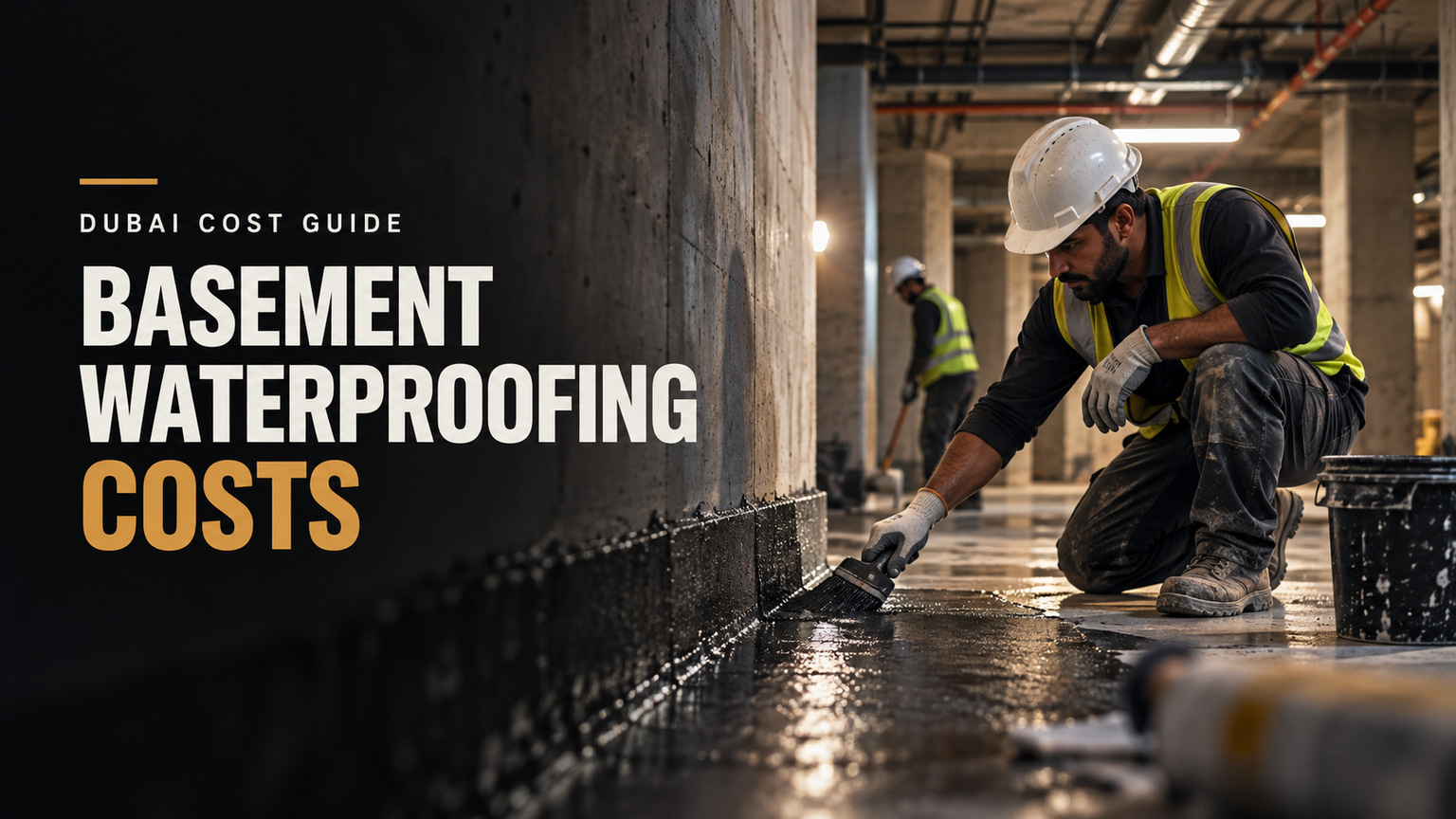

Basement Waterproofing Cost in Dubai: Prices and Quote Comparison
Quick Answer
Basement waterproofing in Dubai has no single fixed price. One 2026 UAE guide lists AED 40–100/m², while a Dubai contractor lists AED 130–300/m² for a different tanking scope. Crack injection, excavation, and repairs may cost extra. Your final price depends on water ingress, treated area, access, materials, and the work included.
Key Takeaways
Basement waterproofing quotes can differ even for buildings of similar size. These findings show which costs deserve attention before you choose a system or contractor.
- Published 2026 guides range from AED 40–100/m² for UAE-wide basement waterproofing to AED 130–300/m² for differently scoped Dubai tanking work.
- Measure the wall and slab surfaces that need treatment; basement floor area alone can give a misleading estimate.
- Cracks, joints, and active leaks may need separate injection work priced by linear metre or individual repair item.
- New basements allow exterior waterproofing before backfilling, while existing buildings may need internal treatment or costly excavation.
- Concrete repairs, protection boards, screeds, failed-coating removal, and finish reinstatement can add substantial costs.
- Compare contractor quotes using the same quantities, materials, testing scope, exclusions, VAT treatment, and written warranty terms.
- Groundwater conditions and applicable Dubai material approvals should guide system choice before price becomes the deciding factor.
The best comparison starts with a clear scope of work. Once each contractor prices the same needs, the difference between their totals becomes far more useful.
Basement Waterproofing Cost in Dubai: Published Price Ranges
Published basement waterproofing prices in Dubai vary by system and work scope. Basic treatment on sound concrete differs from full tanking or active leak repair. Access, preparation, protection, and testing also change the amount charged.
The table compares six published 2025–2026 commercial estimates. Each rate retains its original unit and market. These are planning figures, not official Dubai prices or Crown Edge quotations. The sources do not describe identical work, so their figures should not be averaged.
| Waterproofing work | Published indicative price | Market and timeframe | Scope and pricing limitation | Published source |
|---|---|---|---|---|
| General basement or retaining-wall waterproofing. | AED 40–100/m². | UAE, June 2026. | Broad estimate; materials and preparation vary. | QuotesDone UAE waterproofing cost guide. |
| Crystalline or cementitious basement treatment. | AED 70–120/m². | Dubai-focused, 2026. | Internal treatment; inspection affects scope. | DryGuard basement waterproofing guide. |
| More complex, injection-heavy basement treatment. | About AED 100–150+/m². | Dubai-focused, 2026. | Treated-area guidance; extensive repairs may cost more. | Same DryGuard guide cited above. |
| Basement or retaining-wall tanking. | AED 130–300/m². | Dubai contractor guide. | Sound-substrate assumption; some corrective work costs extra. | Abdulla Carpentry waterproofing rate table. |
| Basement or foundation tanking. | AED 30–70/ft². | Dubai, 2025–2026. | Different unit and work assumptions. | Fit Out and Renovation pricing guide. |
| Basement tanking in Deira. | AED 25–50/ft². | Deira, Dubai, 2026. | Marketplace estimate; full quote basis is undisclosed. | Biddaro Deira cost estimate. |
Use the rate closest to your proposed treatment for early budget planning. Then check its exclusions. A contractor offering AED 80/m² for a membrane layer may not include the protection, leak repairs, or floor reinstatement another contractor has priced.
Units also need care. One square foot equals 0.09290304 square metres. Thus, AED 30–70/ft² converts to about AED 323–753/m². This calculation changes only the unit. It does not make the underlying services comparable.
A useful budget needs more than the lowest published figure. Request a measured scope, named waterproofing system, and separate rates for major repairs. Published rates can help you question a quotation, but they cannot establish a reliable Dubai-wide median.
Estimate Your Basement Waterproofing Budget
Measure the surfaces that will actually receive waterproofing. Then add the repairs and supporting work that the chosen system needs. This approach gives a better starting point than multiplying the basement floor area by one market rate.
For existing buildings, the first inspection should also identify the likely water source. A damp wall may need different work from a failed construction joint. Pricing either problem before diagnosing it risks missing the main repair.
Measure Walls, Slabs, Cracks, and Joints
Wall area can be estimated from the treated perimeter and height. Measure the slab area on its own. Cracks, construction joints, and special details need separate quantities where the contractor prices them individually.
Consider a hypothetical rectangular basement measuring 10 m by 8 m. Its floor covers 80 m², and its perimeter measures 36 m. Treating every wall to a height of 2.5 m gives 90 m² of gross wall area. Including the full floor creates 170 m² of potential treatment.
That is more than twice the floor area alone. The difference could cause a major budgeting error if walls are part of the specified work.
These are sample dimensions, not a diagnosis. A real plan may treat only selected walls. Openings, changes in level, and inaccessible surfaces also affect quantities. The final measurement must follow the proposed system and the agreed measurement rules.
Record cracks and joints in linear metres where appropriate. A 4 m leaking joint is not the same work as 4 m² of coating. Injection may involve drilling, packers, resin, inspection, and more than one sealing stage.
Pipe penetrations, wall-floor junctions, expansion joints, and pile heads can also need dedicated details. Count them separately when relevant. Their small surface area does not always reflect the care needed to seal them.
Build an Itemised Cost Estimate
The estimate should show distinct work packages. A bill of quantities, or BOQ, lists each item, its measured amount, and the agreed rate. This lets contractors price the same project without hiding major costs inside a vague lump sum.
Estimated project cost = area waterproofing + crack and joint repairs + concrete repairs + detailing + protection and reinstatement + access or excavation + testing + site costs + applicable tax.
The following cost framework separates the main measurement types. It is not a blank price worksheet. It shows how each part should be measured and what changes its cost.
| Cost component | Measurement basis | Main cost driver |
|---|---|---|
| Wall waterproofing. | Treated m². | Wall height, access, and system. |
| Slab waterproofing. | Treated m². | Area, surface condition, and detailing. |
| Crack and joint repair. | Linear metres or repair items. | Leak activity, resin, and repair stages. |
| Concrete repair. | Measured area or defined repair item. | Defect depth and repair method. |
| Corners and penetrations. | Linear metres or item count. | Number and type of special details. |
| Protection boards and screeds. | Applicable m². | Layer type, thickness, and extent. |
| Excavation and access. | Defined work package. | Depth, space, safety, and reinstatement. |
| Finishing work. | Measured surfaces or items. | Removal and replacement scope. |
| Inspection and testing. | Defined test and record package. | System and project acceptance needs. |
| Site costs and tax. | Itemised amounts. | Mobilisation, restrictions, and tax treatment. |
Area and linear repairs should remain separate in the BOQ. That distinction also helps when hidden defects emerge. You can then price a new repair item instead of accepting an unexplained rise in the whole contract.
Using the hypothetical 170 m² and a published planning rate of AED 70/m² gives AED 11,900. This is arithmetic only, not a contractor estimate. It assumes the same treatment and rate apply to every measured surface. It excludes unpriced repairs, access, protection, and other project costs.
A more reliable quote replaces those assumptions with inspected quantities and suitable systems. Ask the contractor to explain each major item before accepting the total.
What Makes Basement Waterproofing More Expensive?
Active water, damaged concrete, restricted access, and protection work can drive costs far beyond a basic coating rate. A small basement with several leaking joints may require more specialist labour than a larger, sound basement under construction.
The main question is what must be repaired before the waterproofing system can work. The answer determines both the method and the amount of supporting work.
Water Pressure, Active Leaks, and Concrete Defects
Dampness and flowing water are different problems. A sound wall with light seepage may suit an appropriate area treatment. Water escaping through a joint under pressure may need targeted work first.
For instance, Sika Injection-101 RC product guidance describes a water-reactive polyurethane material for temporary control of high water intrusion. It is not presented as a complete permanent sealing solution.
The manufacturer also provides Sika Injection-107 guidance for permanent watertight sealing of suitable water-bearing cracks and joints.
These products illustrate an important difference. Stopping visible water flow may be one stage. Achieving a lasting seal may need another. Neither product should be selected solely from a price list.
Ask an injection contractor to identify the defect and expected water conditions. The proposal should name the resin, explain the treatment stages, and state how the completed repair will be checked. Not every damp basement needs injection, and not every crack needs the same resin.
Preparation, Protection, and Reinstatement
The membrane itself may be only one part of the cost. Surface preparation, protection, and finishing can have separate rates. Buyers who compare membrane-only pricing with a complete package may mistake missing work for savings.
A 2025 Al Garhoud substructure quotation provides a useful illustration. The third-party-hosted document lists distinct prices for membrane and protective layers. It is one project quotation, not a verified market average.
| Project quotation item | Listed rate | Purpose |
|---|---|---|
| Horizontal SBS membrane. | AED 80/m². | Horizontal waterproofing layer. |
| Vertical SBS membrane. | AED 75/m². | Wall waterproofing layer. |
| Protection board. | AED 38/m². | Protection where specified. |
| 50 mm protective screed. | AED 47/m². | Protective layer where specified. |
Where the listed horizontal membrane and screed both apply, their rates total AED 127/m² before other work. This is a limited calculation from one quotation. It does not establish a complete installed price. The board, screed, and membrane must each be counted only where the design calls for them.
Existing basements may need damaged paint, tiles, or failed coatings removed first. Exposed concrete can reveal honeycombing or other defects. Any required repairs should be assessed and priced as early as practical.
Floor work can add another stage. Some projects need protective screeds, corrected drainage falls, or new finishes. Crown Edge’s floor screeding services provide a related service reference. The waterproofing proposal must still define the actual screed type and thickness.
Excavation and Restricted Access
An exposed wall is easier to reach than one buried beside a building. Repairing an external membrane may require excavation, safe temporary works, access, protection, backfilling, and surface restoration. Buried services and nearby structures can make the job harder.
Internal work has its own limits. An occupied parking basement may need protected work zones, staged access, debris control, and restricted working hours. Those site needs affect labour and scheduling even without excavation.
External repair costs are often too site-specific for a useful universal square-metre rate. Ask for measured excavation and reinstatement quantities where possible. If contractors propose internal repairs instead, compare their technical suitability before comparing totals.
New-Build vs Existing Basement Waterproofing
New construction allows waterproofing to be planned before walls are buried. Existing buildings often lose that access. Their repair cost can depend more on the leak path and site constraints than on total wall area.
The comparison below separates the main project conditions. It shows possible system categories and cost drivers, not automatic design choices. The right treatment must follow an assessment of water exposure, concrete condition, and access.
| Basement condition | Access and possible method | Main cost considerations |
|---|---|---|
| New-build walls and slabs. | Exterior or pre-applied membranes; suitable integral systems. | Membrane details, joints, protection, and site coordination. |
| Existing internal dampness. | Assess suitable internal treatments. | Surface preparation, water pressure, and finishes. |
| Existing active cracks or joints. | Targeted injection and later sealing where needed. | Defect length, resin, access, and repair stages. |
| Existing failed exterior membrane. | Assess excavation or feasible internal alternatives. | Excavation, repair, backfill, and reinstatement. |
| Deep or high-pressure basement. | Project-specific waterproofing design. | Groundwater, joints, continuity, and drainage. |
The main price difference is often access. A new-build membrane may be placed as part of planned construction. Reaching the same side of a finished wall could mean opening soil, removing finishes, or disturbing other work.
A Fosroc overview of building waterproofing systems distinguishes approaches for shallow and deep basements, including different water-table conditions. It supports system selection by exposure rather than price alone.
Internal treatment can reduce the need for excavation. Yet a low-cost coating is not suitable merely because it is easy to apply. The proposed system must address the expected water pressure and the actual route of ingress.
A Dubai Project Shows Why Details Matter
The Fosroc Al Habtoor Palace Dubai case study describes basement waterproofing that included joints, pile caps, and pile-head treatment. It gives a practical example of system continuity across more than flat wall surfaces.
Water can enter through a weak construction joint while nearby membrane areas remain intact. Treating only the visible flat surface may leave the source of ingress unresolved.
The case study does not publish an installed project price. Its value is technical, not financial. It shows why a quote should name junctions, penetrations, and other special details instead of relying only on treated square metres.
For a new project, those details can be planned with the structural work. For an existing basement, tracing them may require inspection and targeted opening work. The quote should make that difference clear.
Choose the Right Waterproofing Method Before Comparing Prices
Choose the waterproofing method after identifying the leak, water exposure, and available access. First decide where water is entering. Then assess groundwater conditions and the concrete structure. Next, identify systems that can meet the required protection level. Only compare prices once contractors have proposed technically suitable solutions. A cheaper coating and a complete membrane system are not equivalent simply because both are priced per square metre.
Sheet Membranes and Integral Waterproofing
Sheet membranes form a barrier around specified parts of a basement. Seams, edges, penetrations, and changes in direction need suitable treatment. A break in continuity can create a route for water even if the main membrane areas remain sound.
SikaProof P-1201 system information describes a fully bonded sheet waterproofing system for below-ground concrete walls and slabs. It illustrates the type of system used against groundwater ingress.
Material product data does not establish the installed cost. Labour, surface condition, joints, detailing, and protection remain part of the quotation. The contractor should state the complete system build-up and its intended location.
Integral waterproofing takes another approach. It uses a waterproofing system within the concrete construction rather than relying only on a separate external membrane. Product choice, concrete design, joints, and local approvals still matter.
For new construction, an integral system may be considered within the wider structural and waterproofing design. For an existing leaking building, injecting cracks or adding an appropriate repair system may be more relevant than discussing integral materials intended for new concrete.
Crystalline Treatments and Injection Repairs
Crystalline and cementitious treatments can protect suitable concrete surfaces. Their purpose and application differ from targeted injection into cracks and joints.
A coating may cover a large area measured in m². Injection treats specific paths of water movement. The contractor may price it by linear metre, repair location, or defined package. These methods cannot be compared through material cost alone.
A Palm Jumeirah repair BOQ hosted on Scribd illustrates the difference. The document lists crystalline treatment at AED 48/m², polyurethane crack injection at AED 340 per linear metre, and a provisional curtain-injection item at AED 1,367/m².
The underlying BOQ dates from October 2023. It concerns specialist work and comes from a third-party document host. These figures should not be treated as 2026 consumer prices. They show why the repair method and pricing unit need to appear beside each rate.
A leaking construction joint could require several injection stages. A sound wall needing area treatment may involve a very different process. The quote should explain the condition being treated and the expected result, not simply name the cheapest material.
High Groundwater Pressure and Complex Basements
High groundwater exposure makes system selection more demanding. Joints, penetrations, slabs, and walls must work together. A locally repaired crack may not solve widespread ingress if the underlying design has other weak points.
BS 8102:2022 from the British Standards Institution addresses protection of below-ground structures against water ingress. Its scope includes barrier waterproofing, structurally integral watertight construction, and drained-cavity methods.
A drained-cavity system manages collected water through designed drainage. It differs from trying to block all water with a coating. Its full cost may include channels, collection points, pumps where specified, access for maintenance, and supporting electrical work.
BS 8102 is a UK code of practice. It is a useful technical reference, but it does not automatically replace Dubai approval or project design rules.
For complex basements, request a design that accounts for expected water exposure and intended building use. Compare the total installed systems, including their ongoing maintenance needs where relevant. A low coating rate alone cannot establish technical suitability.
Compare Basement Waterproofing Quotes Without Missing Costs
A fair quote comparison starts with equal work scope. Give contractors the same inspection findings, treatment quantities, water conditions, and expected result. Ask them to explain any difference in proposed method.
The most useful comparison is not always between the lowest totals. It is between complete proposals that address the same problem. A quote missing injection, testing, or reinstatement needs further review before its price can be judged.
Contractor Quote Comparison Checklist
Use the following checklist as a procurement tool. Its purpose is to confirm technical and commercial coverage, not to calculate quantities already shown in the cost framework.
Site diagnosis and treatment extent
- Confirm the location and likely cause of each leak.
- Classify visible conditions as dampness, seepage, or active water flow.
- Confirm treated wall and slab areas in m².
- Measure cracks and joints in linear metres where relevant.
- Identify penetrations, corners, and other special details.
Proposed materials and work
- Name the waterproofing system and manufacturer.
- State the specified membrane thickness or coating build-up.
- Define cleaning, preparation, and failed-coating removal.
- Identify concrete repairs and honeycomb treatment.
- Specify injection resin and the planned repair stages.
- Include joints, corners, and penetration details where needed.
Protection and access
- Confirm required boards, screeds, and protection layers.
- Define excavation, drainage, and backfilling where needed.
- Include access equipment and restricted working conditions.
- State how debris and damaged finishes will be handled.
Testing and commercial terms
- Define suitable inspections and acceptance tests.
- Request product information and work records at handover.
- Confirm mobilisation fees and minimum job charges.
- Identify exclusions and rates for unforeseen work.
- Show VAT and other site charges clearly.
- Record work dates, payment stages, and access limits.
- Obtain written warranty coverage and exclusions.
A detailed lump-sum quote can still be acceptable. It should explain enough of the included work to support a fair comparison. Missing items should be clarified in writing before approval.
Check Warranty Scope, Not Just Duration
A long warranty may offer little protection if key leak paths fall outside its scope. Review the work covered, conditions, claim process, and available remedy.
Ask whether treated cracks and joints are included. Check exclusions for later drilling, structural movement, or leaks from new sources. These terms can differ between contractors and between systems.
Completion records also matter. Request material details, inspection findings, test records where applicable, and the final repair locations. Such evidence can help identify what was done if a covered problem returns.
Do not assume any particular warranty duration or coverage applies across Dubai contractors. The actual written terms should form part of the commercial comparison.
Compare Two Hypothetical Quotes
Consider two proposals for the same existing basement. Both contractors have inspected a leaking wall-floor joint and damp wall surfaces. Neither quote has a stated price here. The comparison tests completeness without inventing market rates.
| Comparison point | Hypothetical Quote A | Hypothetical Quote B | Buyer consequence |
|---|---|---|---|
| Wall treatment. | Covers measured wall area. | Covers the same wall area. | Area quantities are comparable. |
| Active joint leak. | Excludes injection. | Includes defined joint injection. | Quote A omits a known defect. |
| Surface preparation. | Basic cleaning only. | Includes defined concrete repair. | Scope differs before treatment. |
| Waterproofing details. | Corners not separately described. | Corners and penetrations defined. | Quote A needs clarification. |
| Protection. | Excludes protective screed. | Includes specified protective screed. | Reinstatement obligations differ. |
| Testing. | Visual check only. | Includes specified inspection records. | Acceptance evidence differs. |
| VAT and site charges. | Listed separately. | Listed in total. | Totals need a common tax basis. |
| Warranty. | Duration stated; exclusions unclear. | Written coverage and exclusions supplied. | Risk allocation differs. |
Quote A is not necessarily a poor proposal. But its omissions prevent a fair total-price comparison. The buyer must either request the missing work or confirm why the contractor believes it is unnecessary.
Quote B includes a wider scope. Its value still depends on a suitable design, competent work, and clear terms. Once the technical needs match, buyers can compare rates, schedules, and warranties with greater confidence.
Dubai Waterproofing Standards and Approvals
Dubai approval conditions can affect the waterproofing system selected for a project. They do not establish a fixed market price for basement work. Product acceptance and correct system design are separate matters.
Dubai Municipality Circular 8-2-1, dated 23 August 2021 permits qualifying integral waterproofing systems for concrete building elements, including substructures, without a concurrent rubberized bitumen or membrane system. The allowance depends on the stated conformity and Building Permits Department approval conditions.
This is not blanket approval for all integral products. Nor does it mean a project can omit joint details or other needed protection. The consultant and contractor must confirm the correct approval route and design for the proposed work.
Dubai Municipality also provides a Technical Approval process for applicable building products. Depending on the product and approval route, this may involve review of product properties, tests, or demonstrations.
For a buyer, the main task is documentary. Request the named product, system build-up, applicable conformity evidence, and approval information required for the project. If a contractor substitutes a different material, confirm that the change remains acceptable before work proceeds.
Technical acceptance should also cover how the system is fitted. A suitable material can still fail to protect a basement if joints, penetrations, or surface preparation are poorly handled. Ask who will inspect those details and what evidence will be supplied at completion.
Frequently Asked Questions
These answers cover common pricing and repair questions that arise before a site inspection. They should be used with the scope and system guidance above, rather than as fixed quotations.
How much does it cost to waterproof a basement per square metre in Dubai?
Published figures differ by scope. One UAE-wide 2026 guide lists AED 40–100/m², while a Dubai contractor guide lists AED 130–300/m² for basement tanking under stated assumptions. They do not establish one market range. A useful price needs measured work and a suitable treatment plan.
Is internal basement waterproofing cheaper than external waterproofing?
Internal work can avoid excavation around an existing building. Yet injection, concrete repairs, and specialised internal systems can add costs. Confirm that each approach can meet the required protection level before comparing prices.
Is crack injection included in basement waterproofing prices?
It depends on the quotation. Some rates cover area treatment only. Injection may be priced per linear metre, defect, or repair package. Ask for the measured quantity, method, and included stages.
Can basement waterproofing be priced from floor area alone?
Floor area rarely provides enough information. Treated wall area, cracks, joints, penetrations, and ancillary work can add major costs. Measure the surfaces and details named in the proposed work scope.
Does waterproofing cost include removing damaged finishes?
Removal and reinstatement may be separate charges. Request clear prices for stripping coatings, tiles, plaster, or flooring where needed. The proposal should also define how those surfaces will be restored.
How long does basement waterproofing take?
Duration depends on area, access, repairs, curing, and testing. A small targeted leak repair differs from a full basement system. Ask for a schedule showing preparation, treatment, inspection, and reinstatement.
Is a waterproofing membrane always needed in Dubai basements?
Different projects may use membranes, qualifying integral systems, suitable internal treatments, or combined methods. The choice depends on the structure, groundwater, design, and applicable approvals. No single method fits every basement.
Should I repair a basement leak before repainting?
Find and treat the water source first. Paint alone will not seal an active crack or failed joint. Repainting before repair can hide continuing moisture and lead to further finish damage.
Get a Basement-Specific Waterproofing Assessment
A reliable quotation starts with a site assessment and measured treatment scope. Record visible leaks, damaged finishes, access limits, and known repair history. Ask each contractor to explain the likely water source and proposed remedy.
For a Dubai project, Crown Edge provides waterproofing works and basement waterproofing services. Its service information can serve as a starting point for discussing inspection and treatment needs. The public service information does not establish a fixed price or project-specific warranty.
Request an itemised proposal covering the selected system, quantities, repairs, detailing, protection, testing, and finishing work. Keep exclusions and warranty conditions in writing. Then compare competing proposals against the same scope.
For related property-care topics, the Crown Edge blog is an additional browsing resource. It is not a substitute for a basement-specific technical assessment or quotation.
The goal is a suitable waterproofing system with a complete, clear, and accountable work scope. A lower price becomes meaningful once it covers the work your basement actually needs.