

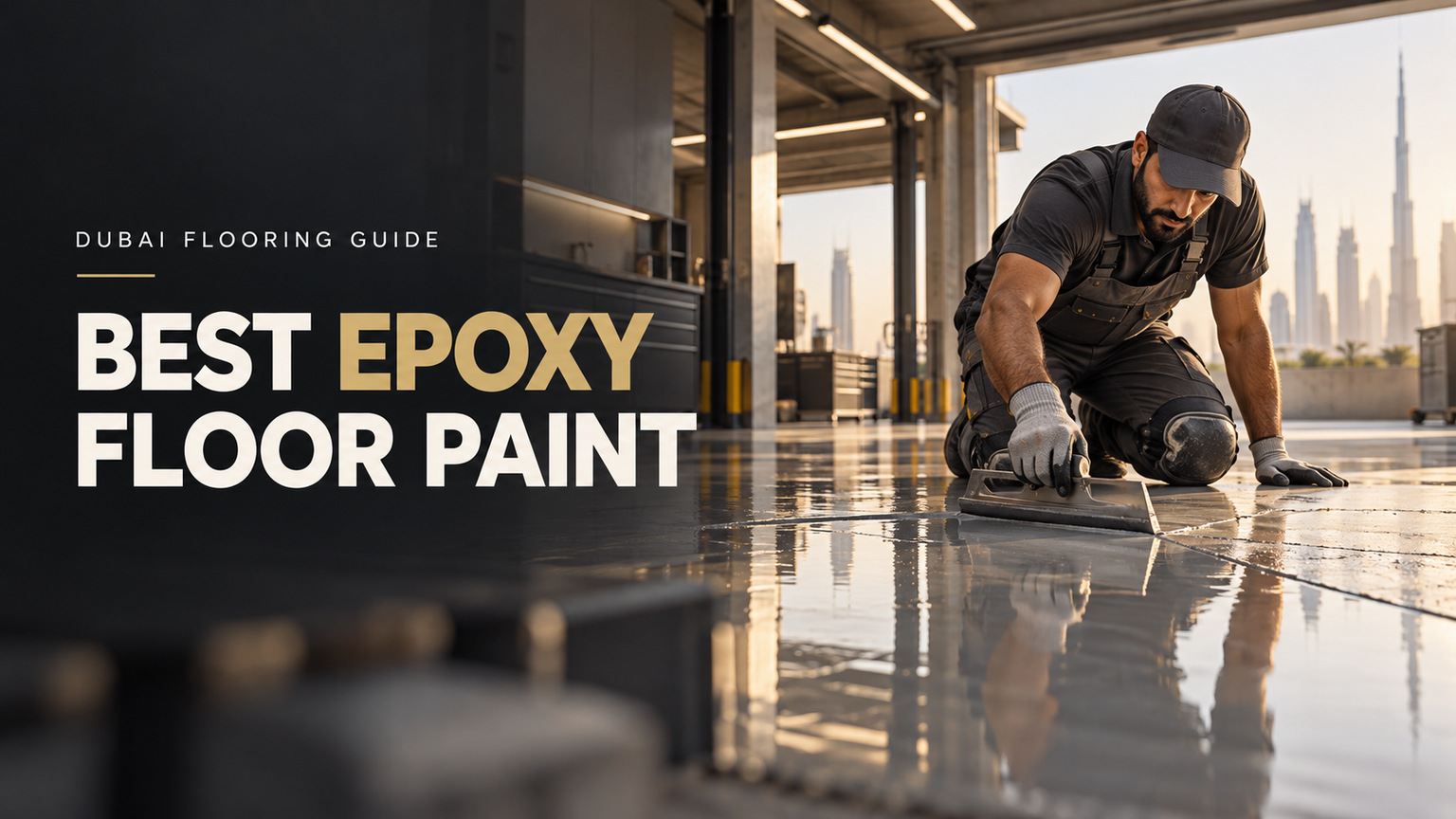

Best Epoxy Floor Paint in Dubai: What to Choose and Why
Quick Answer
The best epoxy floor paint in Dubai depends on the floor’s use and condition. A two-part epoxy topcoat can suit light-duty indoor floors, while busy garages and workshops may need a tougher coating system. Heavy traffic, moisture, chemicals, wet surfaces, and direct sunlight can all change the right choice.
Key Takeaways
Choosing epoxy floor paint starts with how the floor will be used. These seven points help narrow the options before you buy materials or request a quote.
- Light-duty indoor concrete can suit a two-component epoxy topcoat when the surface meets the product’s needs.
- Garages and workshops may need a high-solids epoxy coating designed for greater wear and chemical exposure.
- Heavy warehouse traffic calls for a full flooring system assessment, not a basic paint choice.
- Concrete moisture, surface strength, cracks, and old coatings must be checked before epoxy work starts.
- Direct sunlight can change epoxy colour, so a compatible UV-resistant finish may be a better choice.
- The UAE Sikafloor-264 datasheet specifies +10°C to +35°C application temperatures for that product, not all epoxy paints.
- Contractor quotes should state floor preparation, coating layers, thickness, curing limits, and the work included in the price.
The main decision is about the whole floor, not the paint tin. Start with traffic and exposure. Then check the concrete and compare the full coating systems.
Choose the Right Epoxy Floor Paint for Your Space
The best coating for a villa walkway may be the wrong one for a busy garage. Floor use comes first. Think about weight, wheels, spills, sunlight, and how often the area gets wet. A sound product choice must also suit the concrete beneath it.
Use this matrix to narrow the options. The products shown are manufacturer examples, not independent winners. Each row assumes the floor can meet the chosen system’s preparation and application needs.
| Floor use | Suitable coating choice | Product example | Main check |
|---|---|---|---|
| Indoor walkways and light-use rooms | Two-part epoxy topcoat. | Jotafloor Topcoat. | Foot traffic and surface condition. |
| Garages and workshops | Higher-performance epoxy coating. | Jotafloor EP Coating. | Tyres, wear, spills, and coating build-up. |
| Heavy-use warehouses | Engineered industrial resin floor. | No universal product choice. | Wheel loads, impact, wear, and thickness. |
| Wet service areas | Textured epoxy system with suitable aggregate. | Sikafloor-264 system options. | Slip testing, cleaning, and drainage. |
| Sun-exposed concrete | Compatible UV-resistant floor finish. | Jotafloor PU Topcoat HS, a polyurethane. | UV exposure and system compatibility. |
The main split is between routine use and demanding use. A basic topcoat may do its job well on a walkway. Forklift routes and harsh spills need far more care. Crown Edge’s epoxy flooring services in Dubai include several system types. The floor’s use should guide which type is assessed.
Light-duty floors and pedestrian areas
A two-part epoxy topcoat is a sensible starting point for sound indoor concrete. This can include a plant room, service passage, or lightly used workshop. It gives the floor a coated finish without assuming it must carry heavy loads.
Jotun describes Jotafloor Topcoat as a light-duty epoxy product. Its stated uses include walkways and similar service areas. Those uses support a light-duty shortlist. They don’t prove that the same coating will stand up to constant heavy wheel traffic.
Check how the floor is cleaned and how often it gets wet. If people may walk through water or oil, the finish needs a separate slip review. A smooth, glossy floor isn’t always the safest surface.
Garages, workshops, and commercial floors
A garage may need more than a light-duty topcoat. Tyre contact, parked vehicles, tools, cleaning fluids, and moving loads can stress the coating. The exact demands vary from site to site.
Start with a higher-performance epoxy category. Ask for the full coating build-up, not just a brand name. That should cover surface prep, primer where needed, coat count, and target thickness.
A small villa garage and a busy car park need not use the same system. The first may face low daily traffic. The second can see constant wheel movement and harder wear. Choose based on the real duty, not the word garage alone.
Warehouses, wet zones, and exposed floors
Heavy loads can shift the choice beyond ordinary floor paint. A warehouse may have sharp turns, loaded wheels, impact, and repeat traffic on fixed routes. The system designer needs those details before choosing a finish.
Wet areas raise a different concern. Water, oil, and cleaning agents change how safe the surface feels underfoot. A textured finish may help, but it needs a suitable test and cleaning plan.
Sunlight brings another trade-off. Some epoxy finishes can change colour under direct UV exposure. If colour retention matters, review a compatible UV-resistant topcoat or another suitable exposed-floor system.
Epoxy Paint vs Industrial Epoxy vs Self-Leveling Floors
These terms describe different jobs. A coating adds a protective or decorative layer. A thicker resin system may form a wearing surface built for harder use. A leveling layer can correct the base before the final floor goes down.
The comparison below helps avoid a common mistake: buying a product because its name sounds right, without checking the full floor build-up.
| Floor system | Main role | Main buying risk |
|---|---|---|
| Light-duty epoxy topcoat | Coated finish for suitable low-wear concrete. | Too little protection for heavy use. |
| High-solids epoxy coating | Industrial coating for specified service demands. | Assuming all system builds perform alike. |
| Self-smoothing epoxy system | Resin wearing layer with a smooth finish. | Missing thickness and substrate needs. |
| Cementitious leveling layer | Corrects parts of an uneven base. | Treating the base layer as the finished epoxy floor. |
| Polyurethane topcoat | Finish with product-specific UV or wear properties. | Using an incompatible coating combination. |
The name alone says little about the final result. A contractor should state each layer and its role. A sound system also depends on the floor beneath it.
Thin coatings and higher-build floors
A thin epoxy coat can be useful on a sound, light-use floor. Yet it may offer too little protection where wear is severe. Higher-build resin floors use a more involved system. The right choice depends on the load and the maker’s approved build-up.
Thickness is not the only factor. Surface prep, bond strength, aggregate, and exposure all count. Two quotes can name epoxy while describing very different floors.
An uneven base needs its own review. Crown Edge offers self-levelling flooring solutions, while floor screeding services address another part of floor-base work. A cement-based leveling product should not be confused with a finished self-smoothing epoxy layer.
Where polyurethane fits
Polyurethane is not epoxy. It is a separate coating chemistry. It can still form part of an approved floor system when the products are compatible.
This choice matters on a floor exposed to sun. Some epoxy coats may discolour even when the coating still serves its main purpose. A UV-resistant polyurethane finish can be worth checking where the shade and look of the floor must stay stable.
Do not mix two brands or coating types based on a general claim about UV resistance. Ask for a system that the manufacturer accepts for the substrate, exposure, and intended use.
Product Examples Worth Comparing in Dubai
Jotun Jotafloor Topcoat, Jotafloor EP Coating, and Sika Sikafloor-264 are useful epoxy examples for Dubai buyers. Compare each product’s intended traffic, use class, surface needs, and full coating build-up. Sun exposure may also change the choice. Jotafloor PU Topcoat HS is a polyurethane option, not another epoxy paint. These products serve different jobs, so they cannot form a fair best-to-worst ranking without matched performance tests.
Jotun Jotafloor Topcoat: light-duty epoxy
Jotun’s Jotafloor Topcoat product information describes a two-component, polyamide-cured epoxy coating. Jotun lists uses such as walkways, stairs, plant rooms, and light-duty workshops.
That makes it a useful example for indoor spaces with modest wear. The product also has optional non-slip aggregate choices. These need to be specified as part of the floor finish, not assumed from the base paint.
A small service room may fit this use class. A busy loading route may not. Ask for written approval of the full system where the traffic is more demanding.
Jotun Jotafloor EP Coating: higher-duty epoxy
Jotun positions Jotafloor EP Coating as a high-volume-solids epoxy coating. Its listed uses include garages, workshops, car parks, factories, and plant rooms.
Jotun also describes abrasion and chemical resistance. Those are useful traits, but they need context. The type of spill, its concentration, its temperature, and its contact time all matter.
A workshop handling mild cleaning fluids has different needs from a chemical process area. Get the right chemical-resistance data before treating a general claim as proof.
For busy floors, ask about target coat thickness and surface prep. A product used in factories is not a promise that every possible factory floor will suit it.
Sika Sikafloor-264: a detailed technical example
Sikafloor-264 is a two-part epoxy used as a roller or seal coat. Its UAE-labelled data also covers specified self-smoothing and textured uses.
The Sika Gulf Sikafloor-264 product page sets out its intended flooring uses and system options. Slip-resistant finishes can be built with a suitable aggregate and coating method.
This product is useful because Sika gives clear figures. They cover material use, concrete needs, mixing, working time, and cure limits. The figures below apply to the cited UAE version of this product.
Sika lists a Part A to Part B mix ratio of 79:21 by weight. It also gives about 0.25–0.30 kg/m² for a roller coat. The ratio must be measured as the maker directs. Do not guess it by eye or use a ratio from another epoxy kit.
Jotafloor PU Topcoat HS: a UV-resistant option
The Jotafloor PU Topcoat HS product page describes a polyurethane coating with UV and weathering resistance.
It can be part of a comparison for exposed floors. It should not be called an epoxy floor paint. Nor should its UV claims be taken as approval for every outdoor slab or high-load floor.
The full system must suit the site. Check the base coat, topcoat bond, wear, sunlight, water, and planned cleaning method before approving the build-up.
Check the Concrete Before Buying Any Epoxy
A sound concrete base is vital. Even a costly coating can peel or lift if the slab is wet, weak, or dirty. Old paint, oil, dust, and loose areas can also hurt the bond.
Start with the base, not the colour. The checks below use Sika’s UAE-labelled Sikafloor-264 data as a worked example. They are not universal limits for all floor paints.
| Check | Sikafloor-264 example | Decision if the check fails |
|---|---|---|
| Concrete moisture | Below 4% by weight using stated methods. | Hold coating work and review moisture. |
| Rising moisture | None allowed. | Find and address the moisture cause. |
| Concrete strength | At least 25 N/mm² compressive strength. | Review slab soundness and repair needs. |
| Pull-off strength | At least 1.5 N/mm². | Review bond and surface condition. |
| Surface cleanliness | Sound, clean, and free from weak material. | Prepare or repair before coating. |
| Primer and layer fit | Follow the approved system. | Confirm the correct layer build-up. |
These values come from the December 2025, version 08.03, Sika Gulf product data sheet for Sikafloor-264. A different product can have different limits. Use the sheet for the actual supplied material.
Moisture and bond checks
Concrete can look dry while still holding too much moisture. Water within the slab may harm the bond after the coating goes down. New concrete, old slabs, and floors near damp areas all deserve care.
Ask which test was used and what result it gave. A number without its method is not enough. Moisture measured by weight differs from relative humidity measured inside the slab.
ASTM F2170-19a describes an in-situ relative-humidity test for concrete slabs. It does not set one safe RH limit for every epoxy product. Nor is it proof that this test is mandatory for every Dubai floor.
If a slab fails the chosen maker’s limit, don’t coat it just to meet a handover date. The cause and next step need a sound review.
Grinding, cracks, and old coatings
A new coating needs a sound bond. That often calls for mechanical prep, such as grinding, plus dust and dirt removal. Weak old coats need special care. So do oil stains, cracks, and loose concrete.
Cracks are not all alike. A stable hairline crack may need a different repair from an active joint. The repair should match the type of movement and the new floor system.
Crown Edge lists surface preparation and concrete repair services among its related work. Prep can form a large part of a sound epoxy job.
The primer decision also depends on the full system. Some approved Sika builds allow narrow exceptions under set conditions. That does not mean all epoxy can go onto bare concrete without primer.
A practical pre-coating decision
Treat the floor as ready only when the core checks pass. The concrete should be sound. Moisture must meet the chosen product’s limit. Repairs must be fit for coating, and the surface must be clean.
Then confirm that the primer and finish are approved together. If one major check fails, stop and resolve it. A rushed coating over a poor base can turn a low quote into a costly repair.
Plan Epoxy Work Around Dubai Heat
Heat can shorten the time available to work with mixed epoxy. High humidity and a damp surface can also affect fitting. Dubai projects need site checks, not just a claim that a product suits hot climates.
The December 2025 UAE Sikafloor-264 product data sheet, version 08.03, gives a clear example. It sets an air and substrate range of +10°C to +35°C. Relative air humidity must be no more than 80%. The base and uncured floor must stay at least 3°C above the dew point.
Dew point is the temperature at which moisture can form on a surface. A slab may be too close to that point even when the air feels warm. The actual floor temperature matters as much as the room reading.
Working time drops as temperature rises
Pot life is the usable time after the two epoxy parts are mixed. It is not the same as the time needed for the floor to cure.
The December 2025 UAE Sikafloor-264 data shows a clear change with heat. Approximate pot life is 45 minutes at +10°C, 20 minutes at +20°C, and 12 minutes at +30°C. The working window gets much shorter as the temperature rises.
That affects how much material a crew should mix at once. Larger batches may be hard to place before they become unusable. The contractor should follow the actual product method, not a fixed batch routine from another job.
Plan access around the cure schedule
A floor may be ready for walking well before full cure. That difference matters in garages, stores, and work areas that need to reopen.
The following figures come from Sika’s December 2025 UAE Sikafloor-264 product data sheet, version 08.03. They are approximate times under stated conditions. They are not a cure table for all epoxy paint.
| Temperature | Pot life | Foot traffic | Light traffic | Full cure |
|---|---|---|---|---|
| +20°C | About 20 minutes. | About 24 hours. | About 4 days. | About 7 days. |
| +30°C | About 12 minutes. | About 18 hours. | About 2 days. | About 5 days. |
A floor that can take foot traffic is not yet ready for every load. Avoid moving heavy racks or vehicles onto it just because walking is allowed.
The site manager should set a clear handover plan. Mark the area, restrict access, and state what use is allowed at each stage. Check the full system’s cure data before reopening the space.
Calculate Epoxy Floor Paint Quantity
Material use starts with floor area and the chosen product’s rate. Multiply the area in square metres by the stated kg/m² rate. Then account for each extra coat and the rest of the floor system.
For a Sikafloor-264 roller-coating example, the stated theoretical use is about 0.25–0.30 kg/m² for one layer.
Worked example: 100 m² of concrete floor.
100 m² × 0.25–0.30 kg/m² = 25–30 kg of theoretical material for one roller-coating layer.
This is a material calculation, not a full bill of quantities. It does not include primer, another coat, broadcast aggregate, floor repair, or site losses. The true order also depends on pack size and the approved system.
What changes material use?
Rough concrete can use more material than a smooth, sound surface. Repairs and uneven areas may change the area that needs work. A textured floor can also need aggregate and extra coats.
The method is just as important. The same product can have different rates for roller and self-smoothing use. The cited Sika data, for example, lists about 0.9–1.2 kg/m² for a self-smoothing wearing-course application. That is a separate use case from the roller coat.
Do not choose the lowest rate simply to cut the purchase cost. The selected thickness and full system must suit the floor’s service needs.
Material weight is not installed cost
A quote covers more than resin. Surface grinding, crack repair, primer, labour, access, and cure time may all add cost. The same floor area can need very different work on two sites.
A clean, sound room may need far less prep than an old workshop floor with oil and weak concrete. Comparing material prices alone hides that gap.
Compare Contractor Quotes by the Work Included
The lowest epoxy quote is not always the best-value floor. First make sure each contractor is pricing the same job. A low figure may leave out grinding, repairs, primer, or a needed topcoat.
Use one written scope for all bidders. It should state the floor’s use and the result required. A clear scope makes both cost and risk easier to compare.
What a useful epoxy flooring quote should show
A sound quote should cover the full path from the old slab to the finished floor. Use this list to check whether the main items are present.
- State the measured floor area in m² and its planned use.
- Name the coating maker, exact products, and approved layer build-up.
- Describe the surface prep method and any removal of old coatings.
- List the treatment of cracks, joints, weak areas, and other defects.
- Give the primer, coat count, and target coating thickness.
- State the slip finish or aggregate where the floor may get wet.
- Confirm how moisture and bond strength will be checked.
- Identify relevant chemicals, heat, tyre use, and sunlight exposure.
- Show site temperature limits and the planned work schedule.
- State foot-traffic, vehicle-use, and full-cure handover times.
- Itemise the AED price, exclusions, and applicable warranty terms.
A quote need not use complex language to be useful. It does need to name the work. A single line for epoxy floor painting gives the buyer very little to compare.
Why two prices can differ so much
One bidder may price a light-duty roller coat over a ready slab. Another may include grinding, repairs, primer, and a thicker resin system. Both may call the result epoxy flooring.
Those are not equal offers. Ask the bidders to explain the differences before judging price. If a contractor proposes a cheaper system, ask what duty it can serve and which work has been removed.
There is no sound Dubai-wide price range in the verified source set used here. A real AED/m² comparison needs current local quotes for the same floor area, condition, and finish.
Questions to ask before approval
Ask for the exact product data. Confirm the coating is fit for the intended traffic and spills. Request the surface prep plan and the curing limits in writing.
If the floor will see sun, ask how colour change will be handled. In wet areas, request the planned texture and slip criteria. For heavy wheels, ask for the full resin system and load basis.
Good answers should point to the proposed products and work scope. They should not rely on broad promises such as heavy duty or lifetime protection.
Common Questions About Epoxy Floor Paint
A product comparison still leaves three decisions for Dubai buyers. First, can the existing concrete take the proposed coating? Next, will the floor face light use, heavy wheels, water, chemicals, or direct sun? Finally, how long must the space stay closed, and what work is included in the price? The answers below help separate a simple paint job from a floor that needs a more detailed system plan.
What epoxy floor paint is best for a Dubai garage?
A higher-performance two-part epoxy coating is a useful category to assess. Garage traffic, parked loads, tyre contact, spills, and slab condition shape the choice. Check the maker’s approved system before buying. A light-use villa garage may need less than a busy shared car park.
Is one-part floor paint as durable as two-part epoxy?
A two-component epoxy combines resin and hardener to form the coating. One-part floor paints can use different binder types and curing methods, depending on the product. A fair durability comparison needs matched products and test data. Do not judge performance by part count alone. Follow the maker’s stated use class and site limits.
Can epoxy floor paint go over old concrete?
Yes, if the old concrete is sound and can meet the chosen system’s needs. Moisture, dirt, grease, weak areas, cracks, and old paint can block a good bond. The floor may need grinding, repairs, or a suitable primer before coating.
How long does epoxy floor paint take to cure in Dubai?
Cure time varies by product and site temperature. For the UAE Sikafloor-264 example, full cure is about seven days at +20°C and five days at +30°C. Walking and light traffic may be allowed sooner. These are product-specific times, not a rule for all epoxy floors.
Will epoxy floor paint turn yellow in sunlight?
Some epoxy coatings can change colour under direct sunlight. The cited Sikafloor-264 data warns of possible colour change without necessarily reducing its main function. A compatible UV-resistant polyurethane finish may be a better choice where colour retention matters. Check the full system before use.
Is epoxy flooring suitable for wet areas?
It can be, with the right finish and site controls. Smooth epoxy can be slippery when wet. An approved textured system may help. The right aggregate, cleaning plan, footwear, and slip test depend on the area. Do not assume every anti-slip label fits every wet floor.
Can epoxy floor paint handle warehouse traffic?
Some engineered epoxy flooring systems can suit industrial work. Ordinary light-duty paint may not. Wheel load, turning, impact, spills, and wear paths must be reviewed. Ask for a complete system plan and the maker’s relevant performance data.
How much does epoxy floor paint cost in Dubai?
Price depends on the floor size, base condition, system thickness, layer count, prep, and finish. The actual scope matters more than a broad online rate. Get itemised local quotes for the same work. That is more useful than an unsupported single AED/m² figure.
Make the Final Flooring Choice
Choose the coating type that fits the floor’s daily work. Then check the concrete and the site conditions. A product name or low material price is not enough.
For a light-use room, a suitable epoxy topcoat may be all that is needed. A garage or workshop may call for a higher-duty system. Wet areas, harsh chemicals, heavy wheels, and direct sun deserve their own checks.
Ask the contractor to state the full system and work scope. Confirm surface prep, thickness, cure limits, and any limits on use. Keep the chosen product data with the quote.
For projects in Dubai, Crown Edge can be considered for a professional floor assessment and a suitable epoxy flooring proposal. A clear review of the base and intended use is the right place to start.