

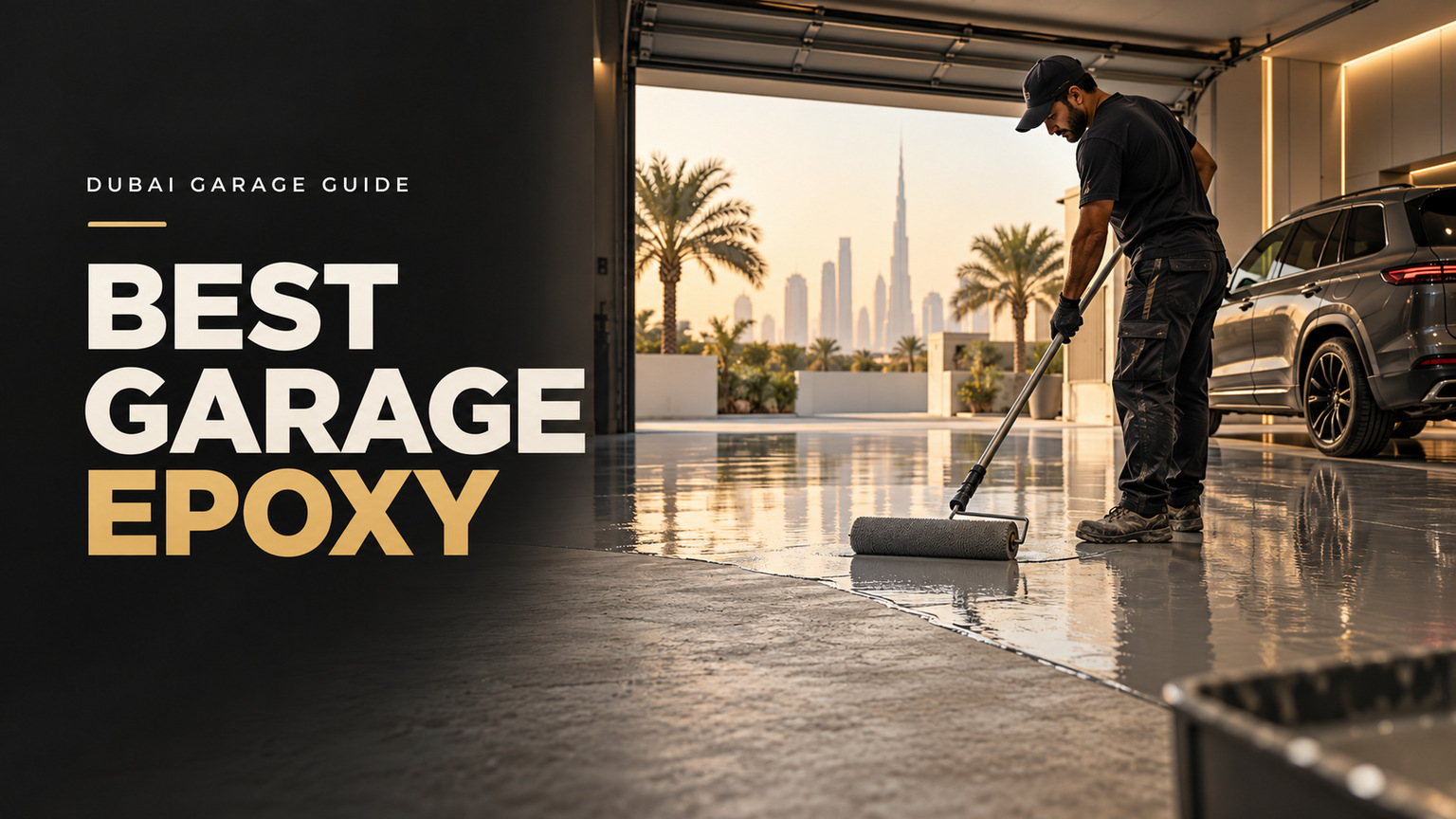

Best Epoxy for Garage Floors in Dubai: Types and How to Choose
Quick Answer
The best starting choice for a sheltered Dubai home garage is a two-component, garage-rated epoxy coating on sound, suitably dry concrete. Choose thicker self-levelling epoxy for greater floor build or demanding use. Sun-exposed areas may need a compatible UV-resistant finish. Concrete moisture, preparation and vehicle traffic must guide the final system choice.
Key Takeaways
The right garage floor depends on more than the type of resin. These seven findings help Dubai property owners compare suitable systems and avoid costly mistakes.
- A two-component epoxy coating approved for vehicle traffic is a sound starting choice for most sheltered residential garages in Dubai.
- Self-levelling epoxy offers a thicker, seamless finish, but extra thickness does not guarantee longer service life.
- Garage entrances exposed to direct sunlight may need a manufacturer-approved UV-resistant polyurethane finish to protect colour and gloss.
- Concrete cracks, oil contamination, old paint and weak surfaces must be assessed before choosing an epoxy system.
- Moisture testing must follow the chosen manufacturer’s acceptance rules, not a single humidity limit applied to every epoxy.
- Hot-tyre resistance, wet-floor traction and chemical resistance are product-specific features that buyers should check separately.
- Dubai garage epoxy quotations should identify the complete coating system, preparation work, film thickness, curing rules and total cost.
For most home garages, start with vehicle suitability and concrete condition. Choose a heavier system only when the floor’s use supports that choice. A clear written scope matters more than an impressive product label.
Best Garage Epoxy by Use Case
The right epoxy depends on traffic, sunlight, floor condition and finish needs. A covered villa garage has different demands from a busy repair workshop. Open entrances also need more care than fully sheltered spaces. The selection matrix below identifies the starting system for each setting. It is a buying guide, not an independent ranking of brands.
| Garage condition | Recommended system category | Main approval check |
|---|---|---|
| Sheltered home garage | Two-component garage-rated epoxy coating. | Sound concrete and approved vehicle traffic. |
| Decorative or demanding garage | Self-levelling epoxy. | Approved thickness, preparation and traffic use. |
| Sun-exposed entrance | Compatible epoxy with UV-resistant finish. | Weathering, traffic and layer compatibility. |
| Busy workshop | Heavy-duty epoxy or specialist epoxy screed. | Loads, impact and chemical exposure. |
| Light-to-medium traffic with water-based preference | Suitable two-component water-based epoxy. | Published performance and confirmed UAE availability. |
| Damp, cracked or contaminated floor | Repair or moisture treatment before coating. | Cause of damage and substrate acceptance. |
The condition of the concrete can override every coating choice in this table. Even a suitable garage epoxy may fail on a weak, wet or contaminated floor.
Sheltered residential garages
For a typical covered garage, begin with a two-component coating made for vehicle use. Look for a product that supports parking, tyre contact, walking and routine cleaning. The complete system must suit the concrete beneath it.
Jotun Jotafloor EP Coating is a relevant UAE-market example. Jotun lists garages, car parks and workshops among its uses. It also describes abrasion and chemical resistance. The solvent-free, two-component formulation may suit a professional garage-floor system.
These are manufacturer claims, not independent proof that Jotun is the best brand. The primer, preparation, film build and curing rules still need checking. A roller-applied system may be enough for a sound residential floor with modest finish needs.
Decorative garages and higher-build floors
Self-levelling epoxy is worth considering where appearance and greater resin build matter. It can provide a smooth, seamless finish suited to the approved system design. It is not a substitute for repairing weak or uneven concrete.
Jotun Jotafloor EP SL is a two-component, solvent-free example. Its declared dry film thickness is 1.5–5 mm. Dry film thickness is the coating thickness after curing.
Jotun also reports suitability for specified tyre types and dynamic loading up to 30 tonnes, subject to its system conditions. That statement concerns the named flooring product. It does not establish the load capacity of the supporting concrete slab.
A thicker resin layer can serve a real design need. It should not be sold as a guaranteed increase in service life.
Workshops and heavy vehicle use
Mechanical repairs place different demands on a floor. Tools may fall, equipment may move often and chemicals may spill. A specialist system may be worth its higher material use and added preparation needs.
Jotun Jotafloor Screed is a three-component epoxy screed. Jotun states a dry film thickness of 4–6 mm and positions it for demanding floor use.
Before choosing a heavy-duty system, identify the vehicles, equipment, impacts and chemicals involved. A heavy coating cannot correct a slab that lacks the needed structural strength. Nor does a thick coating guarantee resistance to every workshop fluid.
Sunlit garages and open parking areas
Sunlight changes the finish decision. An epoxy body coat may meet the traffic needs of a garage yet show colour or gloss changes at its open entrance.
Jotun markets Jotafloor PU Topcoat for improved weathering and colour retention in exposed traffic areas. PU means polyurethane. It is not epoxy.
A compatible PU finish may help protect the intended appearance. The supplier must approve the complete layer system, including the primer, epoxy and topcoat. An outdoor parking area may also need separate checks for water exposure, traffic and site conditions.
Damp or damaged garage floors
A more expensive resin will not solve active water ingress. Find the moisture source before choosing a coating. Cracks, loose paint, oil stains and weak concrete may also need treatment.
If the base cannot meet the manufacturer’s acceptance rules, pause the coating decision. Repairs, drying, substrate replacement or a different approved system may be needed.
Compare Epoxy Systems and Manufacturer Examples
Choose a complete coating system, not a product name alone. The word epoxy does not confirm thickness, vehicle use or chemical resistance. Some products are wearing coats. Others are sealers, primers or specialist screeds. These roles matter when comparing quotations.
The following manufacturer examples show the main distinctions. Non-UAE products are included only to explain different system categories.
| Product example | Chemistry and role | Declared use or feature | Thickness | Market context |
|---|---|---|---|---|
| Jotafloor EP Coating | Two-component epoxy coating. | Garages, car parks and workshops. | Confirm approved system build. | UAE product page. |
| Jotafloor EP SL | Self-levelling epoxy. | Greater build and demanding floor use. | 1.5–5 mm dry film. | UAE product page. |
| Jotafloor Screed | Three-component epoxy screed. | Specialist heavy-duty applications. | 4–6 mm dry film. | UAE product page. |
| Jotafloor PU Topcoat | Polyurethane finish. | Weathering, colour and gloss retention. | Confirm compatible build. | UAE product page. |
| Sikafloor Garage | Water-based two-component epoxy. | Light-to-medium garage traffic. | Check product data. | South Africa; UAE supply unverified. |
| Sikafloor MultiDur ES-05 RC AP | Roller-applied epoxy system. | Parking-bay flooring. | About 0.5 mm nominal. | Malaysia; UAE supply unverified. |
These products have different intended uses. Their published figures do not come from one controlled comparison. Buyers should compare systems that meet the same project needs rather than rank unlike products by a single number.
Water-based versus solvent-free epoxy
Neither formulation is automatically better for every garage. Water-based epoxy uses water as part of its formulation. Solvent-free epoxy avoids the same conventional solvent system. Both categories can include two-component garage coatings.
Sika Sikafloor Garage is a South African example. Sika describes light-to-medium garage use, low VOC emissions, chemical resistance and water-vapour permeability.
The cited page does not establish UAE supply or identical local formulation. Its water-vapour permeability also does not mean it can be applied over any wet slab.
For a real project, compare vehicle-use approval, required film build, surface conditions, curing and local technical support. Those factors matter more than the formulation label alone.
A topcoat is not always a garage wearing surface
Some epoxy products serve limited roles. A name containing epoxy or topcoat does not prove suitability for repeated tyre turning.
Jotun Jotafloor Topcoat is described for light-duty applications. These include walkways and certain workshop areas. Its stated uses should not be stretched into a general heavy-vehicle approval.
Similarly, Jotafloor Sealer is a penetrating epoxy sealer for suitable concrete and masonry. It can support an approved coating system. It should not be treated as a complete garage wearing surface without manufacturer approval.
A proper quotation names each layer and explains its job. If the proposed product is only a sealer or finishing coat, ask what supplies the main wearing surface.
Choose the Right Floor Thickness and Finish
Specify the floor build around the garage’s real use. Film thickness, surface texture and traffic suitability work together. Thickness alone cannot predict service life, slip resistance or bond quality. A thin approved coating may suit a sheltered parking bay. A greater build may suit demanding traffic or finish needs. The contractor should state the total dry film thickness, each layer’s purpose and the manufacturer’s approved system.
Roller coating versus self-levelling epoxy
Roller coatings usually form thinner surfaces than self-levelling systems. Yet there is no single thickness that defines every roller coating or every garage floor. Product design and intended use determine the appropriate build.
An illustrative benchmark comes from Sika’s Malaysian Sikafloor MultiDur ES-05 RC AP system. Its nominal system thickness is about 0.5 mm. Compare that with the 1.5–5 mm range declared for Jotafloor EP SL in the UAE.
These figures show two approaches to resin build. They do not prove that the thicker floor lasts three to ten times longer. The products differ, and no matched durability test was established.
Ask whether the stated thickness applies to one coat or the full system. Also check whether the primer, aggregate and finish are counted. Mixing those figures can make two bids appear more similar than they are.
Choose grip before choosing gloss
A smooth, glossy surface can suit a dry display garage. It may be less suitable near a washing area or an entrance where water is carried inside.
Compatible anti-slip aggregate can add texture. Aggregate is a fine solid material added to or scattered across a wet coating to improve grip. The final result depends on the approved material and application method.
Texture brings a trade-off. A very rough floor can trap dirt and take more effort to clean. A smooth floor may be easier to maintain but offer less traction when contaminated. Choose a finish suited to the expected wet and dry conditions.
The verified research does not establish one universal Dubai garage slip coefficient. Do not accept an invented safety rating or assume that a glossy finish is automatically unsafe. Ask what finish is proposed and how its suitability will be assessed.
Check chemical and tyre exposure
A private garage may face motor oil, tyre marks and cleaning products. Workshops may see stronger fluids and longer contact times. The required resistance can differ greatly.
Chemical resistance is not a single yes-or-no property. It depends on the exact substance, strength, contact time and coating. A product that resists one fluid may be unsuitable for another.
Describe the likely spills before accepting the system. Include frequent washing and tyre turning where relevant. The supplier should match those needs to published product data, not a general promise of industrial strength.
Prepare and Test the Concrete Before Coating
The concrete must meet the selected system’s acceptance rules. Surface preparation is not an optional cosmetic step. Poor adhesion, trapped moisture and weak concrete can lead to failure even when the resin is suitable.
Inspect the slab before agreeing on the coating scope. The following table links common floor problems to the checks needed before work begins.
| Floor issue | What to inspect | Required response |
|---|---|---|
| Old paint or coating | Bond, condition and compatibility. | Remove or treat as the system requires. |
| Oil contamination | Surface and absorbed residues. | Clean and prepare using approved methods. |
| Cracks | Cause, movement and extent. | Select a suitable repair method. |
| Weak or dusty concrete | Surface strength and integrity. | Repair or remove unsound material. |
| Uneven floor | Levels and amount of correction. | Assess levelling or screeding. |
| Damp concrete | Moisture condition and test results. | Apply the system’s acceptance rules. |
| Active seepage | Water source and ongoing movement. | Resolve the underlying cause first. |
A floor can have more than one defect. For example, grinding off old paint does not also prove that trapped oil or excess moisture has been resolved. Each material issue needs its own acceptance check.
Define the required surface profile
ICRI Guideline 310.2R-2013 provides guidance on selecting concrete surface preparation for coatings, overlays and repairs.
It includes the concept of concrete surface profile, or CSP. This describes the texture left after concrete preparation. The right profile depends on the product and intended system.
Mechanical preparation may be needed to remove weak surface material and create the specified texture. Grinding by itself does not confirm a suitable result. The installer must check cleanliness, surface strength, profile and any existing coating.
Crown Edge lists related flooring and additional services for buyers reviewing a wider project scope. Confirm exactly which preparation and repairs are part of the proposed work.
Correct major unevenness before coating
Self-levelling epoxy and cement-based floor levelling have different roles. The former can form a resin wearing surface. The latter can help correct or prepare a substrate, subject to product compatibility.
For major surface correction, review self-levelling flooring options and confirm the proposed layer’s intended use. A floor with severe level defects may instead need floor screeding.
Neither treatment should be included by default. The actual slab condition must justify it. Any new layer also needs suitable strength, curing and moisture conditions before epoxy is applied.
Test slab moisture where specified
Concrete may hold moisture even when its surface feels dry. A moisture-sensitive coating can develop bond or blistering problems when the slab does not meet its acceptance limits.
ASTM F2170-19a describes measuring relative humidity inside concrete slabs using in-situ probes. The result reflects the tested locations and conditions at the time of measurement.
This standard provides a test method, not one universal maximum humidity for epoxy floors. The coating manufacturer must define the suitable tests and acceptance limits for the chosen system. Applicability of this method to that resin system must also be confirmed.
Record the results where testing is required. If water actively enters the slab, investigate the cause rather than relying on a dry-looking surface.
Check conditions before mixing
Dubai garages can differ greatly in temperature and humidity. An enclosed, cooled garage is not the same work setting as a partly open parking bay.
The selected product data must govern concrete and air temperature, relative humidity and dew point. Dew point is the temperature at which moisture can form on a surface.
The installer must also follow the mixing ratio, pot life, recoat intervals and curing rules. Pot life is the usable period after the components are mixed. Applying material outside these limits can affect the finished coating.
Request the current UAE technical data sheet and a site-specific work plan. Do not transfer timings or temperature limits from another product.
Protect Against Sunlight, Hot Tyres and Slipping
Garage coatings face several separate forms of exposure. Sunlight can affect appearance. Tyre heat and movement can stress the wearing surface. Water, oil and cleaning residues can affect walking grip. A product may handle one of these demands without meeting the others. Before choosing a finish, list the conditions at each part of the garage and ask for product-specific evidence.
Sunlight at garage entrances
A covered garage may receive direct sun at its threshold. That small exposed area can have different finish needs from the shaded floor behind it.
UV exposure can affect the colour or gloss of some epoxy coatings. An approved, weather-resistant polyurethane finish may help where appearance retention matters. Yet this does not make every epoxy and PU combination suitable.
Ask the supplier to name the approved topcoat and underlying resin. Check the intended vehicle use as well as weathering claims. For an open driveway, assess the whole outdoor system rather than adding a topcoat to an indoor design without proof of suitability.
Hot-tyre pickup and wheel turning
Hot-tyre pickup describes marking, softening or lifting linked to tyre contact. Its risk depends on the exact coating, bond, cure and use conditions.
The American Sherwin-Williams H&C Shield-Crete water-based garage epoxy is marketed with resistance to hot-tyre pickup. This shows that the feature is a specific product claim, not an automatic property of all epoxy.
The cited American product literature does not confirm Dubai availability or local field results. Do not transfer its claims to an unrelated coating.
For a garage where drivers often turn their wheels while parked, ask for evidence covering that use. Check the coating’s vehicle approval and the earliest allowed return-to-traffic time. A floor that feels dry may still need more curing before cars can park on it.
Wet floors, oil and cleaning demands
A garage floor may be dry most days yet become wet during washing. The entrance may also receive rainwater, dust or residue from tyres. These conditions should guide the surface texture.
A compatible aggregate finish can provide extra grip, but no coating remains slip-proof under every condition. Oil and other contaminants can still create a hazard. Cleaning therefore remains part of the safety plan.
Ask for a finish sample where practical. Consider both walking traction and ease of cleaning. A very rough surface may be hard to maintain, while a highly polished finish may be unsuitable for frequent wet use.
The handover should state approved cleaning products and methods. It should also explain how to treat spills without damaging the resin.
Seven Checks Before Approving Garage Epoxy Installation
A complete proposal should answer seven questions before work starts. This framework brings the main product, substrate and handover decisions into one review. It is an editorial buying checklist, not an official seven-step standard.
Use it before comparing the final quotation or paying a deposit.
- 1. Exposure: Record whether the garage is enclosed, shaded, partly sunlit or fully exposed. Identify areas with outdoor conditions.
- 2. Traffic: List vehicle types, parking habits, tyre turning, equipment loads, washing and likely chemical contact.
- 3. Concrete condition: Inspect cracks, weak areas, old paint, oil contamination and prior repairs. Define any needed treatment.
- 4. Moisture: Record the required assessment, suitable test method, actual findings and manufacturer acceptance limits.
- 5. System build: Name the preparation method, primer, resin layers, coat sequence and total specified dry film thickness.
- 6. Finish: Confirm texture, wet-floor traction needs, colour and any manufacturer-approved UV-resistant topcoat.
- 7. Handover: Record curing rules, vehicle-return conditions, cleaning guidance, warranty terms and exclusions.
Each check should lead to a clear written answer. A phrase such as premium industrial epoxy provides none of this detail. It cannot replace a named product system and an agreed method of work.
Checks 1–3: Match the floor to its use
Start with what happens in the garage. A shaded parking space may need less protection from direct sunlight. A repair workshop may require more impact and chemical resistance. A floor that receives frequent tyre turning needs a suitable vehicle-rated finish.
Concrete condition is just as decisive. If the floor has widespread contamination, cracks or loose material, the repair scope may become a larger part of the job than the coating itself.
Checks 4–5: Confirm the base and coating build
The contractor should provide the substrate acceptance rules from the selected system. These include the relevant surface condition and moisture checks. The proposal must then name all approved layers and their intended thicknesses.
If these details are missing, it is difficult to judge whether the quotation covers a complete floor system. It is also harder to investigate a future defect.
Checks 6–7: Agree on the finish and return to use
Finish decisions should be made before coating begins. Adding texture or a different topcoat later may require a new approved layer plan.
Handover terms also matter. Ask when walking, cleaning and vehicle parking are allowed. These stages may have different limits. The written warranty should identify coverage and exclusions rather than rely on a verbal promise.
Compare Garage Epoxy Quotations in Dubai
A garage epoxy quotation should price the complete agreed work. Comparing only the AED per square metre can hide major differences in preparation, resin build and finish. One contractor may include repairs and testing. Another may assume the floor is ready to coat. The lower figure is not necessarily the better offer.
No reliable set of comparable current Dubai installation prices was established in the verified research. Rather than publish an unsupported market rate, the following worked example compares three hypothetical scopes without inventing prices or manufacturer approvals.
Worked example: three garage-floor proposals
Assume a Dubai villa owner needs to coat an existing concrete garage. The base is initially assumed sound, but inspection and moisture acceptance are still pending. Three contractors suggest different systems.
The table describes hypothetical scope choices, not actual contractor bids or approved site designs.
| Decision field | Proposal A: basic roller system | Proposal B: higher-build resin | Proposal C: exposed-area system |
|---|---|---|---|
| Intended use | Sheltered home parking. | Decorative or more demanding garage. | Garage with sunlit entrance. |
| Main coating | Garage-rated two-component epoxy. | Approved self-levelling epoxy. | Garage-rated epoxy with compatible weather-resistant finish. |
| Preparation | Inspect, clean and prepare the concrete. | Inspect, prepare and assess build needs. | Inspect and prepare both shaded and exposed areas. |
| Repairs | Define after slab inspection. | Define after slab inspection. | Define after slab inspection. |
| Moisture | Meet the selected system’s limits. | Meet the selected system’s limits. | Meet the selected system’s limits. |
| Thickness | State approved roller-system build. | State approved higher-build thickness. | State each approved layer thickness. |
| Surface texture | Match normal parking and walking use. | Match finish and grip needs. | Match wet and exposed use. |
| UV protection | Not assumed necessary in shade. | Add only where exposure requires it. | Confirm approved UV-resistant finish. |
| Vehicle suitability | Require explicit product approval. | Require explicit product approval. | Confirm traffic approval for all exposed layers. |
| Return to service | Follow exact product curing rules. | Follow exact product curing rules. | Follow complete system curing rules. |
| Price evidence | No quotation supplied. | No quotation supplied. | No quotation supplied. |
| Main unresolved issue | Slab acceptance and defined build. | Need for extra thickness. | Full layer and weathering compatibility. |
Proposal A is the logical starting option for a sheltered garage with modest finish needs. Proposal B needs a clear reason for its greater build. Proposal C addresses a separate sunlight condition and cannot be judged as equivalent to a shaded-floor design.
The example also shows why an attractive system name is not enough. Every proposal still needs an exact product code, a site assessment and written approval for the intended use.
Information every quotation should include
A useful request for quotation gives each contractor the same project brief. Ask for the following details as part of the submitted scope.
- Area and base: State coated area in m², current concrete condition and any excluded zones.
- Preparation and repair: Name cleaning, coating removal, crack repairs, levelling and the intended surface profile.
- Moisture acceptance: Identify the chosen test method where applicable, results and permitted limits.
- Products and layers: Give manufacturer names, product codes, primers, coat counts and approved dry film thickness.
- Finish and traffic: State texture, UV protection, vehicle approval and any chemical-use limits.
- Programme and handover: Define work dates, cure restrictions, vehicle-return rules, cleaning instructions and warranty exclusions.
- Commercial total: Show total AED, AED/m², VAT treatment, optional work and exclusions.
Once these fields are complete, buyers can compare the same scope across bids. Any missing or conditional item should be resolved before deciding which total is lowest.
Calculate the complete cost
Use one cost framework for every contractor.
Total installed cost = preparation + repairs + coating system + finishing work + other agreed charges.
The quoted unit rate is the total divided by the coated area. Use the same treatment of VAT and exclusions in each calculation. Do not add VAT twice when it is already included.
For instance, one bid may exclude crack repairs while another includes them. The quoted unit rates are not directly comparable until those scope differences are resolved. A lower resin cost can also be offset by greater floor-preparation needs.
Avoid comparing a roller coating and a thicker self-levelling system on price alone. First confirm that both meet the same project needs. If only one satisfies the required use, the cheaper alternative is not an equivalent offer.
Request a project-specific system
After narrowing the suitable category, request a written proposal based on the actual garage. It should identify the product system, preparation method, substrate acceptance and return-to-service conditions.
Crown Edge provides epoxy flooring services in Dubai across several resin flooring and finish categories. A project assessment can help define the right scope.
The manufacturer products discussed here are comparison examples. Their inclusion does not establish that Crown Edge currently supplies or installs those exact brands.
Common Garage Epoxy Problems and Their Prevention
A visible coating defect does not prove one cause. Peeling, blistering, stains and early wear can arise from different conditions. Before accepting a repair proposal, review the coating system, concrete condition and installation records.
This failure matrix links common symptoms to useful checks and possible prevention methods. It is a diagnostic aid, not a substitute for examining the floor.
| Problem | Possible cause | Evidence to inspect | Prevention or response |
|---|---|---|---|
| Peeling or debonding | Weak bond, contamination or poor preparation. | Surface condition and bond assessment. | Match preparation to the approved system. |
| Blistering | Moisture, trapped material or unsuitable conditions. | Slab moisture and installation records. | Investigate the cause before recoating. |
| Tyre pickup | Unsuitable coating, weak bond or early use. | Vehicle-use data and cure history. | Specify approved tyre performance and curing. |
| Chemical stains | Exposure beyond product resistance. | Fluid type and contact duration. | Select suitable resistance and clean spills. |
| Colour change | Sunlight exposure or coating ageing. | Exposure pattern and finish product data. | Use a compatible weather-resistant finish. |
| Slippery surface | Smooth texture, water or contamination. | Finish texture and normal conditions. | Match grip to use and maintain the floor. |
| Early wear | Traffic demand, coating build or other defects. | Thickness and service conditions. | Select and apply an approved system. |
The same symptom may have several causes. For instance, coating loss near a parking position could involve tyre exposure, poor bond or both. The inspection must establish which failure mechanism is present.
Peeling near tyre marks
Do not assume the tyres alone caused the damage. Review adhesion, surface preparation, contamination and cure history. A small visible defect may hide a larger weak area.
The repair method depends on the cause and extent. Painting over a poorly bonded layer can leave the original problem untouched. Ask the contractor to explain how the base will be checked before recoating.
Moisture-related blistering
Blisters may be linked to slab moisture or trapped material. Application conditions and layer compatibility can also play a part. Their appearance alone does not settle the diagnosis.
A suitable repair may involve removing affected material, assessing moisture, repairing the base or changing the system. Active seepage needs its own investigation. Applying another finish is not proof that the source has been resolved.
Stains, cleaning trouble and early wear
A floor that is hard to clean may have an unsuitable texture or damaged finish. Some products may also react poorly to certain cleaning chemicals. Check the coating maker’s guidance before using stronger cleaners.
Early wear calls for a review of traffic, film build and application records. Avoid a repair that simply adds more resin without identifying why the original system wore out.
Garage Epoxy FAQs
These questions address decisions that may remain after choosing a broad coating category. Exact application limits, curing times and product availability must come from the selected system’s current UAE product data. They should not be guessed from another manufacturer’s product or a different regional market.
Which epoxy is best for a Dubai home garage?
A garage-rated two-component epoxy is a credible starting choice for a sheltered residential floor. The final product must suit the traffic and concrete. A higher-build resin is worth considering only where finish or service needs justify it. Open entrances may need an approved weather-resistant finish.
Is water-based epoxy better than solvent-free epoxy?
Neither category wins by definition. Both can include suitable two-component coatings. Compare actual vehicle-use approval, chemical resistance, film thickness and substrate acceptance. Also check local product support. A water-based product sold in another country is not proof that the same system is available in Dubai.
Can garage epoxy withstand hot car tyres?
Some products are marketed for hot-tyre pickup resistance. That claim must apply to the exact chosen coating. Correct preparation and curing also matter. Frequent parked-wheel turning should be identified in the project brief. Ask the supplier for evidence covering the expected use rather than relying on a generic epoxy label.
Will epoxy discolour in Dubai sunlight?
Some epoxy finishes can change colour or gloss under UV exposure. The risk is most relevant where the coating receives direct sun. An approved polyurethane finish may help maintain appearance. Confirm that the topcoat suits the traffic and the underlying epoxy system. A shaded garage and an exposed driveway should not share a finish choice by default.
Can epoxy be applied over old paint or damp concrete?
Only when the chosen system permits the actual substrate conditions. Old paint needs adhesion and compatibility checks. It may require removal. Moisture must meet the manufacturer’s acceptance rules, with suitable testing where specified. Active water ingress needs separate treatment before routine epoxy work can proceed.
When can cars park on newly applied epoxy?
Use the manufacturer’s exact vehicle-return guidance for the installed system. Cure time depends on the product, coating build and site conditions. Walking on the surface may be allowed before vehicle parking. Do not assume that touch-dry means ready for tyres. The contractor should provide a written return-to-use instruction.
How much does garage epoxy cost in Dubai?
The price depends on area, concrete condition, repairs, coating build and finishing needs. The verified research did not establish a reliable market-wide AED/m² rate. Obtain dated, site-specific quotations with matching scope. Compare total AED, unit rate, VAT, curing restrictions and warranty terms before choosing a contractor.
Make the Final Garage-Floor Decision
For most sheltered Dubai home garages, begin with a manufacturer-approved two-component epoxy coating. Move to a thicker self-levelling or specialist system when the finish, wear or loading needs support it. Sunlit thresholds and wet areas deserve separate treatment in the plan. A more costly system is not a better choice unless it solves a real project need.
The concrete must pass the chosen system’s acceptance checks before coating starts. A clear proposal should state the preparation, exact products, layer build, traffic approval and curing rules. It should also explain how the finished work will be checked and maintained.
Before accepting a quotation, compare the written scope with the garage’s actual use. Confirm who will repair cracks, remove old coatings and assess moisture. Ask for a clear answer if any work is excluded. Make sure the contractor has allowed for the chosen texture, sunlight exposure and vehicle-return restrictions.
Keep the agreed product details and handover instructions. They will help with cleaning, future repairs and any warranty claim. If the concrete condition remains uncertain, resolve that issue before approving the coating.
Choose the system that fits the actual garage, not the one with the most impressive label.