

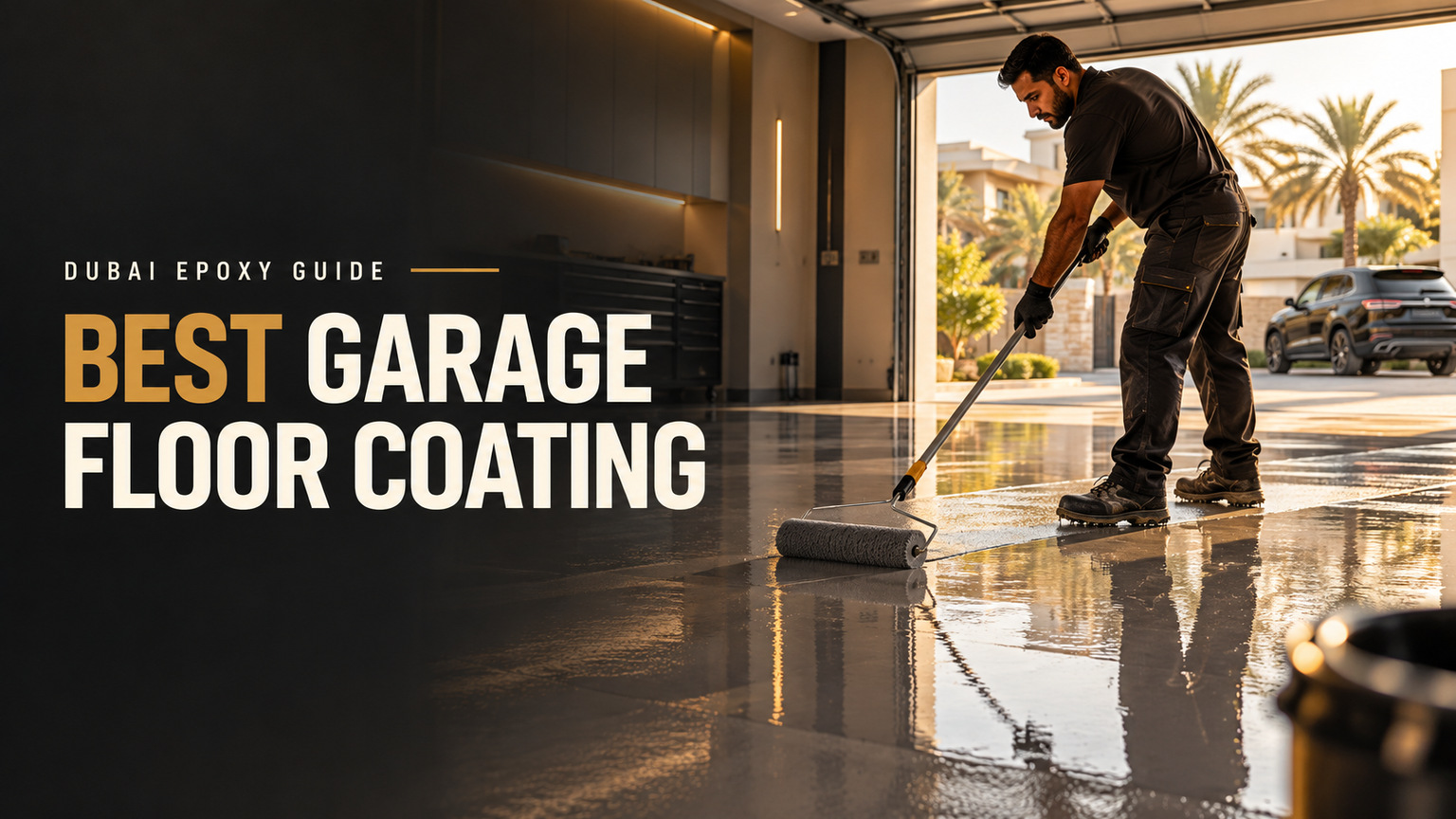

Best Epoxy Garage Floor Coating in Dubai: How to Choose
Quick Answer
The best epoxy garage floor coating in Dubai is a complete system matched to the concrete, vehicle use, and sun exposure. A well-prepared epoxy floor suits many enclosed garages. Where direct sunlight reaches the floor, consider a compatible UV-stable polyurethane finish. Slab moisture, surface preparation, and slip resistance also affect the choice.
Key Takeaways
A good garage floor starts with the right system, not the most expensive product. These points help narrow the choice before you compare quotes.
- Enclosed garages can use epoxy systems designed for concrete floors and regular vehicle traffic.
- Sunlit garage entrances benefit from a compatible UV-stable finish to help retain colour and gloss.
- Concrete needs mechanical preparation that removes weak material, old coatings, oil, and surface dust.
- Slab moisture must meet the chosen manufacturer’s limits before the coating work begins.
- Wet or oily garage floors may need a textured finish with suitable slip resistance.
- Mapei documents 2 mm and 5 mm floor builds for different uses, not universal garage thickness rules.
- A sound quote names each coating layer, the preparation method, and when vehicles can return.
The strongest choice is a system that fits the garage and passes the checks for its intended use. A brand name alone cannot establish that fit.
Best Garage Floor Coating by Garage Condition
For most enclosed Dubai garages, a garage-rated epoxy system is a sensible starting point. Direct sun, heavy use, surface damage, or damp concrete can change that answer. Use the conditions below to narrow the choice before selecting a finish.
Dubai Garage Floor Coating Selector
The following matrix helps match common garage conditions to a suitable system direction. It draws on manufacturer guidance for epoxy, polyurethane, surface preparation, and moisture testing. It is a buyer’s screening tool, not a substitute for site checks or an approved product system.
| Garage condition | Coating direction | Why it fits | Check before work |
|---|---|---|---|
| Enclosed garage with sound, dry concrete. | Garage-rated epoxy system. | Suitable for routine vehicle use. | Moisture, surface prep, and traffic rating. |
| Garage entrance with regular direct sun. | Epoxy base with compatible UV-stable PU finish, or an approved UV-stable vehicle system. | Helps retain colour and gloss. | Sun exposure and layer compatibility. |
| Floor exposed to water or oil. | Textured epoxy or approved non-slip resin system. | Adds grip where needed. | Wet and oily slip risk. |
| Pitted, weak, or uneven slab. | Concrete repair and prep before coating. | Gives the resin a sound base. | Damage, cracks, levels, and surface strength. |
| Slab with high or unknown moisture. | Test first; use an approved moisture solution if needed. | Reduces risk of coating failure. | Test results and product limits. |
| Workshop or higher-load garage. | Resin system rated for the actual duty. | Addresses higher wear and chemical exposure. | Wheel loads, point loads, and chemicals. |
These directions reflect how manufacturers separate vehicle-floor systems. For example, Jotun’s Jotafloor EP Coating is offered for garages, workshops, and car parks. It is designed for concrete and offers abrasion and chemical resistance.
A Dubai villa garage that holds two passenger cars may not need a heavy-duty parking deck system. A workshop with metal stands, frequent spills, and hard-wheel equipment has different demands.
Start with the most demanding part of the garage. A narrow strip of direct sun at the entrance may affect the finish choice, even if most of the floor stays shaded.
Five Checks That Decide the Best System
A coating system should pass five checks before a contractor commits to it. Each addresses a different cause of poor results.
1. The slab must be suitable. The concrete needs enough strength and a sound surface. Weak patches, loose coatings, and oil must be dealt with before resin work starts.
2. The finish must suit the light. Enclosed floors have different UV exposure from open garages and driveway edges. Direct sun may call for a UV-stable exposed coat.
3. The coating must suit the load. Passenger cars, workshop tools, forklifts, and hard wheels do not create the same wear. The product data must cover the actual use.
4. The floor must offer suitable grip. A smooth, glossy surface may be easy to wipe down. It may be a poor match for an entrance that often gets wet.
5. The installer must work within product limits. Moisture, heat, humidity, and cure time affect the result. The contractor should record the checks and follow the selected system’s data sheet.
These five checks form a practical choice framework. They are not a separate code or a new technical standard. A product can look ideal on paper and still be wrong for the slab.
Epoxy vs Polyurethane: Choose by Exposure
Epoxy works well in many enclosed garages. A UV-stable polyurethane finish is often the better exposed layer where the floor gets direct sun. The two materials can also form part of one approved system.
The distinction is easier to see when each material’s role is clear. Epoxy often provides the main coating build. A suitable polyurethane can provide the weather-facing finish.
| Feature | Garage-rated epoxy | UV-stable polyurethane finish |
|---|---|---|
| Main role. | Body coat or exposed coating. | Exposed finish or part of a traffic system. |
| Enclosed garage. | Often suitable. | May be used when the system calls for it. |
| Direct sunlight. | Check UV limits. | Designed for better UV and colour stability. |
| Wear resistance. | Depends on the product and build. | Depends on the product and use class. |
| Surface texture. | Can use approved aggregates. | Can form part of textured systems. |
| Main buying check. | Slab, traffic, and chemical fit. | UV rating, traffic duty, and layer compatibility. |
The comparison is about intended use, not a blanket winner. Mapei’s underground car park epoxy system shows one common epoxy use. Its documented build includes a primer, quartz aggregate, and epoxy layers.
For exposed vehicle areas, Mapefloor Parking System WD uses a UV-stable polyurethane system. Its components also show how epoxy and polyurethane may serve different roles in one floor.
Fully Enclosed Garages
A garage that stays shaded is a good place to consider an epoxy system rated for vehicle use. Epoxy forms a hard resin finish over prepared concrete. The exact grade affects its wear and chemical resistance.
Consider a villa garage used for daily parking and light storage. The main needs may be tyre traffic, easy cleaning, and resistance to common drips. A full commercial traffic-deck build could be more than the space needs.
That doesn’t make the cheapest thin coating the right choice. The contractor still needs to check adhesion, slab moisture, and the product’s service limits.
Flowcrete’s Flowcoat SF150 Car Park Grade is one manufacturer example of a solvent-free epoxy coating intended for underground parking use. It also offers a textured system option.
For an enclosed garage, ask the installer which actual system suits the cars, cleaning products, and floor condition. Do not accept the word ‘industrial’ as proof of suitability.
Open Garages and Sunlit Entrances
Direct sunlight changes the finish decision. A suitable UV-stable polyurethane topcoat can help preserve colour and gloss where the surface is exposed.
Jotun’s Jotafloor PU Topcoat HS is described as resistant to UV, weathering, abrasion, and chemicals. Jotun lists car parks and residential or commercial concrete floors among its applications.
Suppose a garage remains shaded except for its front two metres. That entrance may still receive daily sun. A plain epoxy finish could have a different appearance over time from the shaded area. A UV-stable exposed system is worth considering if a consistent look matters.
Do not assume any polyurethane topcoat will work over any epoxy. The primer, body coat, and topcoat need approved compatibility. Some products also have limits on wheel loads or other site conditions.
For an open parking deck, the design may need added flexibility, weather resistance, and traffic protection. Flowcrete’s Deckshield ED is an example of a UV-resistant external vehicle-floor system. It should not be treated as a default requirement for every villa garage.
Choose the Right Coating Build, Thickness, and Texture
A thin roller coat, a self-levelling resin, and a textured multilayer floor serve different needs. The right choice depends on the full build, not thickness alone.
A coating system can contain several working layers. Each has a job. The primer helps the system bond to a suitable substrate. The main resin coat provides the planned build. An aggregate layer may add texture. A finish coat protects the exposed surface.
Garage Floor Coating Layer Guide
The layer sequence below is a conceptual guide. It shows how a typical resin system may be built, but it is not an installation recipe.
| Layer or stage | Main purpose | Buyer check |
|---|---|---|
| Concrete preparation and repair. | Provides a sound base. | Has weak or stained concrete been treated? |
| Compatible primer, when required. | Supports the system’s bond. | Is it approved for the slab condition? |
| Epoxy body coat. | Provides the planned resin build. | Does it suit the garage’s traffic and exposure? |
| Optional quartz or other aggregate. | Adds texture or forms part of the build. | Is the finish suitable for wet use? |
| Approved finish coat. | Forms the exposed wearing surface. | Is UV stability needed? |
Not every resin floor uses every layer. Some products have a simple coating build. Others use several coats and a full aggregate broadcast. Mixing products from different systems without approval can put the whole floor at risk.
The quote should state each layer, product name, and planned thickness. That is far more useful than a single line saying ‘premium epoxy coating’.
What Do 2 mm and 5 mm Really Mean?
Thickness is a system property, not a universal quality score. The right amount depends on the product and the job it must do.
Mapei’s MAPEFLOOR I 500 W product data gives two clear examples. One smooth self-levelling system has a 2 mm build. A documented multilayer non-slip option has a 5 mm build.
These are two versions of a named manufacturer system. They do not set a minimum thickness for every garage in Dubai.
A thicker floor may provide more build or suit a more demanding use. Yet it cannot correct poor bond, trapped moisture, or a weak slab. A thinner approved system on sound concrete can be a better choice than an unsuitable thick one.
Wheel type also matters. Rubber car tyres, hard workshop wheels, and metal stands create different contact loads. If the garage doubles as a repair area, the installer should check those loads before choosing a resin build.
Glossy, Matte, or Textured?
Choose the texture for how the floor will be used. Colour and gloss can follow that decision.
A smooth finish can make dust, tyre marks, and small spills easier to see and clean. A stronger texture may help where water or oil makes the floor slippery. It may also take more effort to scrub.
Manufacturers offer aggregate-based finishes for this reason. Jotun’s Jotafloor Topcoat information describes the use of non-slip aggregate where a textured surface is needed.
A garage with a wash area should not rely on a glossy product photo. Ask what grip the completed floor must provide in wet use. The texture must be part of the approved coating system. Drainage, oil residue, footwear, and cleaning also affect slip risk.
The term ‘non-slip’ should not be taken as a promise that falls cannot occur. A measured slip target, where applicable, needs a suitable test and the correct project rules.
Check the Concrete Before Any Epoxy Goes Down
Sound, clean, dry-enough concrete is the starting point for a lasting resin floor. A premium coating cannot make up for poor preparation.
Garage slabs often have old paint, dust, tyre residue, oil stains, pits, or cracks. Some may also have a curing compound or sealer left on the surface. Each can affect the bond between the resin and the concrete.
A useful pre-coating check covers both the surface and the moisture within the slab. The two are related, but they are not the same test.
Slab Acceptance Checklist
Before coating begins, the contractor should be able to explain how the following conditions will be handled.
- Check the concrete for loose, weak, or hollow areas before coating.
- Identify old paint, sealers, oil, grease, and curing compounds that need removal.
- Prepare the surface to the profile required by the selected resin system.
- Repair pits and assess cracks before applying the primer or body coat.
- Check joints and decide which must stay free to move.
- Test moisture using a method accepted by the coating manufacturer.
- Record the conditions that affect primer and coating application.
- Confirm that the surface is clean before each planned coat.
A floor can appear clean while still holding contaminants. The preparation method must address the actual slab, not merely make it look neat.
Surface Profile, Cracks, and Oil Contamination
Mechanical preparation helps resin grip concrete. Grinding or blasting can remove weak surface material and form the profile a coating needs.
Sika’s epoxy coating application guide gives a useful technical example. It describes preparation around ICRI Concrete Surface Profile 3, often shortened to CSP 3. The guide also calls for clean, sound concrete and the removal of contamination.
CSP describes the texture of the prepared surface. A CSP 3 target is not a rule for every epoxy product. The selected manufacturer’s instructions must set the actual profile.
The same Sika guide gives example substrate strength values of 25 MPa in compression and 1.5 MPa in tension. Those values belong to the referenced system. They should not be copied into a quote for a different product without support.
Small holes or surface pits may need local repair. Deep or widespread level problems may need a separate base treatment. Crownedge’s self-levelling flooring options may be relevant where the floor needs a suitable levelling layer. More serious base corrections may call for floor screeding work.
Cracks need care. A stable surface crack is not the same as an active joint or a moving structural crack. Coating over movement does not stop it. The contractor should identify the cause and select an approved treatment.
Oil stains also deserve more than a quick wipe. Oil can enter porous concrete. The preparation plan must remove contamination enough to meet the resin manufacturer’s bond needs.
Moisture Testing: A Reading Needs a Limit
Do not approve epoxy solely because the garage floor feels dry. Moisture inside concrete can affect the coating bond and lead to failure.
ASTM F2170 is an in-situ method for measuring relative humidity inside a concrete slab. It provides a measured internal condition at the test points and time.
A handheld meter can be useful for screening. Yet the ASTM F2659-23 guide explains that non-destructive meter readings are comparative. They should not replace a quantitative acceptance method when the product calls for one.
The test result also needs a product limit. A figure means little unless the installer can show the selected coating’s permitted moisture level and test method.
For example, Sikafloor-215 product data includes limits of no more than 4% moisture by mass and 85% internal relative humidity under ASTM F2170. These are product-specific values from a US data sheet, not a Dubai rule or a limit for all epoxies.
Moisture by mass and internal relative humidity measure different things. The numbers are not interchangeable.
If testing finds excess moisture, the contractor should reassess the system. A manufacturer-approved moisture-tolerant primer or treatment may be needed. In some cases, work must be held until the source is found.
Water leaking through walls, joints, or other building parts is a different issue. It may need separate waterproofing works before the floor system can be planned. An epoxy coating should not be sold as a cure for an unresolved leak.
Dubai Application Conditions and Parking Time
The right time to park on a new epoxy floor depends on the exact system and site conditions. A fixed promise of 24 or 48 hours is not enough to approve vehicle use.
Resin coatings cure through chemical reactions. Product type, layer thickness, slab temperature, and surrounding conditions can affect those reactions. Dubai’s hot weather makes site checks especially useful, but temperature is not the only concern. Humidity and condensation matter too.
A floor can feel firm before it has reached full service strength. Early wheel loads may put extra stress on a coating that is not ready.
Check Temperature, Humidity, and Dew Point
The installer must work within the product’s allowed conditions. Outdoor air temperature alone cannot show whether the slab is ready.
A referenced Sikafloor MultiDur B-40 AP system gives a clear example. It calls for the substrate to stay at least 3°C above the dew point. The system also lists a substrate or application temperature range of +8°C to +35°C.
Dew point is the temperature at which water vapour may condense on a surface. If the slab is too close to that point, a thin film of water can affect the coating.
Those values are not a universal limit for every product sold in Dubai. A different epoxy may have another permitted range. The installer should measure the real slab and room conditions, then use the chosen technical data sheet.
Air conditioning, ventilation, and a warm slab can also create different conditions within one garage. The work plan should cover those changes instead of relying on the day’s weather forecast.
Cure Time Is Not One Single Number
A coating may have separate times for mixing, recoating, foot traffic, vehicle use, and full chemical service. Those times should appear in the work plan.
Mapei gives an example for MAPEFLOOR I 500 W: final hardening takes seven days at +23°C and 50% relative humidity. That does not mean every garage epoxy needs seven days before parking. Nor does it mean this system can accept cars at any earlier point without checking its own data.
Ask the contractor to distinguish the stages clearly. Pot life describes how long mixed material remains usable. Recoat time guides the next layer. Return-to-service time tells you when the floor can take its intended traffic.
A written schedule should also explain what happens if a coating stage is delayed. Missing a recoat window may require extra preparation. Parking early because the floor looks dry is not a sound substitute for the manufacturer’s directions.
Compare Garage Epoxy Quotes Using Eight Questions
A useful epoxy quote should describe the whole floor system. Brand name, colour, and price alone leave too many risks unanswered.
Two contractors may propose coatings that look much the same in a sample photo. One may include moisture testing, slab repairs, and a UV-stable finish. The other may include only a basic roller coat. Comparing the total price without checking the scope tells you little about the value.
Eight Questions to Ask Your Garage Flooring Contractor
Use these questions to compare actual proposals. Each answer should be clear enough to include in a written quote or scope of work.
- Which exact system will you install? Ask for the manufacturer, product names, and current technical data sheets.
- What layers are included? Confirm the primer, body coat, aggregate, topcoat, and planned thickness.
- How will the concrete be prepared? Ask about cleaning, grinding or blasting, dust removal, and required surface profile.
- How will slab moisture be checked? Request the test method, measured result, and the chosen product’s acceptance limit.
- What repairs are included? Identify cracks, joints, pits, weak concrete, old coatings, and oil-contaminated areas.
- Will the exposed finish resist UV? Check the finish at sunlit entrances and confirm it is approved within the full system.
- What texture will the floor have? Discuss grip, wet use, cleaning, and any required slip assessment.
- When can the garage return to use? Get recoat, foot-traffic, parking, cleaning, and warranty terms in writing.
Good answers also make changes easier to manage. If the contractor finds weak concrete after grinding, the scope should explain how added repair work will be assessed and approved.
For Dubai projects, buyers can review the types of epoxy flooring services available through Crownedge. A service page is a starting point for discussion. The final choice still needs a site check and a named coating build.
What Makes One Quote Cost More?
The largest cost difference may come from work you cannot see in a finished photo. A quote with more concrete preparation may carry a higher initial price but cover work a cheaper quote has omitted.
The main cost drivers include floor area, slab condition, repairs, coating thickness, aggregate use, UV finish, labour, access, and the number of work stages. A larger garage may also need more joint work or have several exposure zones.
A credible quote separates normal preparation from major repairs. It should say what is included and what would cause extra work.
There is no sound basis here for a single Dubai-wide AED/m² price. Product systems and site conditions vary too much. Ask suppliers to price the same defined scope before judging which offer is cheaper.
A warranty deserves the same care. Check what it covers, for how long, and whether substrate moisture or movement is excluded. No warranty should replace proper floor checks.
Common Garage Floor Coating Mistakes
Most avoidable coating problems begin before the final layer goes down. A wrong system, poor slab prep, or early vehicle use can affect a floor that looked fine at handover.
The table below connects common errors to their likely effect and the action that helps prevent them. It is a prevention guide, not a way to diagnose a failed floor from a photo.
| Common mistake | What can go wrong | Better action |
|---|---|---|
| Coating over dust or weak concrete. | Poor bond or local peeling. | Prepare and assess the slab. |
| Skipping moisture checks. | Debonding or other finish defects. | Test against product limits. |
| Using a finish without a suitable UV rating. | Colour or gloss change in sunlit areas. | Choose an approved UV-stable exposed system. |
| Selecting gloss without checking wet use. | Greater slip concern where water or oil is present. | Specify suitable texture and assess grip. |
| Ignoring moving cracks or joints. | Cracks may show through the coating. | Assess movement and use the correct joint treatment. |
| Parking before the approved cure stage. | Early wear or coating damage may occur. | Follow written vehicle-return limits. |
Hot-tire pickup is another concern worth asking about. It describes a coating bond problem associated with tyre contact and heat. Yet the precise cause of marks or peeling needs a site assessment. There is no sound universal claim that one resin type can never suffer this problem.
If a finished floor peels, the answer may involve moisture, poor preparation, wrong chemistry, early loading, or several factors at once. Repair work should begin with an assessment of the failure, not a thicker coat over the same surface.
When a garage is used for washing cars, the owner should also plan for water control. Texture helps with grip, but poor drainage and oil residue can still make the floor unsafe.
Frequently Asked Questions
These answers cover the most common final checks before a Dubai garage floor project. The selected manufacturer’s data remains the source for exact product limits and cure times.
Is Epoxy Good for a Garage Floor in Dubai?
Yes. A garage-rated epoxy system can work well on a sound, prepared concrete slab. It can serve normal vehicle use and help create a cleanable surface. The correct grade depends on traffic, chemicals, moisture, and sun exposure. Open or sunlit floors may need a UV-stable finish.
Does Garage Epoxy Need a UV-Resistant Topcoat?
A UV-stable topcoat is worth specifying where direct sunlight reaches the floor and appearance matters. A fully enclosed garage may not need the same finish. The topcoat must suit the traffic and be approved for use with the other resin layers.
How Thick Should an Epoxy Garage Floor Coating Be?
There is no single thickness for every garage. Mapei documents 2 mm and 5 mm builds for different MAPEFLOOR I 500 W systems. The suitable build depends on the intended duty and product instructions. A thicker coat cannot fix weak or damp concrete by itself.
Can Epoxy Be Applied to a Damp Garage Floor?
Only when the chosen system permits the measured slab condition. Some approved systems offer moisture-tolerant solutions. Others need the slab to meet lower limits. The contractor should test the concrete and compare the result with the manufacturer’s acceptance criteria before coating.
How Soon Can I Park on a New Epoxy Garage Floor?
Use the vehicle-return time in the chosen product’s instructions. Do not assume the floor is ready because it feels dry. Layer thickness and site conditions can affect curing. Foot-traffic approval and full chemical cure may occur at different times.
Will Epoxy Stop a Concrete Garage Floor from Cracking?
No. Epoxy is not a repair for structural movement. Stable surface defects may be repaired within an approved coating system. Moving joints and active cracks need a different assessment. A coating that spans uncontrolled movement may crack or lose its bond.
Is a Textured Garage Floor Better Than a Glossy One?
A textured finish may offer better grip where water or oil is common. Smooth finishes can be easier to wipe clean. The best balance depends on the garage’s use, cleaning method, and any required slip assessment. Texture should be part of the specified system.
Is a More Expensive Garage Epoxy System Always Better?
No. A higher price may reflect more layers, repairs, testing, or a UV-stable finish. It may also cover work the garage does not need. Compare the full scope, product data, preparation, and warranty before choosing. A low quote that omits key checks can be poor value.
Final Garage Floor System Check
The best epoxy garage floor coating is the one that fits the actual garage. For a dry, enclosed Dubai garage, a suitable epoxy system may be enough. Sunlit entrances, wet conditions, workshop loads, and weak concrete can call for a different build.
Before work starts, confirm five things: the slab is fit for coating, the finish suits the exposure, the resin suits the traffic, the texture suits the slip risk, and the work plan follows the product’s limits.
A clear scope should name the products, preparation work, moisture checks, layer build, and safe return-to-service time. These details make it easier to compare quotes and judge the finished work.
For a garage project in Dubai, Crownedge can be contacted to discuss the floor condition and possible coating options. Request a site-based assessment and a written system proposal before making the final choice.