

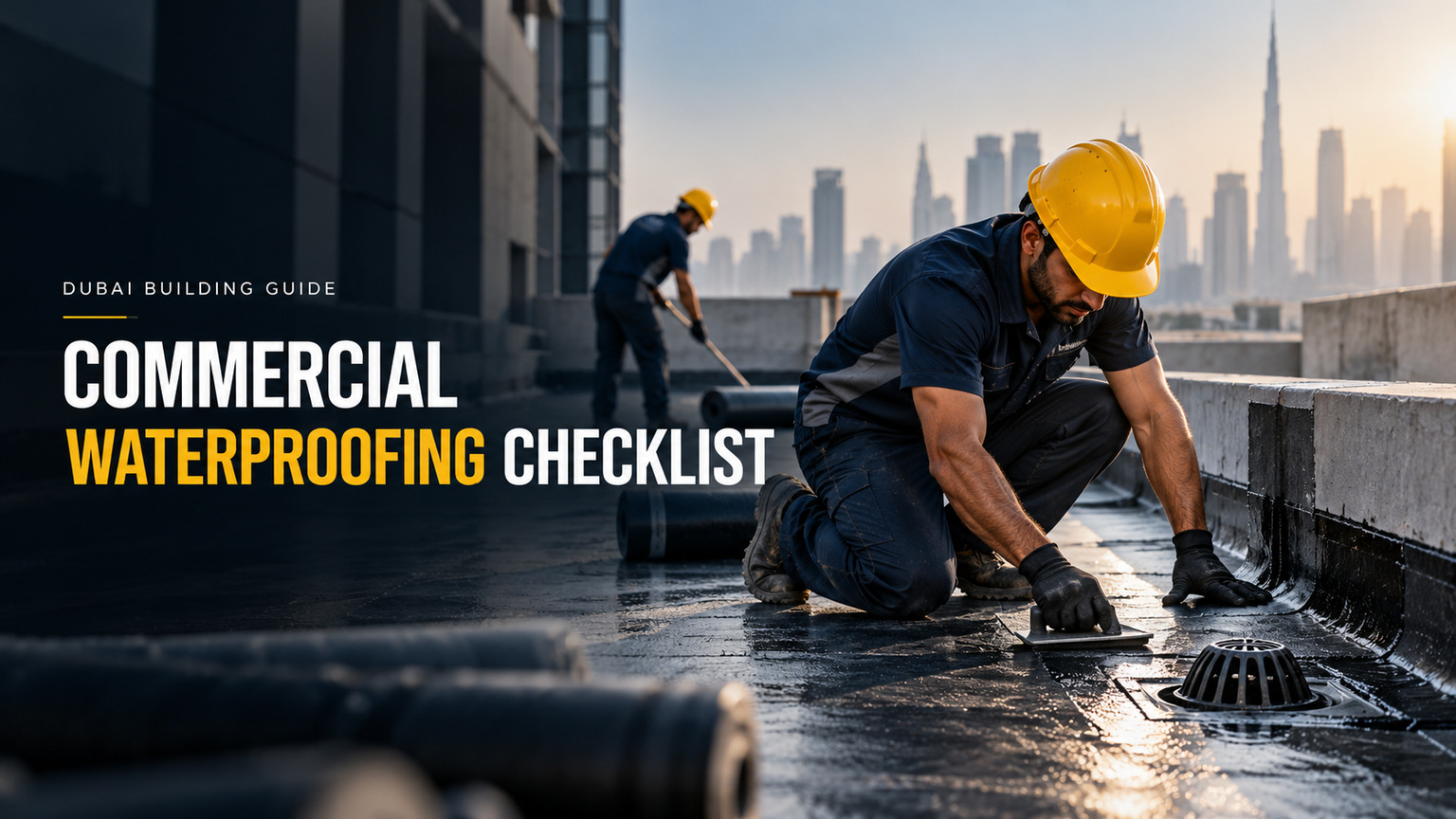

Commercial Building Waterproofing in Dubai: Systems, Selection & QA Checklist
Quick Answer
Commercial building waterproofing in Dubai should be chosen by building zone, water exposure, and system compatibility. Roofs, basements, parking decks, and wet areas face different risks, so no single membrane suits every project. Good results also depend on drainage, sound detailing, suitable testing, and protecting the membrane before covering it.
Key Takeaways
- Commercial roofs need waterproofing systems suited to UV exposure, heat, insulation, drainage, and planned roof use.
- Basement waterproofing must address groundwater pressure, construction joints, pipe entries, and water movement behind the membrane.
- Sheet membranes need sound joints and laps, while liquid systems need careful film thickness and curing checks.
- Drainage falls and outlets must work with the waterproofing system; a membrane alone cannot fix poor drainage.
- ASTM D5957-98(2021) covers certain horizontal waterproofing tests but expressly excludes building roofing systems.
- Electronic leak detection needs a compatible membrane assembly and an electrical return path beneath the membrane.
- Inspect waterproofing before it is covered, protect it from later trades, and keep written test and repair records.
Choose Waterproofing by Building Zone
Choose the system for the place it must protect. A roof faces sun and rain. A basement may face groundwater pressure. A parking deck adds traffic and movement. Wet areas have frequent washing and water around drains.
These differences shape the waterproofing design. One material may work well in several places, but its full system must suit each use.
Commercial Building Waterproofing Selection Matrix
| Building zone | Main water exposure | Systems to consider | Critical details | Quality checks |
|---|---|---|---|---|
| Exposed roof | Rain, sun, heat, movement. | UV-rated liquid membranes, suitable synthetic sheets, or exposed bitumen systems. | Falls, outlets, upstands, penetrations, insulation. | Visual checks and suitable roof integrity testing. |
| Protected or inverted roof | Rain beneath insulation or overburden. | Compatible sheet or liquid membranes within a protected roof system. | Layer order, drainage, insulation, protection. | Inspect and test before concealment where specified. |
| Podium or parking deck | Rain, wash water, traffic, movement. | Protected sheet or liquid membranes beneath a suitable finish. | Ramps, drains, joints, traffic surface, protection. | Appropriate deck testing and repair records. |
| Basement slab and walls | Groundwater and possible water pressure. | Fully bonded sheets, suitable post-applied membranes, watertight concrete systems, or designed drainage. | Pile heads, wall joints, pipe entries, waterstops. | Approved joint details and system-specific inspections. |
| Bathrooms and plant rooms | Splashes, cleaning, local standing water. | Compatible liquid, cement-based, or sheet systems. | Floor drains, thresholds, corners, pipe entries. | Detail checks and suitable water tests after curing. |
| Façade and parapet details | Wind-driven rain and joint movement. | Compatible flashing, sealing, and coating systems. | Openings, joints, transitions, fire compliance. | Detail inspection and specified tests. |
| Existing leaks | Water following an unknown path. | Local repair, injection, membrane replacement, or drainage repair. | Find the entry path and source. | Confirm the repair addresses the cause. |
This matrix is a planning aid, not a finished building design. The right choice still needs product data and project approval.
The SOPREMA Middle East waterproofing range separates products by their intended use. Its categories include substructure, roofs, wet areas, podiums, and floors.
That approach reflects how commercial buildings work. A mixed-use tower might need several waterproofing systems on the same site.
For commercial projects in Dubai, Crown Edge offers waterproofing services for roofs, basements, wet areas, and leakage treatment.
Commercial Roof Waterproofing: Start With Drainage
A commercial roof needs a complete waterproofing assembly, not just a membrane. The design must account for sun, heat, water flow, insulation, access, and roof equipment.
The SOPREMA roofing range includes modified-bitumen, synthetic, and liquid-applied options. These serve different roof designs.
Exposed vs Protected Roof Systems
On an exposed roof, the waterproofing layer faces outdoor conditions. It needs suitable resistance to the expected sun, weather, and movement.
A protected roof places other layers above the membrane. These may include insulation, ballast, paving, or other approved finishes.
The layer order affects water flow and inspection access. It also affects future repairs.
A roof used only for plant access has different needs from a public terrace. Foot traffic, equipment supports, and later maintenance all affect the choice.
Before approving a roof system, confirm whether its membrane is designed for permanent UV exposure. Some below-ground membranes are not.
Drainage Falls and Ponding
Water should reach the outlets through the planned drainage route. The waterproofing layer must remain sound where water gathers.
Poor falls can leave water standing near drains and plant supports. Blocked outlets add further risk.
Crown Edge’s floor screeding service includes slope screeding for roofs, bathrooms, and parking decks. It describes using falls to help direct water away.
For a commercial roof, the design team should check:
- Roof levels provide the planned route to drains.
- Outlets are placed at suitable low points.
- Overflow provisions meet the approved design.
- Plant supports do not block drainage paths.
- Roof movement or deflection will not defeat the planned falls.
- The membrane suits any ponding conditions allowed by its manufacturer.
There is no single roof slope that should be prescribed for every Dubai building. The required falls and outlet capacity depend on the approved roof design.
Roof Details Are Not Minor Work
Large roof areas may be easy to cover. Problems often arise where the membrane meets another item.
Consider a roof with several air-conditioning units. Each support may introduce a raised base, a fixing, or a penetration. Every interface needs the correct detail.
Drains, doors, parapets, corners, and pipe entries also need attention.
A useful example is SOPREMA ALSAN FLASHING LM. This product is made for waterproofing details and flashing work. Its published Middle East data give an application range of 5°C to 45°C.
That range belongs to the named product. It is not a temperature rule for every roof membrane.
Basement and Foundation Waterproofing: Control Groundwater
Below-ground waterproofing must address water pressure and every route into the structure. A roof membrane chosen for sunlight cannot simply be treated as a basement system.
Water may reach a basement from surrounding soil. It may press against walls or slabs. Construction joints, pile heads, and service pipes create weak points if left untreated.
BS 8102:2022 gives recognized guidance for protecting below-ground structures. It covers barrier systems, watertight construction, and drained cavities.
The standard supports a risk-based design approach. Its use on a Dubai project depends on the applicable contract, project specification, and authority requirements. It is not established here as a universal Dubai legal mandate.
Pre-Applied and Post-Applied Systems
A pre-applied membrane is placed before the concrete is cast against it. This can help where outside access will be lost after construction.
Post-applied systems are fitted to the concrete after it is built. They need suitable access, preparation, and protection.
Watertight concrete and joint systems may form part of the design. Some projects also use drained cavities to manage water that reaches the structure.
These are not interchangeable choices. The designer must assess ground conditions, the required internal environment, and the planned build sequence.
For instance, a basement wall built against a boundary may offer little outside access later. Its waterproofing choice must suit that construction method.
Joints, Pile Heads, and Pipe Entries
A membrane cannot close a joint that has no approved detail.
The basement waterproofing plan should show how water is stopped at:
- Wall-to-slab junctions and construction joints.
- Movement joints that allow structural motion.
- Pile heads and foundation interfaces.
- Tie holes and temporary fixing points.
- Pipe sleeves and service penetrations.
- Corners and changes in membrane direction.
Joint waterstops and membrane accessories must work as one system. Mixing unapproved parts can create uncertain joints and repair duties.
What Manufacturer Data Really Proves
SikaProof A+ 12 product data provide a useful case.
Sika describes a fully bonded FPO sheet for below-ground reinforced concrete. Its stated total thickness is 1.75 mm, including a 1.20 mm waterproofing layer.
The manufacturer reports a pass at 60 kPa for 24 hours in a watertightness test. It also reports lateral water migration resistance up to 7 bar.
These are separate test results, not a general design-pressure rating. They must be read with the full product data.
The same data give a +5°C to +45°C ambient application range. They also warn against permanent UV exposure. Sika states the product must be protected within 90 days of application.
Those limits matter on a Dubai site. A product may be suited to hot climates yet still need protection from direct weather.
Fosroc Proofex Engage offers another below-ground approach. Fosroc describes a pre-applied membrane that bonds to poured concrete and limits water tracking between the membrane and concrete.
Both show why a specification must name the exact system. The words sheet waterproofing alone are not enough.
Podiums, Parking Decks, and Wet Areas
These areas need waterproofing that works beneath the planned finish. The membrane may be hidden under screed, paving, insulation, or a traffic layer.
The finish protects or serves the surface. It does not always provide the main water barrier.
Podium and Parking-Deck Assemblies
A parking deck above occupied rooms needs special care. Water reaching the deck can cause damage to the space below.
The assembly must manage traffic, drainage, movement, and water entry at drains and joints.
Some projects use a waterproof membrane below a separate wearing course. Other systems include a traffic-bearing waterproof layer designed for that use.
These choices must not be confused with standard decorative flooring.
Crown Edge’s epoxy flooring and parking coatings provide useful context for the wearing surface. Yet an epoxy floor finish should not be assumed to form a complete primary waterproofing system.
Ask for evidence of the intended use and all required layers. Check how the system treats ramps, cracks, and joints.
Wet Areas and Floor Build-Ups
Commercial kitchens, washrooms, and plant rooms expose floors to repeated wetting. Water may reach corners and pipe entries long before a large area fails.
The system should suit the cleaning method, substrate, drains, and planned floor finish.
A bathroom floor may need falls to a drain. A plant room may need protection near equipment bases. Thresholds also need a clear water-control detail.
Self-levelling flooring and floor preparation can help prepare certain floor finishes. Yet a levelling product is not automatically a waterproof membrane.
Check that the screed, primer, membrane, adhesive, and finish are compatible. The approved build-up should make each layer’s role clear.
Protect the Membrane After Application
A passed inspection can be wasted by damage from later trades.
Concrete work, backfill, paving, equipment fitting, and sharp tools may harm an exposed membrane. Protection must therefore be part of the planned system.
SOPREMA SOPRABOARD SF is an example of a board made to protect waterproofing during later construction work.
The project must still select a suitable protection layer and fitting method. A protection board is not a substitute for the membrane itself.
Sheet vs Liquid Waterproofing: Compare Installation Risks
Choose between sheet and liquid waterproofing by the job’s details and site controls. Neither type is the best choice in every case.
A sheet may offer a set factory-made thickness. It still needs sound seams and terminations.
Liquid waterproofing can cover complex shapes without field sheet laps. Its success depends on substrate condition, correct film build, and proper curing.
| Decision factor | Sheet membrane | Liquid-applied membrane |
|---|---|---|
| Main quality risk | Poor seams, laps, or terminations. | Thin areas, pinholes, or incomplete curing. |
| Complex shapes | May need extra pieces and joint details. | Can follow shapes with suitable reinforcement. |
| Thickness control | Factory-made sheet thickness. | Applied wet or dry film thickness. |
| Substrate demands | Must meet bonding and surface needs. | Must meet primer, moisture, and surface needs. |
| Application limits | Depend on joining method and product. | Depend on cure, temperature, and product. |
| Repair method | Compatible patches and joint treatment. | Compatible local repair and recoating. |
| Protection | Depends on exposure and overburden. | Depends on exposure and overburden. |
Sheet Membranes
Check the lap method first. Some sheets use tapes, adhesives, heat welding, or other approved means.
Corners and pipe entries need care. A joint that looks closed may still have a weak bond.
The manufacturer should provide approved details. The contractor should use matching parts and the stated fitting method.
Liquid Membranes
Liquid systems shift more of the work to site controls. The substrate must be ready before coating starts.
The correct primer, number of coats, film thickness, and curing time all matter.
Fosroc Nitoproof 600 is one example of a modified-polyurethane liquid membrane. Fosroc lists several building applications and methods of application.
For cold liquid-applied elastomeric membranes within its scope, ASTM C836/C836M-18(2022) provides a material standard. It covers specified systems used beneath a separate wearing course, traffic course, or backfill.
It does not apply to every product marketed as waterproof paint.
When comparing a sheet with a liquid product, ask which installation checks each system needs. A lower material price means little if the quote leaves out those controls.
Verify Waterproofing Before It Is Covered
Inspect each stage before the next trade hides it. Once a membrane sits under paving or backfill, faults become harder to find and repair.
The project should set clear hold points. Each one records that a defined part of the work is ready for the next step.
Six Waterproofing Quality Hold Points
- Substrate: Check surface condition, curing, cracks, moisture limits, and approved falls before starting.
- Details: Inspect drains, corners, joints, upstands, and pipe entries against the approved drawings.
- Membrane: Check coverage, sheet seams, film thickness where relevant, and required curing.
- Integrity test: Use an approved test suited to the assembly. Record defects, repairs, and any retest.
- Protection: Check that boards, screeds, toppings, or other layers will not harm the membrane.
- Handover: Record later penetrations, repair work, test results, photographs, and final approved details.
These hold points form a practical QA framework. They are not a substitute for the project’s formal inspection and test plan.
Flood Testing vs Electronic Leak Detection
Flood testing and electronic leak detection do different jobs. Neither should be selected by habit.
| Test factor | Flood testing | Electronic leak detection |
|---|---|---|
| Main purpose | Observe watertightness under ponded water. | Find membrane breaches through electrical methods. |
| Typical use | Suitable horizontal waterproofing decks. | Compatible exposed or covered membranes. |
| Added water load | Yes. Structural capacity must be checked. | Usually avoids a large ponded-water load. |
| Main limit | Containment, loading, slope, and test scope. | Conductive return path and assembly compatibility. |
| Roof use | ASTM D5957 excludes building roofs. | ASTM D7877 covers compatible roof membranes. |
| Result | Evidence from the test conditions. | Breach locations under the test conditions. |
The ASTM D5957-98(2021) flood-testing guide covers certain horizontal waterproofing work with slopes up to 20 mm/m, or 2%.
It addresses cases such as plaza decks and parking decks over occupied spaces. It expressly excludes building roofing systems and continuously submerged uses.
The guide discusses limited ponded-water testing. Its technical provisions include water-head and structural-loading controls. The research checkpoint identifies 100 mm as a relevant short-term head limit, subject to the guide’s full conditions and engineering review.
Do not treat 100 mm as an automatic safe test depth. Water adds load to the structure. A qualified structural engineer must assess that load before the test.
For roof membranes, use an appropriate roof-specific test method from the approved plan.
The ASTM D7877-25 guide covers electrical methods that detect and locate membrane breaches. It applies to suitable roofing and waterproofing assemblies.
Its methods need an electrically conductive path beneath the membrane. Insulation and other non-conductive layers may block that path. A suitable conductive layer may need to be part of the original assembly.
For covered roofs and landscaped podiums, this must be planned early. It may be too late to add an effective test system after all layers are installed.
A Passing Test Is Not the End
The test record should name the area, method, date, result, and any repairs. It should also show who checked the work.
If another trade cuts through the membrane later, the earlier result no longer proves that area remains sound.
Require a repair record and suitable follow-up checks for any later damage.
Diagnose Leaks Before Choosing a Repair
Find the water path before paying for a repair. A damp mark may appear far from the entry point.
Water can travel along joints, under finishes, or behind a membrane. A visible stain only shows where moisture reached the surface.
| Symptom | Possible cause | First checks |
|---|---|---|
| Water below a roof drain. | Drain joint, flange, membrane detail, or blockage. | Check the outlet, falls, and membrane tie-in. |
| Damp around a service pipe. | Poor collar, seal, or later trade damage. | Check the penetration and approved movement detail. |
| Basement wall dampness. | Groundwater path or failed construction joint. | Check water pressure, joints, and outside drainage. |
| Water stands on a roof. | Poor falls, blocked drains, or deflection. | Check levels, outlets, and the membrane condition. |
| Leak after paving work. | Membrane damage during later construction. | Review protection, work history, and test records. |
| Repeated leak along a crack. | Joint movement or a rigid failed repair. | Check crack activity and flexible detailing needs. |
These are possible causes, not confirmed diagnoses.
An internal injection may control some joint leaks. A patch may repair a local membrane fault. Yet neither method is right for every groundwater or drainage problem.
Ask the repair contractor to state the likely cause, how it will be checked, and why the chosen repair fits that cause.
A repair quote should also describe how success will be assessed after the work.
What a Commercial Waterproofing Quotation Must Include
Compare the full work scope, not just the price per square metre. Two quotations may name the same membrane yet cover different preparation, detailing, and testing work.
One may include drainage screed and protection boards. The other may exclude both. The lower total could lead to costly variations later.
Seven Checks Before Approving a Waterproofing Quote
- [ ] Exposure: The quotation identifies the building zone, water source, and expected water pressure.
- [ ] Substrate: It states the surface type, needed repairs, preparation, and moisture limits.
- [ ] Movement: It includes cracks, construction joints, movement joints, and suitable joint details.
- [ ] Drainage: It defines responsibility for falls, drains, outlets, and related screeding work.
- [ ] System: It names the maker, product, primer, membrane, accessories, thickness, and protection layers.
- [ ] Testing: It states the inspection points, suitable test method, pass conditions, and repair process.
- [ ] Handover: It lists the test reports, photographs, drawings, repair records, and written warranty terms.
A complete quotation also assigns work at trade boundaries. The waterproofing contractor may not own every drain, pipe sleeve, or equipment base.
Those duties still need to be clear.
Compare Like-for-Like Work
Ask each bidder to show what is included and excluded. Check whether the quote covers substrate repairs, corners, pipe entries, protection, and removal of failed materials.
Product thickness must come from the chosen system. There is no single membrane thickness that suits all commercial applications.
The same applies to costs and service life. Site access, area, overburden, repairs, product type, and working conditions change the scope. An unsupported Dubai-wide rate would not support a sound choice.
Keep Useful Handover Records
At handover, the owner or facilities team should receive enough detail to maintain and repair the work.
Useful records include approved product data, drawings, inspection results, test reports, and marked repair locations. Photographs taken before concealment are valuable.
Written warranty terms should identify the responsible party, covered work, exclusions, and claim process. Never assume that product and workmanship warranties offer the same cover.
Dubai Standards and Approval Checks
Meet the applicable Dubai project rules first. Then use the correct technical standards and product data to assess the chosen waterproofing system.
Dubai Municipality’s Building Code information identifies the Dubai Building Code as the city’s unified set of minimum building requirements.
The 2021 edition includes roof provisions addressing waterproofing and thermal insulation. The exact applicable clauses must be checked against the authoritative code for the project.
Projects may also fall under a particular authority. The PCFC/Trakhees document register lists the Dubai Building Code among its planning documents.
Do not assume that all sites share the same approval process.
Standards and Their Proper Roles
| Reference | What it helps establish | Important limit |
|---|---|---|
| Dubai Building Code, 2021 edition. | Local building and roof design requirements. | Apply the relevant authority and project clauses. |
| BS 8102:2022. | Below-ground water-ingress risk and system design. | Not shown here as mandatory for every Dubai basement. |
| ASTM C836/C836M-18(2022). | Performance criteria for certain liquid elastomeric membranes. | Does not cover every waterproof coating. |
| ASTM D5957-98(2021). | Flood-testing methods for defined horizontal waterproofing work. | Excludes building roofing systems. |
| ASTM D7877-25. | Electronic membrane-breach detection methods. | Needs a compatible conductive path. |
Standards serve different purposes. A test standard does not approve a design. A product test result does not prove full project compliance.
The chosen waterproofing assembly also needs to meet any relevant fire and façade rules. Current product approval must be checked where such approval applies.
Prepare a Zone-by-Zone Waterproofing Scope
List each waterproofing area before seeking final quotations. A simple schedule can expose missing details early.
For each zone, record its location, water exposure, substrate, proposed system, critical joints, drains, protection, test method, and responsible trade.
Then compare that list with the drawings and quotation. Any blank item needs a clear answer before work moves ahead.
This is especially useful on mixed-use projects. A tower may combine basements, podiums, plant areas, roof terraces, and wet rooms. Each has a different waterproofing task.
Crown Edge provides commercial waterproofing services in Dubai. A project discussion should start with the building drawings, known water risks, existing conditions, and the required scope of work.
Commercial Waterproofing FAQs
Which waterproofing system is best for a commercial roof in Dubai?
The right choice depends on the roof assembly and exposure. Check UV resistance, drainage, insulation, traffic, and membrane details. Exposed and protected roofs may need different systems. No single membrane is best for all commercial roofs.
Is basement waterproofing different from roof waterproofing?
Yes. Basements may face groundwater pressure and water movement through joints. Roofs mainly face rain, sun, heat, and drainage demands. Their systems and details are chosen for different conditions.
Are liquid waterproofing membranes better than sheet membranes?
Not in every case. Liquid systems can suit complex shapes, but film thickness and curing need control. Sheet membranes have defined manufactured thickness but need sound seams and laps. Choose by exposure, substrate, and the full approved system.
Can every commercial roof be flood-tested?
No. ASTM D5957-98(2021) expressly excludes building roofing systems. Roof tests must suit the actual assembly and approved test plan. Water loading also needs proper structural review when ponding is proposed.
What is electronic leak detection in waterproofing?
It uses electrical methods to find breaches in a suitable membrane. A conductive return path is needed below the waterproofing layer. Insulation or protection materials may affect whether the method can work.
Does epoxy flooring replace waterproofing on a parking deck?
Not automatically. Some traffic-bearing systems are designed for waterproofing duties. Standard decorative epoxy flooring may not be. Check the stated use of the complete system, including joints and water exposure.
What causes commercial waterproofing to fail?
Common risks include weak joint details, poor surface preparation, drainage faults, thin or damaged membrane areas, and harm from later trades. The real cause must be checked before choosing a repair.
What should a contractor provide after waterproofing work?
Ask for approved system details, product information, inspection records, suitable test results, and repair records. Keep photographs and as-built details. Written warranty and care instructions also help the facilities team plan future work.
SEO Title: Commercial Building Waterproofing Dubai | Systems & QA
Meta Description: Compare commercial waterproofing systems in Dubai for roofs, basements, parking decks and wet areas. Use selection, testing and QA checklists.