


Concrete Polishing Services in Dubai: Finishes, Costs and How to Choose
Quick Answer
Concrete polishing services in Dubai are suitable when the existing slab is sound and the finished floor meets the site’s needs. Choose the level of shine, aggregate exposure and surface treatment before comparing prices. If the slab is damaged or needs stronger chemical protection, assess coatings or decorative overlays instead.
Key Takeaways
The right concrete finish depends on more than its appearance. These findings help Dubai buyers assess their floor, compare systems and agree on a measurable result before work starts.
- Existing concrete needs an on-site assessment for cracks, coatings, contamination and surface strength before mechanical polishing can be specified.
- The Concrete Polishing Council defines four appearance levels using reflection clarity, with separate optional gloss measurements.
- Aggregate exposure and an approved sample help define the finished look; abrasive grit numbers alone cannot guarantee it.
- Mechanical polishing, grind-and-seal, epoxy flooring and decorative overlays are different systems with distinct uses and maintenance needs.
- One Dubai supplier advertised polishing from AED 180/m² in September 2026, but this is not a verified market average.
- A glossy surface does not prove slip safety, and concrete grinding needs suitable controls for hazardous silica dust.
- Comparable contractor quotes should state the preparation work, finish target, treatments, exclusions, inspection method and maintenance handover.
A practical choice starts with the slab and its intended use. Once those are clear, specify the appearance, check safety needs and compare complete quotations for the same work.
Choose the Right Concrete Polishing Finish
Choose the finished appearance before agreeing on the grinding method. A polished concrete floor can look soft and understated or highly reflective. Both can be suitable. The right result depends on the room, its use and the condition of the concrete beneath it.
For Dubai showrooms, offices and homes, appearance may lead the decision. Warehouses and busy commercial floors often place more weight on cleaning, wear and safe use. Strong overhead lighting can also make surface variations more visible.
The ACI/ASCC 310.1-20 specification for polished concrete slab finishes provides a technical framework for products, construction, testing and acceptance. It covers slabs on the ground and suspended slabs. This US-developed reference can support a Dubai project contract, but it is not automatically a mandatory local rule.
Two separate choices shape the finish: reflection clarity and aggregate exposure. Agree on both before comparing bids. A contractor’s grinding sequence alone does not define the appearance a buyer should expect.
Concrete Polishing Finish Selector: Levels 1–4
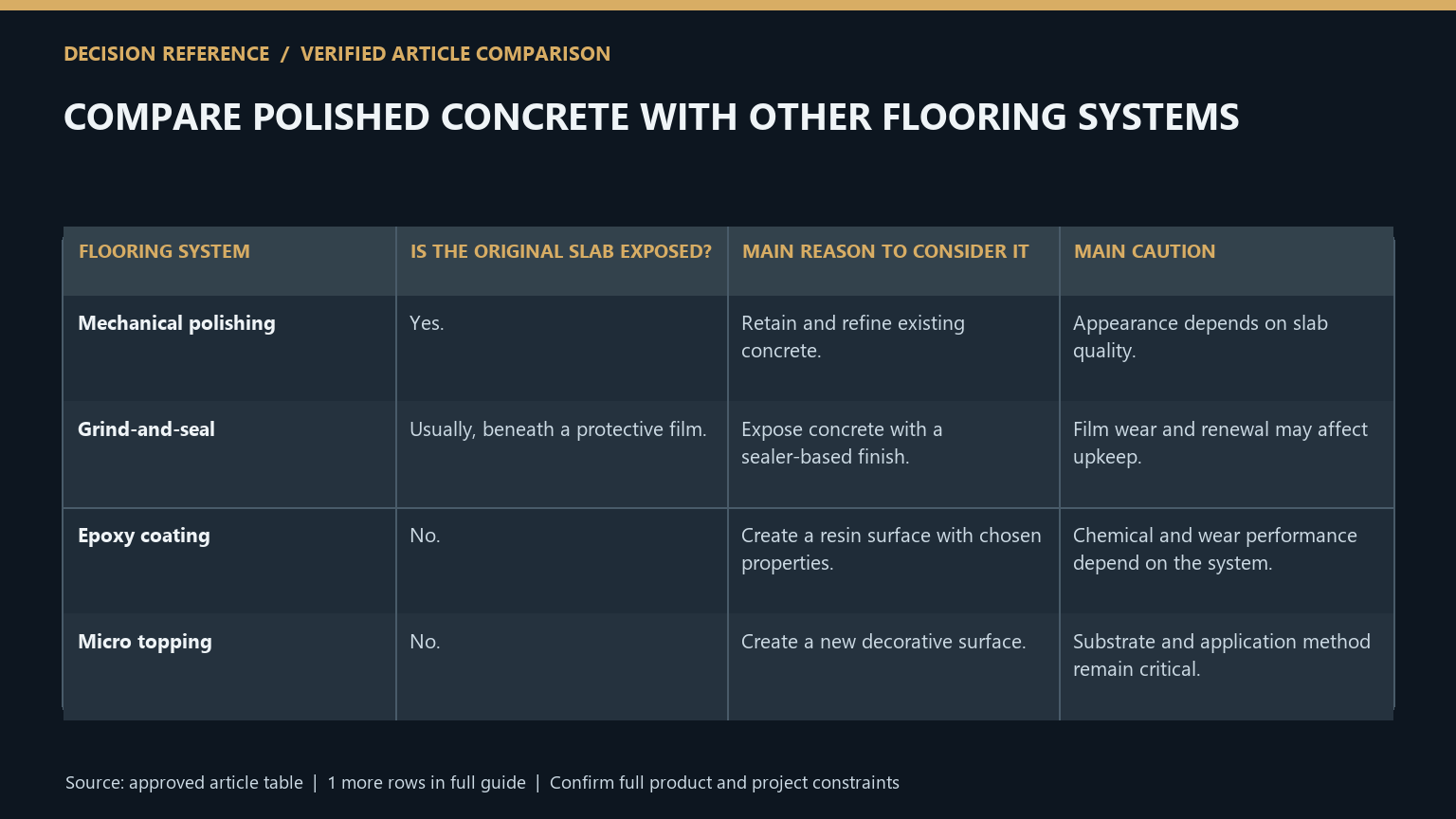
The Concrete Polishing Council (CPC) sets out four appearance levels. Its February 2024 chart uses distinctness of image, or DOI, to describe reflection clarity. The levels offer a way to turn broad design words into defined finish targets.
| CPC level | Appearance | Average DOI | Optional average gloss | Buyer consideration |
|---|---|---|---|---|
| Level 1 | Ground or flat. | 0–9 | Below 10. | Suits a low-reflection design brief. |
| Level 2 | Honed or satin. | 10–39 | 5–25. | Offers a softer reflected appearance. |
| Level 3 | Polished. | 40–69 | Above 35. | Suits projects seeking clearer reflections. |
| Level 4 | Highly polished. | Above 70 | Above 50. | Suits projects prioritizing sharp reflections. |
Source: CPC Polished Concrete Appearance Chart, February 2024. The chart also specifies average haze below 12 for all four levels. Gloss is an optional measurement within this framework.
DOI describes how clearly objects appear in a reflected image. Gloss describes reflected light. A floor may register shine without showing a sharp reflection. Neither measurement establishes slip resistance, stain protection or structural suitability.
For a large showroom, Level 3 may be a useful design target. A facility seeking a softer appearance may prefer Level 2. Neither is automatically the best choice for every floor. Ask the contractor to produce a representative sample before approving the full area.
Aggregate Exposure Changes the Floor’s Character
Aggregate exposure describes how much stone within the concrete becomes visible after grinding. Shallow grinding may retain more of the original cement surface. Deeper grinding can reveal more stone, though the result depends on how the slab was made.
The CPC’s guidance on aggregate classes and appearance levels uses three aggregate-exposure classes and four sheen levels. It advises specifying the visual result rather than relying only on grinding steps.
This matters in existing Dubai buildings. One floor section may contain different stone, old repairs or colour changes. Removing more concrete cannot guarantee that every area will look alike. A sample made only in the best-looking corner may create false expectations.
Select sample areas that represent normal and less uniform parts of the slab. Record the approved exposure, finish level and accepted variations. Where a uniform appearance is essential, assess whether the existing concrete can realistically provide it.
A promise of a 3,000-grit finish cannot replace an agreed appearance target. Grit identifies an abrasive stage, not a guaranteed DOI reading. Specify what the completed floor must look like and how that result will be assessed.
Check Whether Existing Concrete Can Be Polished
Existing concrete can be polished when its condition supports the planned work. A site assessment must come before a firm finish promise. Grinding can expose existing problems rather than conceal them.
A slab may look sound from a distance but contain weak surface layers, old coatings or hidden repairs. It may also have movement at joints or cracks. These conditions affect the method, appearance, price and sometimes the choice of flooring system.
Existing Slab Suitability Checklist
A useful initial inspection considers the floor as a whole, not just its colour. Use the following checks to prepare for an on-site contractor assessment. Record visible problems and operational needs before agreeing on the proposed finish.
- Existing finish: Identify coatings, adhesives, sealers and past treatments that may need removal.
- Cracks and joints: Record visible cracks, joint movement and damaged edges. Ask which defects need specialist review.
- Surface soundness: Check for loose, weak or deteriorating concrete that could affect the finished floor.
- Stains and contamination: Identify oil, chemicals and ingrained marks that might remain visible.
- Flatness and damage: Note uneven areas, patches, deep scratches and damaged sections.
- Aggregate appearance: Decide whether exposed stone and natural colour changes are acceptable.
- Building use: Record pedestrian traffic, wheeled loads, cleaning methods and likely spills.
- Work restrictions: Confirm access, permitted hours, dust controls, occupied areas and downtime.
- Safety needs: Identify ramps, wet zones and other places needing a defined friction result.
- Sample feasibility: Reserve a suitable area for trial grinding and finish approval.
This checklist identifies concerns, not engineering conclusions. Visual inspection cannot prove concrete strength, structural stability or moisture suitability. Suspected movement, serious damage or other technical risks may require further testing and qualified review.
Crown Edge advertises floor grinding, surface preparation and crack repair among its flooring services. Such work may form part of preparing an existing slab, even when the final finish has not yet been chosen.
Defects That Can Change the Project
Not every crack rules out polishing. Some defects may be repaired before finishing. Yet repairs can remain visible when the surrounding concrete is exposed. Agree on the acceptable visual difference through a sample.
Active movement raises a separate concern. A surface treatment cannot fix a structural problem or stop a moving joint. Deep cracks, failed joints and signs of slab movement need suitable technical review before cosmetic work begins.
Old adhesive can also change the scope. Removal may reveal marks or concrete with a different texture. Heavy staining may extend below the layer that can reasonably be ground away. Grinding deeper solely to chase a stain may change aggregate exposure across the room.
Moisture needs attention when the planned treatment or alternative flooring system depends on it. A slab that looks dry is not proof of suitable moisture conditions.
For a badly damaged floor, polishing may require extensive preparation and still produce an uneven appearance. Compare local repair, resurfacing or replacement before committing to a finish. The cheapest-looking method at the start may not provide the best completed floor.
Compare Polished Concrete with Other Flooring Systems
Mechanical polishing, grind-and-seal, epoxy and decorative overlays are different systems. They may create similar-looking floors but have distinct surface properties and maintenance needs. Choose the system around the actual use of the space.
The Concrete Polishing Council glossary distinguishes grinding, honing, polishing and film-forming products. These terms help buyers identify what a quotation is actually offering.
Flooring System Decision Matrix
A natural concrete appearance does not always require the same construction method. The following matrix separates five common approaches by surface type, use and limitations. It is a selection aid, not a universal ranking of durability or cost.
| Flooring system | Is the original slab exposed? | Main reason to consider it | Main caution |
|---|---|---|---|
| Mechanical polishing | Yes. | Retain and refine existing concrete. | Appearance depends on slab quality. |
| Grind-and-seal | Usually, beneath a protective film. | Expose concrete with a sealer-based finish. | Film wear and renewal may affect upkeep. |
| Epoxy coating | No. | Create a resin surface with chosen properties. | Chemical and wear performance depend on the system. |
| Micro topping | No. | Create a new decorative surface. | Substrate and application method remain critical. |
| Decorative polished screed | No. | Install a purpose-made surface for later finishing. | Thickness and curing depend on the product. |
The first decision is whether the original slab should remain visible. If its colour and repairs are unacceptable, polishing alone may not achieve the design. If chemical exposure demands a defined protective barrier, a coating system may deserve closer review.
A Dubai service comparison from United Concrete Grinding also presents mechanical polishing, grind-and-seal and epoxy as separate offerings. Supplier descriptions help explain local terminology, though they do not prove comparative performance.
Mechanical Polishing Versus Grind-and-Seal
Mechanical polishing refines concrete with abrasives. The process may include a densifier and suitable protective treatment. A densifier acts on the concrete’s near-surface properties. It is not automatically equivalent to a film-forming resin coating.
Grind-and-seal work generally combines grinding with an applied sealer. The surface may resemble polished concrete, especially at first. Yet an applied film can have different wear, repair and renewal needs.
Ask which layer creates the final appearance. Is the shine mainly the result of mechanical refinement or an applied coating? The answer affects product selection, maintenance instructions and the likely scope of future work.
Polished Concrete Versus Epoxy Flooring
Choose a floor around its operating conditions, not shine alone. A dry showroom may favour exposed polished concrete. A workshop handling oils, cleaners or process liquids may need a more defined protective surface.
Crown Edge describes epoxy flooring systems for commercial and industrial use. Resin floors can be specified with different finishes and protective properties.
Epoxy, however, is not one fixed level of chemical protection. Performance depends on the chosen products, surface preparation, full system design and exposure conditions.
For demanding areas, request product data for the actual chemicals, traffic and cleaning methods. Ask about joint movement, damaged coatings and repair procedures. Do not assume every epoxy system will outperform every polished slab.
Polishing Versus Micro Topping and New Screed
Micro topping creates a new decorative surface over a prepared base. It does not simply polish the original structural concrete.
Crown Edge’s micro topping works offer a separate decorative approach. This may suit a floor with uneven visual character or a project requiring a different surface appearance.
Where floor levels or substrate quality need correction, floor screeding services may form part of the work. Self-levelling flooring can address suitable levelling needs. Yet an ordinary levelling product is not automatically a polished finished wear surface. Check its permitted use against product data.
Some suppliers provide purpose-made decorative polished screeds. Duphill’s polished concrete system describes a proprietary screed around 20–50 mm thick and a conditional five-to-seven-day treatment timeline.
Those figures apply to that described system. They are not universal thickness or curing rules for new structural slabs or all decorative overlays. The chosen product must fit the available floor height, substrate condition and project schedule.
Concrete Polishing Costs in Dubai
Concrete polishing has no independently established single market-average rate for Dubai in the available research. A useful quotation must match the slab, finish, area and scope of work.
One Dubai supplier, RBS Group, advertised installed polishing from AED 180/m², with pricing marked reviewed on September 18, 2026. At that advertised starting rate, 100 m² gives a basic illustration of AED 18,000.
That calculation is not a project quotation. The figure is one supplier’s promotional starting price, not an audited Dubai average, a guaranteed price or a Crown Edge rate. RBS also explains in its September 2026 UAE concrete polishing cost guide that actual prices depend on site conditions.
A price per square metre is useful only when the underlying work is clear. Repairs, coating removal, edge detailing and work restrictions can change the total. The quoted finish also needs a defined method of acceptance.
What Changes the Price?
The main cost drivers are the steps needed to create the agreed floor. Two spaces with the same area can require very different work. Before pricing, inspect the factors below and decide which belong in the base scope.
| Cost factor | What to check before pricing |
|---|---|
| Existing slab | Weak concrete, cracks, patches and uneven areas. |
| Coating removal | Type and extent of old finishes or adhesives. |
| Aggregate exposure | Grinding needed to reveal the desired material. |
| Appearance target | Required polishing work and acceptance level. |
| Edges and corners | Access for edge tools and detailing. |
| Surface treatment | Densifier and proposed protective products. |
| Floor area and layout | Total m², separate rooms and obstacles. |
| Site restrictions | Working hours, dust isolation and access. |
| Mobilization | Equipment transport, setup and minimum charges. |
Consider an open 100 m² floor beside a 100 m² area split into several occupied retail rooms. The second site may need more edge work, protection and separate work phases. Equal area does not imply equal cost.
Ask bidders to separate confirmed preparation from work that depends on hidden conditions. A provisional allowance for major repairs should be labelled as such. This keeps unexpected findings from being mistaken for included work.
Compare Written Quotations on the Same Basis
A lower AED/m² figure has limited value if it excludes essential work. Ask each contractor to quote the same area, finish and working conditions. A useful written comparison should cover the following items.
| Quote field | Required detail |
|---|---|
| Floor area | Measured total in m². |
| Current condition | Inspection findings and defects. |
| Preparation | Cleaning, stripping, grinding and repairs. |
| Aggregate exposure | Agreed exposure class or sample result. |
| Finish | Target appearance and DOI where specified. |
| Treatments | Named densifier and protective products, if any. |
| Edge work | Perimeters, corners and difficult areas. |
| Safety controls | Dust management, isolation and site protection. |
| Quality checks | Mockup, inspection and acceptance method. |
| Programme | Working days, access and reopening conditions. |
| Commercial terms | AED/m², total AED, VAT and exclusions. |
| Handover | Final cleaning, care guidance and treatment records. |
The total price should explain what the buyer receives. VAT treatment, mobilization, repair allowances and excluded work may change the final amount. A proposal using a different flooring system should be assessed separately rather than compared only by price.
For the best comparison, obtain a site assessment first. Then send the same finish brief and operating conditions to each bidder. This reveals genuine differences in scope instead of hiding them behind headline rates.
Specify Slip Safety, Dust Control and Site Rules
A polished appearance does not establish slip safety. Grinding dust also needs its own control plan. Treat these as separate decisions alongside the finished floor’s appearance and durability.
Dubai projects can range from vacant new buildings to occupied offices. Each setting creates different work risks. A vacant warehouse may permit broad work zones, while a live retail site needs closer control of access, noise and dust.
Specify safety needs before the contractor prices the job. This includes where testing is needed, which areas must remain open and who approves the work method. A polished surface should be judged by its intended conditions, not a photograph or sales description.
Test Surface Friction Where Needed
A shiny floor may look slippery. A less reflective surface may appear safer. Neither impression provides a reliable friction result.
The relevant assessment depends on footwear, water, contaminants, traffic and surface conditions. Wet entrances, ramps, food-service areas and other high-risk locations deserve particular care.
ASTM E303-22 describes a British Pendulum Tester method for assessing surface friction. The standard notes that its results may not agree with results from other methods.
Do not treat a pendulum result as interchangeable with every other slip test. No universal passing number for all Dubai polished concrete floors was established in the verified research.
For a wet entrance, agree on the test method and conditions before work begins. State whether the floor will be tested wet, dry or under other relevant conditions. The acceptance requirement should reflect the site’s use and applicable local rules.
If the chosen system cannot meet the required result, consider another finish or treatment. A more reflective appearance should never override a defined safety need.
Control Concrete Grinding Dust
Grinding concrete can release respirable crystalline silica. This fine dust can harm workers if exposure is not controlled. Dust can also spread into occupied rooms or nearby work areas.
The contractor should plan suitable extraction or wet methods, isolation, cleanup and worker protection. These controls must match the equipment and task. A small handheld edge grinder may need a different approach from a large floor grinder.
The US Occupational Safety and Health Administration provides technical guidance on silica dust from grinding. For certain handheld-grinder collection systems, its guidance includes airflow of at least 25 cfm per inch of wheel diameter and 99% filtration efficiency.
These are US tool-specific figures. They are not universal settings for all floor grinders or automatic Dubai legal requirements.
An occupied Dubai office presents further concerns. Ask how nearby staff, furniture, ventilation openings and adjoining rooms will be protected. Confirm how dust will be collected and waste removed. The method should also address site access and safe separation from other building users.
Dust control should appear in the proposed work method and price. Leaving it undefined can lead to disruption and extra cost after work begins.
Check Dubai Building Requirements
Confirm the rules that apply to the actual building before work starts. Landlord conditions, facility procedures and authority requirements may affect access, preparation and the work schedule.
The Dubai Municipality building publications portal provides official construction and building guidance. Relevant provisions depend on the site and type of work.
Dubai’s Law No. 5 of 2025 Concerning Public Health also forms part of the wider public-health and built-environment context. It should not be treated as proof of a specific concrete-polishing permit.
For a commercial project, identify who controls site access and work approval. The responsible party may include building management, the landlord or a relevant local or free-zone authority. Ask which fit-out, safety and work-permit conditions apply.
The verified research did not establish a universal Dubai polishing permit or mandatory adoption of CPC appearance levels. US standards alone cannot demonstrate compliance with local requirements.
A complete proposal should make the contractor’s safety approach clear. Buyers should know how work areas will be protected, how dust will be controlled and what conditions must be met before reopening.
What a Concrete Polishing Contractor Should Include
A sound polishing proposal defines the actual system, expected finish and method of acceptance. It should give the buyer a clear basis for reviewing completed work.
A contractor can describe ten grinding stages without defining the final appearance. Another may identify a measurable target and approved sample without prescribing every tool pass. The second approach is often more useful for comparing the promised result.
Define Scope and Materials
The written proposal should identify the floor area, present condition and required preparation. Record coating removal, cracks, repairs and grinding work. Identify how edges, columns, stairs and difficult areas will be treated.
Specify aggregate exposure and the intended CPC appearance level when that framework is adopted. Name the densifier and any protective treatment. Ask for product data where chemical resistance, stain protection or maintenance limits matter.
Separate confirmed work from provisional allowances. Hidden damage may change the job, but any basis for extra charges should be clear. The proposal should also identify exclusions, work hours and site protection needs.
Agree on the Mockup and Acceptance Record
Approve a representative sample before full-scale work. It should reflect the floor’s actual condition and the agreed appearance. Keep a dated record of the sample and accepted variations.
The CPC appearance chart provides a measurement framework. For areas up to 1,000 ft², it calls for at least three distributed measurements. It adds one measurement for each further 1,000 ft² or fraction thereof.
This is CPC guidance, not an automatic Dubai inspection rule. If adopted, the contract should define the selected method, locations and acceptance terms.
A completed acceptance record should contain real findings, not empty boxes presented as proof. The following structure shows what the contractor and buyer should document during the final inspection.
| Record item | What to document |
|---|---|
| Approved sample | Location, date and sample identification. |
| Aggregate exposure | Agreed exposure and acceptable variation. |
| Appearance level | CPC target or agreed visual result. |
| Test method | Instrument and measurement procedure. |
| Inspection locations | Agreed sampling plan and floor zones. |
| Actual results | Measured readings and observed defects. |
| Approval | Responsible person and decision date. |
| Surface treatments | Products and completed treatment stages. |
| Handover | Cleaning guidance and remaining exclusions. |
Actual readings and approvals must be recorded after testing. The table defines the evidence to collect; it does not invent results for an untested project.
The CPC chart cites ASTM D5767 for DOI and ASTM D4039 for haze. Use these methods only when relevant to the agreed inspection plan. The final comparison should consider the approved sample, measured results and acceptable visual variation together.
Avoid vague acceptance terms such as premium shine or mirror finish. They may sound appealing, but neither defines a measurable obligation. A clear record reduces disputes over the expected finish.
Maintain the Finished Polished Concrete
Polished concrete needs regular cleaning and suitable care. Its upkeep depends on the original slab, treatment products, traffic and contaminants. A polished surface should not be sold as maintenance-free or universally stain-proof.
An office lobby and a warehouse may need different care plans. Fine grit near an entrance can wear busy routes. Oils, dyes and aggressive cleaners create other concerns. The contractor’s handover should address the conditions the floor will face.
Care also starts before opening the completed area. Confirm when normal use can resume and whether any treatment needs protection during its early service period. Use the actual product instructions rather than a generic reopening promise.
Daily Cleaning and Spill Response
Remove grit and loose dirt before they abrade the surface. Choose cleaning products compatible with the installed concrete and treatments. Strong chemicals should not be used without checking suitability.
A cleaner that works on one coated floor may harm another finish. Ask whether the contractor recommends a particular cleaning product, dilution or method. Keep the guidance available to the cleaning team rather than only the project manager.
Deal with spills promptly. Oils, dyes and food products may affect some floors even after polishing. Where spills are routine, assess stain protection and chemical needs before choosing the system.
Polishing does not make concrete automatically waterproof. A treatment may improve selected properties, but its limits still matter. If a project needs a protective barrier, that need should have influenced the original flooring choice.
Keep the Agreed Finish Looking Consistent
Heavy traffic may change the appearance of busy routes over time. Entrance grit, wheeled equipment and uneven cleaning can all affect the surface. Strong directional lighting may make these changes more noticeable.
Use suitable entrance protection and a cleaning routine matched to the site’s soil load. For a showroom, check the appearance under normal display lighting. A warehouse manager may place greater emphasis on practical cleaning and joint condition.
Keep records of any protective treatments used. Some products may need renewal, while mechanically refined concrete may call for other care methods. A single maintenance programme cannot cover every system.
Ask the contractor to explain which changes can be handled through cleaning and which need specialist review. Do not assume that loss of shine always calls for the same abrasive process.
There is no verified universal repolishing interval for Dubai buildings. Base future work on product instructions, actual wear and the required appearance. Written handover guidance gives building staff a more reliable starting point than a general promise of long life.
Frequently Asked Questions
These common questions cover practical limits that can affect the choice of flooring system. The final answer for any specific project still depends on the slab, its use and the agreed scope.
Can an old concrete floor be polished?
Yes, if the slab is suitable. Age alone does not decide the result. Surface strength, cracks, coatings and repairs matter more. Some old floors polish well, while others require substantial preparation or another finish.
How long does concrete polishing take?
The time depends on floor area, condition, grinding depth and finish target. Repairs, treatments and site access can extend the schedule. Request a project-specific programme rather than relying on a universal daily production rate.
Is polished concrete waterproof or stain-proof?
No general guarantee is justified. Concrete can still be affected by liquids and contaminants. Protection depends on the slab and chosen treatments. Match the system to the site’s likely spills and cleaning needs.
Can polished concrete be used in a warehouse?
Yes, for suitable warehouse conditions. Check wheeled traffic, surface wear, joints, cleaning and chemical exposure. Where a defined protective barrier is needed, compare polishing with a suitable coating system.
Is polished concrete slippery when wet?
Wet performance depends on the surface, contaminants, footwear and other conditions. Gloss alone does not establish slip safety. Use an appropriate friction test and project-specific acceptance criteria where wet-slip risk matters.
Can polishing remove cracks and stains?
Grinding may reduce some surface marks but cannot reliably remove every deep stain or crack. Repairs can remain visible. Active cracks need separate assessment. A sample helps establish a realistic appearance.
Is polished concrete cheaper than epoxy in Dubai?
Neither is always cheaper. Repairs, coating products, finish targets, access and upkeep affect the total cost. Compare full quotations for systems that meet the same operating needs.
Does Crown Edge offer complete mechanical concrete polishing?
Crown Edge’s published services include grinding, surface preparation, repairs, epoxy flooring and decorative micro topping. Complete mechanical polishing capability, available finish levels and polishing-specific terms require direct confirmation. Ask which services and treatments can be included in the proposed project.
Next Step: Prepare a Floor Assessment and Finish Brief
A useful concrete polishing enquiry starts with floor condition and intended use. Give each contractor the same project facts before requesting a final price. That makes the proposed finish, preparation and cost easier to compare.
Record the floor area, building location and current finish. Add photographs of cracks, stains, joints and damaged sections. Describe the traffic, cleaning methods and likely chemical exposure. These details help identify whether the existing slab is a realistic candidate for polishing.
Choose a preferred appearance using the finish selector. State whether visible aggregate is acceptable and whether a sample is required. If using CPC levels, include the intended appearance and agreed acceptance method.
Explain access hours, dust restrictions, desired work dates and any landlord or facility rules. Ask bidders to identify assumptions and provisional repair work rather than hiding these costs within one square-metre price.
Crown Edge’s documented services provide a route to discuss grinding, preparation, repairs and alternative flooring finishes in Dubai. Confirm whether a complete mechanical polishing system is available before including it in the proposed work scope.
The aim is a floor system suited to the site, with a finish both parties can assess and a price tied to clear work and acceptance terms.