

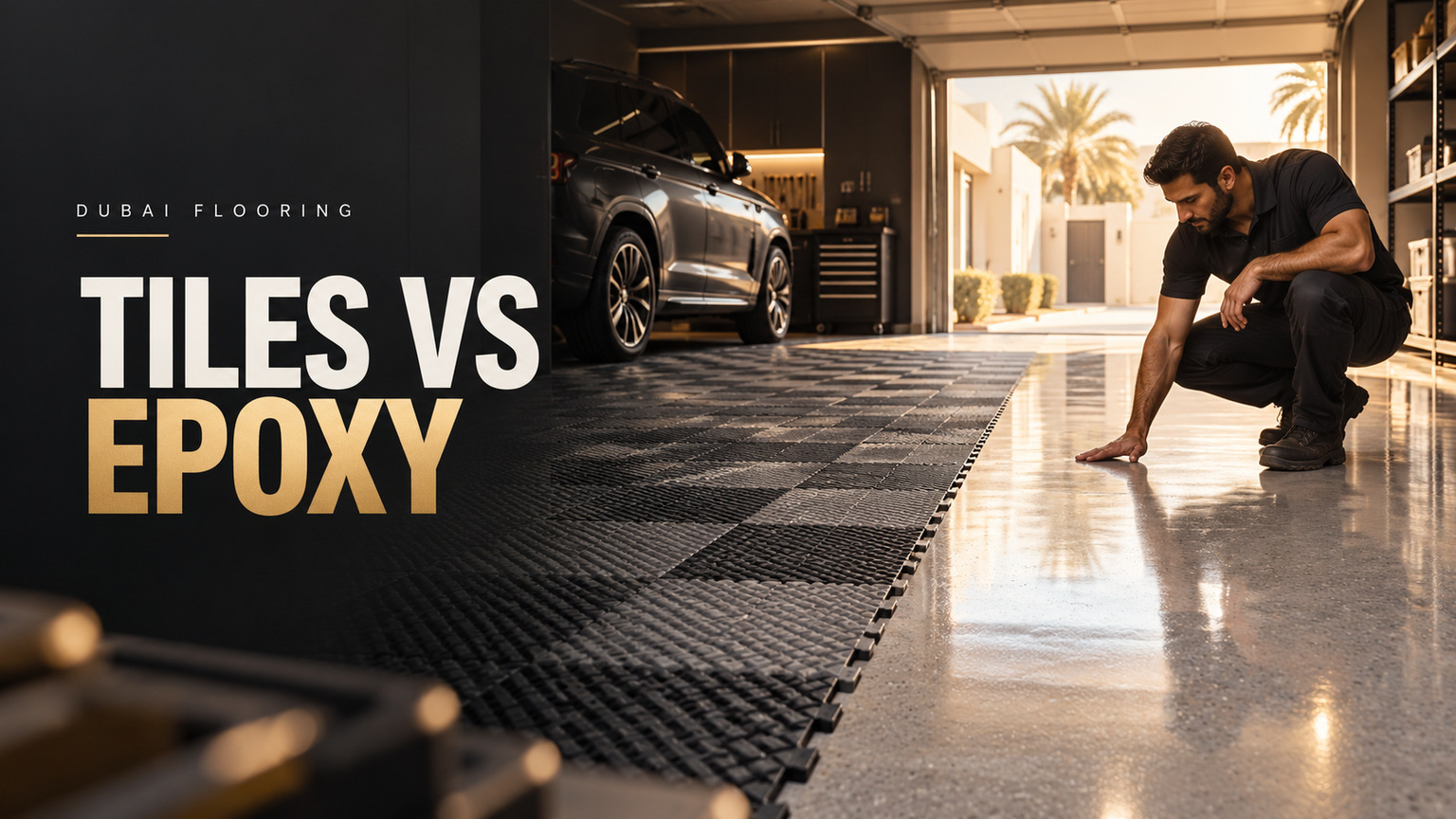

Garage Tiles vs Epoxy in Dubai: Cost, Durability and Best Uses
Quick Answer
Epoxy is often the better choice for Dubai garages that need a seamless, lasting finish over sound, well-prepared concrete. Interlocking garage tiles suit owners who want faster fitting, easy repairs and a floor they can remove. The best choice also depends on direct sunlight, slab moisture, vehicle use and total installed cost.
Key Takeaways
The best garage floor depends on how the space is used. Before comparing prices, check the slab, sunlight and work needed for each system.
- Epoxy bonds to concrete, so proper grinding, cleaning and moisture checks are vital before coating a garage floor.
- Interlocking garage tiles need no resin curing and allow damaged pieces to be replaced without lifting the entire floor.
- Direct sunlight can change the colour of some epoxy coatings, making documented UV protection valuable in Dubai garages.
- Published Dubai garage flooring prices overlap, so neither epoxy nor modular tiles are always the cheaper option.
- Open-profile tiles let water and dirt pass below the surface, where some cleaning work may still be needed.
- Modular tile systems need room for heat expansion, while their thickness can affect garage doors and entrance levels.
- A useful flooring quote must name the product, floor preparation, fitting work, expected downtime and warranty terms.
For a shaded garage with sound concrete, epoxy is a strong choice. For quick fitting or easy replacement, modular tiles may suit better. Neither option should be chosen on price alone.
Garage Tiles vs Epoxy: Which Works Best for Your Garage?
Epoxy creates a continuous coating bonded to the concrete. Interlocking garage tiles form a separate surface above the slab. That one difference affects fitting, cleaning, repair and long-term use.
A well-planned epoxy system can give a garage a smooth, finished look. It also keeps oil and dirt on the exposed surface, where they can be cleaned. Tiles offer a different benefit. They can be fitted without coating the concrete and removed when needed.
Garage Flooring Decision Matrix
The comparison below focuses on professionally applied epoxy and interlocking polypropylene or PVC tiles. It shows what each system can offer in a typical Dubai home garage. Exact results depend on the products and site conditions.
| Decision factor | Epoxy flooring | Interlocking garage tiles | What to check |
|---|---|---|---|
| Floor construction | Bonds to prepared concrete. | Forms a removable layer above concrete. | Slab condition and intended use. |
| Surface finish | Continuous, with no tile joints. | Visible joints and tile edges. | Desired appearance and cleaning method. |
| Fitting | Requires prep, coating and curing. | Requires layout, fitting and edge work. | Vehicle return date. |
| Moisture | Must meet coating system limits. | No epoxy bond, but moisture still matters. | Slab testing and drainage. |
| Direct sunlight | Needs a suitable exposed coating. | Needs a suitably UV-rated tile. | Product data for the exact system. |
| Repairs | Local coating repair may be possible. | Individual tiles can be removed. | Spares and finish matching. |
| Oil and dirt | Stay on the exposed coated surface. | May enter joints or open tile channels. | Cleaning access and chemical resistance. |
| Floor height | Depends on coating build and prep. | Adds the full tile system height. | Door, threshold and ramp clearance. |
| Heat movement | Depends on the coating and substrate. | Needs manufacturer-specified expansion space. | Entrance exposure and perimeter gaps. |
| Cost | Driven by prep, system and thickness. | Driven by tile grade, quantity and fitting. | Complete installed price. |
The strongest choice becomes clearer once the garage’s main need is known. A smooth floor that is cleaned often favors a suitable resin system. A floor that may need to be lifted or changed favors modular tiles.
Durability alone does not settle the choice. A well-made tile and a correctly applied coating can both serve vehicle areas. The exact product matters more than the broad category name.
What Counts as a Garage Tile?
Not every product sold as a garage tile works the same way.
Rigid polypropylene tiles usually connect through molded locking edges. PVC modular tiles are another option, often supplied in solid or textured forms. Their flexibility, thickness and load limits vary by product.
Porcelain is different. It is bonded to the floor with tile adhesive and uses grout joints. It is not a removable modular system. A Dubai epoxy-versus-porcelain comparison from RBS Group discusses that separate choice.
For the rest of this comparison, garage tiles means interlocking modular PP or PVC flooring unless stated otherwise.
Check the Concrete Before Choosing Epoxy
The concrete slab is the first major test for epoxy. If it is weak, dirty or too damp, even a costly coating may have trouble bonding. Good floor prep is part of the system, not an optional upgrade.
Modular tiles avoid the need for a resin bond. Yet they still need a stable base. Loose, damaged or unsafe concrete should not be hidden beneath a new surface without checking the cause.
Moisture, Strength and Surface Preparation
Epoxy needs a sound surface that is free from grease, dust and weak concrete. Mechanical grinding or similar work helps remove weak material and prepare the surface for the coating system.
The Sika Sikafloor Garage product instructions give one useful technical example. Its stated limits show why a contractor must check the slab and site before starting work.
| Sika Garage condition | Published requirement |
|---|---|
| Concrete compressive strength | At least 25 N/mm². |
| Concrete tensile strength | At least 1.5 N/mm². |
| Application temperature | +10°C to +30°C. |
| Relative humidity | No more than 80%. |
| Temperature above dew point | At least 3°C. |
| Concrete moisture | Test-method-specific limits apply. |
These figures belong to the named Sika product. They are not universal rules for all epoxy floors.
The temperature limits also matter in Dubai. A hot garage or warm slab may sit outside a product’s fitting range. The contractor may need a different system or work plan. A coating should not be applied outside its stated limits simply to meet a deadline.
Moisture deserves its own check. ASTM D4263-24 describes a plastic-sheet method used to indicate moisture in concrete before coating. It also warns that capillary moisture can harm some coating systems.
ASTM F2170 covers internal relative-humidity testing in concrete slabs. It helps assess moisture conditions for floor systems where the method applies. Neither standard gives every epoxy product the same moisture limit.
A slab can look dry yet still hold excess moisture. Ask which test will be used and which result the chosen coating permits. If the result falls outside the product limits, the project needs a different plan.
Cracks, Oil Stains and Uneven Concrete
A garage floor often has more than one surface problem. An oil stain may need deep cleaning. A crack may need repair before coating. High spots and low areas can also affect the finished result.
Some floors need self-levelling flooring work to improve the surface. This can help where the slab is uneven. The type of levelling material must suit the planned finish and service loads.
Grinding, crack work and other floor preparation services may also form part of the job. They should appear clearly in the contractor’s quote.
There is a difference between a small surface crack and a slab that keeps moving. A decorative coating is not a structural repair. Ongoing movement needs proper assessment before either flooring choice is made.
When Modular Tiles May Avoid Bonding Work
Interlocking tiles do not depend on an epoxy bond to the concrete. That can be useful where an owner wants a removable floor or less coating work.
Still, water trapped below tiles may need attention. Dirt can also collect under some open-profile systems. A tile floor should not be used to hide active leaks or major slab defects.
For a sound but stained garage floor, modular tiles may be worth considering. For a slab with damp patches, loose concrete or deep cracks, find the cause first. The finished surface cannot fix the problem below it.
Dubai Heat and Sunlight Change the Choice
Direct sunlight is a major reason to check the exact flooring product. A shaded villa garage and an open garage entrance do not face the same exposure.
Some epoxy coatings may change colour under sunlight. UV-stable coating systems and UV-stabilized modular tiles can help, but each product needs proof of suitability. Heat also affects how modular tiles are fitted.
Epoxy Colour Change and UV-Stable Finishes
A change in epoxy colour does not always mean the floor has failed. Colour stability and physical strength are different properties.
Sika notes in its Sikafloor-381 product information that direct sunlight may cause discolouration or colour variation without harming functional performance.
That detail matters near a Dubai garage door. Sunlight may reach the front of the floor while the rear stays shaded. A finish that looks even on day one may age at different rates across those areas.
Sika’s GCC flooring system range includes UV-stable car-park systems. Such products show that sun exposure can be addressed through system design.
Ask the epoxy contractor to name the exposed layer. It may be an epoxy finish, a polyurethane topcoat or another resin system. The supplier should confirm its UV suitability in writing. Do not assume every clear topcoat protects against yellowing.
Modular Tile Heat Limits and Expansion Gaps
Quality modular tiles may be designed for wide temperature ranges. The key is to check the exact material and product data.
For example, Swisstrax Ribtrax Pro uses UV-stabilized polypropylene. The manufacturer publishes these values:
| Ribtrax Pro property | Manufacturer value |
|---|---|
| Tile dimensions | 40 × 40 cm. |
| Thickness | 1.9 cm. |
| Published temperature range | -30°C to 120°C. |
| Published compression strength | 3,120 psi. |
| Material | UV-stabilized polypropylene. |
These values describe Ribtrax Pro, not all garage tiles. A material temperature rating also does not prove that every vehicle, jack or concentrated load is safe on that floor.
Tiles can expand as temperatures change. Swisstrax’s tile fitting instructions call for an expansion gap at fixed edges. The stated minimum is 1/4 inch for Ribtrax and Ribtrax Smooth. Some other styles need 1/2 inch.
Those are specific product instructions. Other brands may need different gaps.
A tile floor that fits tightly against every wall may have no room to move. Before fitting, check the manufacturer’s heat guidance and perimeter clearance. Pay special attention near the garage entrance, where sun exposure can be stronger.
Also measure the garage door. A thick tile system can reduce the clearance below it. Entrance ramps and door tracks need enough space to work without catching the floor.
Installation Time, Cleaning and Repairs
Interlocking tiles usually have the simpler return-to-service process because they need no resin cure. Epoxy needs time for each required coating stage and the final cure before cars can return.
Daily care also differs. Epoxy creates one exposed surface. Open-profile tiles allow dirt and water to pass below their top face. Owners should choose the cleaning method they are willing to maintain.
How Soon Can You Park Again?
There is no single safe return-to-vehicle time for all epoxy systems. Product chemistry, temperature, coat thickness and site conditions affect the schedule.
A normal coating job can include grinding, cleaning, repairs, priming, coating and curing. Some systems need extra layers. Each step adds work or waiting time.
A modular floor skips the liquid coating and cure stages. Workers still need to plan the layout, cut edge tiles, fit ramps and leave room for heat movement. Cars can return once the complete fitted system is ready for its intended use.
Fast-cure resin systems also exist. An owner should compare the actual vehicle-return time offered in each quote rather than assume all epoxy jobs take the same number of days.
Oil, Water, Sand and Drainage
A continuous epoxy surface can be easy to mop or wipe. It has no modular joints for surface dirt to enter. The chosen resin must still resist the oils, cleaning products and other fluids used in the garage.
Open-profile tiles take a different approach. Their holes let some liquid and loose debris pass below the top surface.
The Swisstrax garage tile FAQ explains how water and debris can move through its open tiles and channels. Tiles may be removed to reach spills or dirt below.
That system can help keep water off the visible walking surface. Yet it does not make spilled oil vanish. Contamination below the tiles may still require cleaning.
Solid modular tiles also have joints. Their cleaning needs depend on the seam design, surface texture and product material.
Think about how the garage is used. A car parking space may need routine dust and sand cleaning. A workshop may see oil, tools and cleaning liquids. The preferred surface may change with that daily use.
Repairing a Damaged Section
Individual replacement is one of the clearest benefits of modular tiles. A damaged tile can often be lifted and replaced without removing the entire floor.
Keep spare tiles from the original batch if possible. Colour and design can change over time. A new replacement may not match older tiles perfectly.
Epoxy can also be repaired in some cases. Small chips or worn areas may be treated locally. Larger damage can need more surface work. The repaired patch may differ in colour or sheen from the rest of the floor.
Repair work should match the cause. If the coating lifts because of slab moisture, patching only the visible spot may not solve the issue. The substrate must be checked first.
Garage Tiles vs Epoxy Cost in Dubai
Published Dubai and UAE garage flooring prices overlap. Both epoxy and interlocking tiles appear at low and high price points. The final installed cost depends on the chosen system and the existing concrete.
A low rate may cover a basic finish over sound concrete. Another quote may include grinding, repairs and a more demanding topcoat. Comparing those two figures without checking scope can lead to the wrong choice.
Published Dubai Price Examples
The following figures come from vendor information recorded in the October 2026 research checkpoint. They are indicative published prices, not a verified market average or a Crown Edge quote. Their inclusions may differ.
| Published source | Flooring system | Indicative price |
|---|---|---|
| Urban Flooring | Solid-colour epoxy | AED 65–110/m². |
| Urban Flooring | Epoxy flake | AED 90–150/m². |
| Renovel | Flake garage epoxy | AED 110–200/m². |
| RBS Group | Garage epoxy starting price | Around AED 160/m². |
| GarageFlooring.ae | Interlocking flooring systems | Around AED 55–160/m². |
| GarageFlooringDubai.com | Listed PVC garage tiles | Around AED 159/m². |
The price range for one system can overlap another by a wide margin. A premium tile may cost more than a basic epoxy coat. A high-build epoxy floor may cost more than a basic tile system.
Retail tile listings may also exclude fitting. Some epoxy quotes may exclude concrete repairs or special preparation. Ask each supplier to state what the price includes before comparing the totals.
Worked Example: A 36 m² Dubai Garage
Consider a 36 m² two-car garage. The size is an illustration, not a claim about every Dubai property. It is useful for showing how the quoted rate affects the total.
Using Urban Flooring’s published solid-epoxy range of AED 65–110/m² gives a simple base calculation:
| Calculation | Lower example | Upper example |
|---|---|---|
| Garage area | 36 m². | 36 m². |
| Published rate | AED 65/m². | AED 110/m². |
| Area × rate | AED 2,340. | AED 3,960. |
These are arithmetic examples based on one vendor’s published rate range. They are not project quotes.
Now suppose a contractor finds repairs or extra treatment that is not part of the base rate. Those costs must be added separately.
Project estimate = floor area × comparable installed rate + separately priced work.
For a tile quote, use the same 36 m² area. Then add any fitting, edge ramps, cutting, delivery and other charges not included in the tile price.
The next step is to compare the full quoted totals. Two AED/m² figures only become useful when they cover equivalent work.
Why Two Quotes Can Differ So Much
Epoxy costs depend on the actual slab. A sound floor that needs standard prep may cost less to coat than one with oil stains, cracks or moisture concerns.
The system itself also affects price. A thin coating is not the same as a thick, self-levelling system. Decorative flakes, added grip and a special topcoat can change the build.
Tile costs depend on material grade, thickness, design, cutting and accessories. A floor with many corners or fixed cabinets may need more fitting work. The garage entrance may also need ramps.
Minimum job charges, access and warranties can affect both choices. A small garage may not receive the same per-square-metre rate as a large open floor.
Ask for a written total that includes materials, labour, preparation, accessories and VAT status. The lowest headline price is not necessarily the lowest finished project cost.
Use Five Checks to Choose the Right Floor
A sound choice can be made with five practical checks. Start with the slab, then assess sunlight and the time the garage can be closed. Cleaning and future repair needs help settle the final preference.
This framework is intended for ordinary home garages. A commercial workshop or heavily loaded service bay may need extra tests and project-specific product approval.
The Five-Gate Garage Flooring Framework
Each gate has a clear action. A failed substrate check should stop the choice until the cause is known. Other gates help rank systems that are suitable for the space.
| Gate | Check | Decision consequence |
|---|---|---|
| 1. Concrete | Is the slab sound and suitable for the planned finish? | Resolve moisture or damage before approval. |
| 2. Sunlight | Does direct sun reach the floor? | Require documented UV suitability. |
| 3. Downtime | How soon must cars return? | Compare tile fitting with the full resin cure schedule. |
| 4. Cleaning | Is a seamless exposed surface preferred? | Suitable epoxy offers a continuous finish. |
| 5. Repair | Must sections be removed or changed easily? | Modular tiles offer individual-piece access. |
Consider a shaded villa garage with sound concrete. The owner wants a clean, seamless floor and can allow time for the coating to cure. A suitable epoxy system is a strong candidate.
Now consider a garage that must reopen quickly. The owner also wants to replace any damaged area without recoating the surface. Interlocking tiles may be the more useful choice, provided the base and tile data meet the needs.
A third garage has moisture marks and visible cracks. Neither a coating nor a new tile surface should be approved on appearance alone. The slab needs assessment first.
The framework does not award points to either material. Instead, it shows which site conditions can rule out a poor choice and which preferences decide between sound options.
Durability: Judge the System, Not the Label
The word durable tells a buyer very little. A useful product claim should identify a measurable property or a clear service condition.
For epoxy, check bond strength, coating build, chemical resistance, UV suitability and vehicle traffic limits. For modular tiles, check the material, load data, heat range, tile support and edge design.
Hot tyres also deserve care. Some low-grade coatings may soften or lift under vehicle use. Yet there is no sound universal tyre-temperature limit that proves all epoxy fails or all epoxy survives.
A properly specified garage resin should be chosen for actual tyre loads and traffic. The same rule applies to tile systems. A tile’s compression rating alone does not show how it behaves under every wheel, jack or point load.
Published service-life claims vary too much to support a fixed winner. Ask about the product warranty, the conditions it covers and the maintenance needed to keep it valid.
What to Check Before Accepting a Garage Flooring Quote
A good quote names the complete flooring system. It should also show the work needed before and after the new floor is fitted. A phrase such as premium epoxy or heavy-duty garage tile is not enough.
The aim is to compare two finished floors, not two material names. Use the following checks to find missing work or weak product information.
Epoxy Quotation Checklist
The contractor should explain both the surface prep and the coating build. A sample colour alone does not show how the floor will perform under a car.
- Name the epoxy or resin products and their manufacturers.
- Describe the grinding, cleaning and crack treatment included in the price.
- State the moisture test method and the acceptable result for the selected system.
- Identify the primer, main coat and exposed topcoat.
- State the planned coating thickness and decorative finish.
- Confirm the finish’s suitability for the garage’s sunlight and vehicle traffic.
- Describe any added texture or slip-resistant treatment.
- Give the full walking and vehicle-return schedule.
- Explain repair terms, warranty cover and important exclusions.
A named product system gives the buyer a way to check the technical data. If a quote only names epoxy, ask for more detail before signing.
Modular Garage Tile Quotation Checklist
Modular tiles need their own set of checks. Focus on material quality, heat movement, vehicle loading and access below the floor.
- Name the tile brand, model and polymer material.
- State tile thickness and the finished floor height.
- Provide suitable vehicle-load and concentrated-load data.
- Confirm heat and UV suitability for the expected exposure.
- Show the required expansion gaps at walls and fixed objects.
- Include cutting, edge ramps and entrance finishing.
- Confirm that doors and tracks will clear the fitted tiles.
- Explain how the area below the tiles can be cleaned.
- Identify replacement-tile availability and warranty conditions.
Keep a few spare tiles when practical. It may save trouble if a matching design is no longer sold in the future.
Compare the Total Installed Scope
Here is a completed decision example for a hypothetical 36 m² garage. It shows how an owner might compare two offers without making up contractor prices.
| Quote item | Epoxy proposal | Modular tile proposal |
|---|---|---|
| Base work | Grinding and cleaning required. | Stable, level base required. |
| Moisture | Product acceptance test needed. | Check moisture and trapped-water risk. |
| Main product | Named primer, resin and topcoat. | Named tile model and material. |
| Heat and sun | Confirm exposed-layer UV suitability. | Confirm UV rating and expansion space. |
| Vehicle return | After stated coating cure. | After fitting is complete. |
| Repair | Coating patch or renewed area. | Individual tile replacement. |
| Extra work | Repairs, texture and special topcoat. | Ramps, cutting and edge finishing. |
| Price check | Full installed total required. | Full installed total required. |
The best offer is the one that meets the garage’s needs at a clear total cost. A cheap quote with missing work may lead to extra charges. A higher price may be reasonable if it includes necessary prep or a better-suited product.
For commercial sites, request any needed fire, slip and load documents as well. Product certifications are not interchangeable across materials or projects.
Garage Tiles vs Epoxy: Frequently Asked Questions
The questions below address the issues that can change a garage flooring decision in Dubai. Heat and vehicle use affect product choice. Moisture can affect a coating’s bond, while repair needs may favor modular tiles. Cost and service life also depend on the full system. These answers focus on residential garages and the specific conditions buyers should check before approving a quote.
Will Hot Car Tyres Damage Epoxy?
Hot tyres can be a problem for some poorly suited or poorly bonded coatings. Yet a correctly specified garage resin can be made for vehicle use. The result depends on the coating, floor prep, cure and traffic conditions. Ask for the manufacturer’s stated vehicle-use limits rather than rely on a blanket promise.
Do Garage Tiles Expand in Dubai Heat?
Yes. Many polymer tiles expand as their temperature rises. The amount and fitting rules depend on the material and tile design. Leave the expansion space required by the manufacturer. This matters most near walls, columns and sunlit garage entrances.
Can Epoxy Be Installed Over Damp Concrete?
Only where the selected coating system allows the measured slab condition. Many common epoxy systems need a dry substrate within stated moisture limits. A floor that looks dry is not proof of compliance. Request an appropriate moisture test and the product’s acceptance criteria.
Which Garage Floor Is Easier to Repair?
Interlocking modular tiles are often easier to replace in small sections. Individual pieces can be lifted and changed. Epoxy can sometimes be patched, but repairs may need more prep and may show a slight colour or sheen difference. Both repairs depend on the cause of damage.
Is Porcelain Tile the Same as Interlocking Garage Tile?
No. Porcelain tiles are bonded with adhesive and have grout joints. Interlocking modular tiles form a separate layer, often without adhesive. Their fitting, repair and moisture behavior differ. A porcelain-versus-epoxy decision needs its own comparison.
Which Option Is Cheapest for a Dubai Two-Car Garage?
Neither is always cheapest. Basic epoxy and modular tile price ranges overlap in published Dubai listings. Floor prep, tile grade, coating thickness and accessories can change the total. Ask suppliers to price the same garage area and list all included work.
Is Epoxy or Tile Better for a Garage Used as a Workshop?
The work being done decides the answer. A seamless resin floor may suit frequent surface cleaning and controlled chemical spills, if the system has suitable resistance. Modular tiles allow replacement and may provide useful drainage. Check tool loads, jacks, liquids and cleaning methods before choosing.
How Long Will Epoxy or Garage Tiles Last?
There is no reliable universal lifespan for either category. Product quality, fitting, traffic, heat and care all affect service life. Manufacturer warranties can also have limits and exclusions. Compare written product terms and real use conditions rather than broad claims of lasting a fixed number of years.
Choose a System, Not Just a Surface Finish
The right garage floor is the one that suits the concrete, vehicle use and daily care needs. Appearance matters, but it should not override the site’s limits.
Start with the slab. Check for moisture, cracks, oil and uneven areas. Then assess sunlight at the garage entrance. Decide how long the space can remain closed and how you want to clean it.
A properly specified epoxy system is worth considering for a seamless, lasting finish. Interlocking tiles offer strong benefits where quick fitting and easy replacement matter more.
For owners considering resin flooring, Crown Edge provides epoxy flooring services for residential and other applications. A site-based quote should identify the proposed coating system and the work included. You can review the company’s broader Dubai flooring services before discussing the project. Its flooring blog is another place to look for site information, although specific related articles should be checked before relying on them.
Whatever product you choose, request a complete written scope. That is the most useful way to compare value, avoid missing work and choose a garage floor with confidence.