

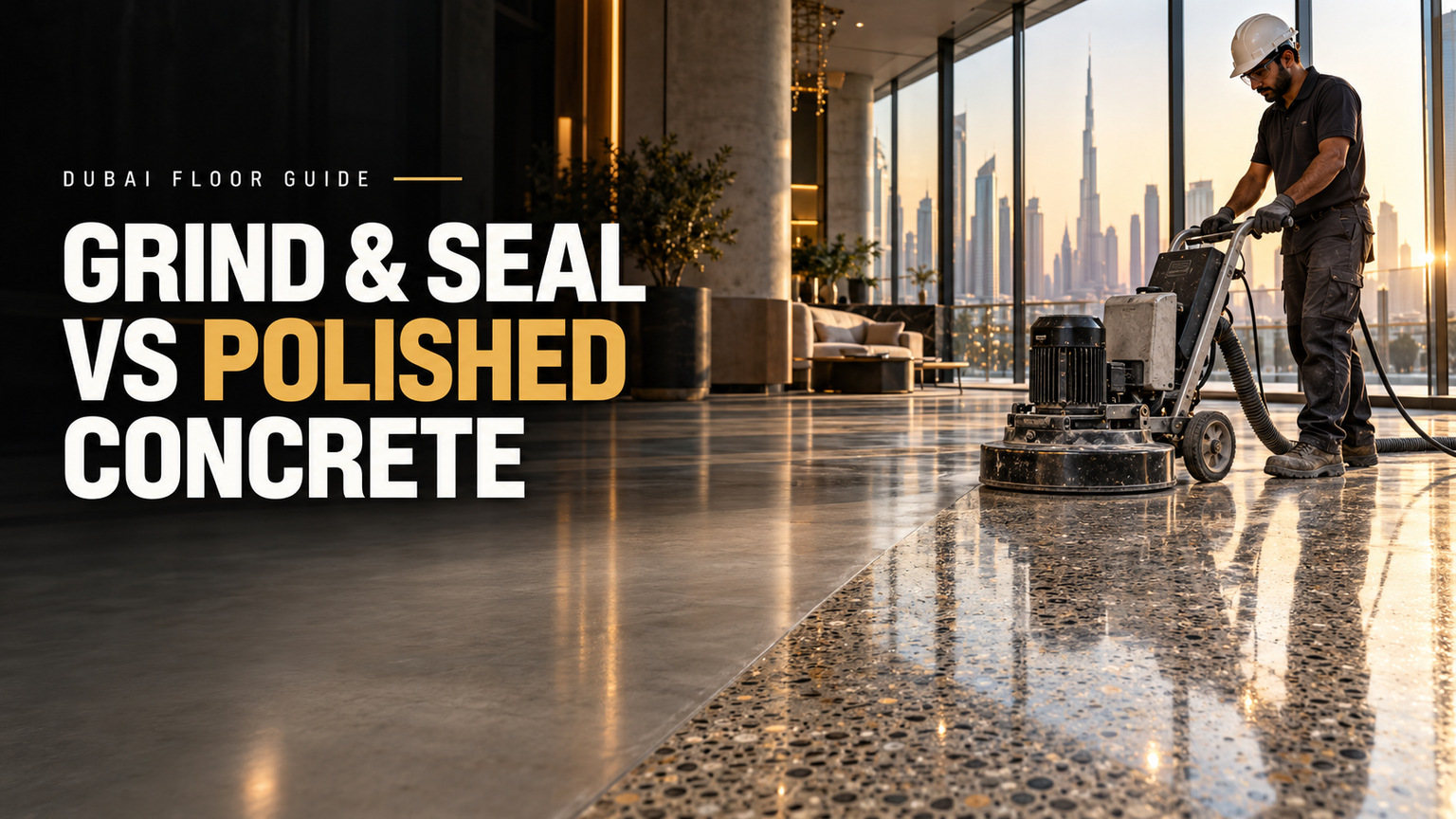

Grind and Seal vs Polished Concrete: Which Is Better for Your Dubai Floor?
Quick Answer
Grind and seal suits floors that need a clear protective coating, while mechanically polished concrete suits sound slabs where the concrete itself forms the main wear surface. Grind and seal relies more on its sealer; polished concrete relies on abrasive refinement. In Dubai, choose based on slab condition, traffic, exposure, safety, and maintenance costs.
Key Takeaways
The right floor depends on more than its final shine. The main differences lie in the finished wear surface, the condition of the concrete, and the care each system will need.
- A conventional grind-and-seal floor gets much of its sheen and protection from a clear coating, while polished concrete develops its finish through grinding and polishing.
- The type of sealer matters more than the grind-and-seal label because acrylic, epoxy, and polyurethane systems have different properties.
- Cracks, old coatings, deep stains, and uneven aggregate can change the finish, preparation work, and total project cost.
- Film-forming grind-and-seal floors may need recoating, while polished concrete still needs routine cleaning and sometimes guard renewal.
- Dubai projects should use the applicable tested slip-resistance requirements rather than judging floor safety by shine or texture alone.
- One Dubai contractor advertised polished concrete from AED 180/m² in October 2026, but that is not a market average.
- Compare full contractor specifications, repair work, maintenance, and downtime before choosing the lower installation quote.
Start with the actual slab and the work the floor must handle. Then compare named products, written scopes, and future upkeep over the same period. A finish that looks cheaper today may not remain the better choice.
Grind and Seal vs Polished Concrete: The Main Differences
The main difference is the surface you walk on. Conventional grind and seal uses a clear coating as a key part of the finished wear layer. Mechanically polished concrete uses grinding, honing, and polishing to refine the concrete itself.
Both can leave natural concrete visible. Both can create an attractive floor. Yet they wear and need care in different ways. A clear coating may be renewed as it wears. Mechanically polished concrete relies less on a thick surface film, though protective treatments may still need care.
The Concrete Polishing Council’s industry glossary defines bonded-abrasive polished concrete as a multi-step mechanical process. Diamond abrasives refine the floor through grinding, honing, and polishing.
By contrast, Westcoat’s Grind & Seal System describes ground concrete finished with a clear topcoat or sealer. This is one documented example of a conventional film-forming system.
Side-by-side flooring comparison
The first comparison is how each finish forms its main wear surface. The next is how that surface handles traffic, spills, cleaning, and repair. Use the table to spot what needs product data before choosing a system.
| Decision factor | Conventional grind and seal | Mechanically polished concrete |
|---|---|---|
| Main finish | Ground concrete with a clear protective coating. | Concrete refined through grinding and polishing. |
| Main wear surface | Sealer or coating film. | Refined concrete, sometimes with a protective guard. |
| Sheen | Depends heavily on the coating. | Depends on abrasive refinement and final treatment. |
| Aggregate exposure | Set by grinding depth. | Set by grinding depth. |
| Stain resistance | Depends on the chosen coating. | Depends on concrete and any protective treatment. |
| Chemical exposure | Requires coating-specific resistance data. | Requires protection-specific resistance data. |
| Maintenance | Cleaning and possible recoating. | Cleaning and possible guard renewal or refinement. |
| Moisture concerns | Coating and primer limits matter. | Slab condition and treatment choice still matter. |
| Slip safety | Finished-system testing may be required. | Finished-system testing may be required. |
| Outdoor suitability | Check coating UV and weather approval. | Check finish and protector approval. |
| Cost | Depends on grinding, coating, and preparation. | Depends on slab condition and polishing scope. |
Appearance alone cannot prove which method was used. A matte floor may have a coating. A glossy floor may be mechanically polished. Ask for the work method and named materials before comparing prices.
How grind and seal is made
The contractor grinds the concrete to remove surface defects and expose the chosen finish. The floor is cleaned and given a clear sealer or coating. A film-forming product creates a protective layer at the surface.
Acrylic, epoxy, and polyurethane are examples of coating types. They can differ in wear resistance, chemical behavior, UV stability, and cleaning needs. The exact product and film thickness matter more than the general name. A clear epoxy system, for example, should not be assumed suitable for direct sun merely because another coating is approved outdoors.
Some contractors use penetrating sealers or hybrid methods under the same grind-and-seal label. Those methods need separate review. The comparison here focuses on conventional systems with a clear film-forming protective layer.
How mechanically polished concrete is made
Mechanical polishing uses a sequence of diamond abrasives. Each pass refines the marks left by the last. A densifier is often used to improve surface hardness and help the polishing process. Further passes develop the intended sheen.
Polished concrete does not always remain chemically untreated. PROSOCO’s concrete flooring product range includes densifiers, guards, and protective treatments. These products serve different needs, such as stain protection and ongoing care.
A penetrating protector is also different from a thick coating film. PROSOCO’s concrete protection guidance describes products that penetrate concrete and help resist water and oil-based stains while retaining its natural appearance.
The useful distinction is not sealer versus no sealer. It is whether the concrete or an applied coating forms the main finished wear surface.
Choose the Right Finish for Your Space
Mechanically polished concrete is worth assessing when the slab can serve as the finished floor. Grind and seal may suit a project that needs a suitable clear protective film. Neither system wins simply because the room is called an office, garage, or warehouse.
Daily use sets the real needs. A dry showroom may place more weight on looks and cleaning. A workshop may need stronger resistance to oil, solvents, or impact. Wet spaces also need tested slip performance.
Dubai floor application guide
Use the following guide to screen the likely options. Each row identifies a starting point, not an approved system. The contractor must still check the slab, materials, and required finished-floor performance.
| Floor use | Practical starting choice | What to check before approval |
|---|---|---|
| Dry retail showroom | Either system may work. | Appearance, traffic, cleaning, and upkeep. |
| Office or reception area | Either system may work. | Sheen, stains, slip needs, and downtime. |
| Dry warehouse | Mechanical polishing may suit the slab. | Wear, joints, loads, and vehicle traffic. |
| Residential garage | Review both systems. | Oil, tyres, cleaners, and chemical resistance. |
| Commercial workshop | Assess exposure before choosing. | Chemicals, impact, abrasion, and repair needs. |
| Wet public area | No default winner. | Tested slip resistance and local rules. |
| Outdoor floor | Product approval is essential. | Sun, heat, water, and wet-slip behavior. |
| Strong chemical exposure | Consider a purpose-built resin system. | Chemical type, strength, contact time, and cleaning. |
A finish that suits a dry retail floor may fail the needs of a wet entrance. Outdoor sun can rule out a coating that works well indoors. Strong chemical exposure may also require a different flooring system altogether. These conditions should outweigh appearance preferences.
Retail, offices, and showrooms
Both finishes can work well as design options where conditions permit. A clear-coated floor can deliver a chosen sheen while keeping the concrete visible. Mechanical polishing may appeal where the owner wants the refined slab to remain the main finished surface.
The slab still controls much of the appearance. Patches, stone patterns, and old marks may remain visible. Review a real sample under the lighting that will be used in the room. A polished floor viewed in daylight can look different under strong retail spotlights.
Warehouses and workshops
A sound, dry warehouse slab can be a candidate for mechanical polishing. Yet the floor must still suit its traffic. Forklift routes, wheel loads, grit, joints, and impact can all affect wear. A system that performs well in storage aisles may not suit a vehicle repair bay.
For workshops, list the liquids that may reach the floor. Engine oil, cleaning agents, strong solvents, and acids are not the same exposure. Ask for chemical-resistance data covering the named product and expected contact conditions.
Where a clear or polished finish cannot meet the duty, an epoxy flooring system may be a more suitable category to assess. Opaque resin flooring differs from exposed-concrete finishes and can be designed for specific industrial needs.
Garages, wet spaces, and outdoor floors
A Dubai villa garage must handle tyre contact, oil drips, sand, and cleaning products. Ask about hot-tyre suitability, stain protection, coating adhesion, and return-to-service time. Do not rely on a general promise that a finish is garage-safe.
Wet and outdoor floors call for added care. Smoothness, water, footwear, and cleaning products all affect slip behavior. Direct sun may change the appearance of some coatings. A system used in a covered car park should not be assumed suitable for an uncovered terrace.
For outdoor work, ask the supplier to confirm the complete system’s UV and weather suitability. Also confirm the required wet-slip result for the actual area.
The Eight Checks That Should Decide Your Floor
The best selection method is to test eight project conditions before choosing a finish. Start with slab quality and daily exposure. Then check safety, weather, access, and appearance. One serious mismatch can rule out an otherwise attractive option.
The matrix separates the facts that must be established from the choices they affect. It is a screening tool, not a numerical score or a claim of engineering approval.
| Check | What to establish | What it changes |
|---|---|---|
| 1. Slab condition. | Is the concrete sound enough to remain exposed? | Whether either finish is feasible. |
| 2. Old materials. | Are coatings, adhesives, or deep stains present? | Removal, repair, and appearance. |
| 3. Traffic. | Will people, carts, or vehicles use the floor? | Wear and finish needs. |
| 4. Spill risk. | Which oils or chemicals may reach the floor? | Protective system choice. |
| 5. Slip needs. | Will the area be wet, sloped, or accessible? | Testing and acceptance. |
| 6. Sun and weather. | Will UV, heat, or water reach the finish? | Product suitability. |
| 7. Downtime. | When must the floor return to use? | Work and curing plans. |
| 8. Sample result. | Does a test area meet the visual target? | Finish acceptance. |
The eight checks lead to four useful outcomes. They do not always produce a choice between the two finishes.
Mechanical polishing candidate: The slab is suitable, its exposed appearance is acceptable, and refined concrete can serve as the main wear surface.
Grind-and-seal candidate: The project needs a clear film, and a specified coating meets the site’s traffic, exposure, safety, and moisture conditions.
Alternative system needed: The slab or operating conditions call for a new decorative layer, major repair, or a purpose-built floor.
Further testing needed: The slab condition, slip result, moisture level, or product suitability remains uncertain. Do not approve either system until that gap is resolved.
A sample can resolve many visual doubts. It cannot replace moisture checks, slip testing, structural review, or product approval where those are required.
Inspect the Concrete Before You Choose
The existing slab can affect cost more than the finish label. Old coatings, deep stains, cracks, and patch repairs change the work needed. They can also remain visible after grinding. Aggregate variation may produce different looks across one room. Inspect the slab before promising a finish or accepting a fixed square-metre rate.
Old coatings, cracks, and stains
Existing concrete may carry epoxy, tile adhesive, paint, or oil. Each material creates a different preparation problem. A surface coating may be removed by grinding, while oil that has entered the concrete can be harder to address. Some stains may remain even after further surface work.
Crown Edge describes floor grinding and surface preparation as services for smoothing rough concrete and removing old surface materials. Such work can help prepare a slab for a new flooring system. It does not guarantee that every old mark or hidden defect will disappear.
Cracks, weak patches, and worn joints need their own review. A clear finish may make repairs more visible rather than hide them. The quote should state which repairs are included and how they will look when complete.
Aggregate exposure changes the look
Aggregate is the sand and stone held within concrete. Grinding exposes different amounts of it. A light grind may show little stone. Deeper grinding can reveal larger pieces and more of the slab’s original mix.
The result is not always uniform. Different concrete pours may contain different aggregate. Repair areas may also respond differently to grinding. A large showroom can therefore show clear color and pattern changes from one bay to another.
The contractor should explain what the slab can realistically deliver. Asking for a uniform stone pattern without a test grind creates a risk of dispute. Further grinding may also increase time and cost without producing the requested appearance.
Approve a mock-up before full work
A representative test area gives the owner a realistic view of the finish. It can reveal patch marks, color shifts, aggregate exposure, and the effect of site lighting. Include edges or repaired areas when they form an important part of the project.
The ACI 310.1-20 polished concrete reference specification, published in November 2020, covers finish needs, testing, evaluation, acceptance, and repair. It offers a useful technical framework. It is not automatically a legal requirement in Dubai.
A useful sample record should capture more than a photograph. Before the full floor is approved, record these points:
- Identify the test area’s location and size.
- Record the grinding depth and visible aggregate.
- Check patches, cracks, stains, and color differences.
- Record the finish sheen and named protective treatment.
- Compare the edges with the main floor area.
- Complete any required slip or other finished-floor tests.
- Obtain dated approval from the owner or designer.
The approved sample becomes a shared appearance target. It cannot prove that the entire slab will match exactly. The contractor should still identify areas where different concrete or old repairs may change the final result.
Maintenance: What Happens as the Floor Wears?
Neither finish is maintenance-free. A film-forming grind-and-seal floor may need recoating as its protective layer wears. Polished concrete needs routine cleaning and may need renewed protection or surface care.
The main difference lies in what is being maintained. A coating is a separate wear layer. A mechanically polished surface is refined concrete with any specified protective treatment. Sand, grit, traffic, and poor cleaning can harm both systems.
Caring for grind and seal
A clear coating may become scratched or dull along busy routes. Heavy traffic can wear the film faster in some areas than others. Its behavior depends on the coating chemistry, site conditions, and cleaning method.
When the film wears, it may need repair or renewal. Before applying another coat, the contractor may need to clean, abrade, or remove part of the old layer. The repair method should follow the named product’s instructions.
Australian contractor CCC Polished Concrete’s grind-and-seal guidance gives roughly four to five years as one possible recoating interval, depending on traffic. This is a contractor-specific example, not a Dubai standard or promised service life.
Ask what visible signs should trigger a recoat. Also confirm whether the whole floor must close during renewal or whether work can be completed in stages.
Caring for polished concrete
Polished concrete needs regular removal of dust and grit. Spills should be managed using products suited to the installed treatment. Harsh cleaning agents may affect the concrete or its protective finish.
PROSOCO’s concrete floor maintenance guidance describes routine care and further protective maintenance for finished concrete. Its advice supports a planned cleaning program, not the idea of a floor that needs no care.
A protective guard may need renewal. Some floors may also need further mechanical surface care. The timing depends on the installed system and the conditions it faces. Use the manufacturer’s written plan rather than assuming one schedule fits every polished floor.
Compare future work, not just the first finish
For a commercial building, maintenance can affect access and trade. Renewing a floor may require moving stock, closing an aisle, or restricting a showroom. These costs are easy to miss when comparing installation rates.
Ask each bidder for a cleaning plan, expected renewal work, and the conditions that trigger intervention. Include local repairs and any required shutdown. A warranty is not proof of total floor life, so read the exclusions and owner care duties.
The better maintenance choice is the one that fits the owner’s actual use. A business that cannot easily shut down may value a different renewal plan from a home garage.
Grind and Seal vs Polished Concrete Cost in Dubai
No reliable Dubai-wide price difference was established between the two finishes. A grind-and-seal system may cost less at first on some projects, but that is not a rule. Surface repairs, coating choice, polishing depth, and work access can change the result.
At the October 18, 2026 research checkpoint, RBS Group’s Dubai polished concrete page advertised true densified polished concrete from AED 180/m², including supply and installation. At that stated starting rate, 100 m² would cost AED 18,000 before extra work outside the quoted scope.
This is one contractor’s published starting price. It is not a Dubai market average, a Crown Edge price, or a matching quote for grind and seal. Buyers still need written prices for their own slab.
What changes the installation price?
A large open floor may be easier to work on than several small rooms. Edges, columns, old coatings, and damaged concrete all affect the scope. The desired amount of exposed stone can also change the grinding work.
When comparing quotations, check whether these common cost items are included:
- Removal of old coatings, paint, or floor adhesive.
- Repair of cracks, joints, and damaged concrete.
- Extra grinding for the selected aggregate exposure.
- Further polishing passes or special finish work.
- Specified densifiers, primers, sealers, or guards.
- Moisture checks and finished-floor testing.
- Night work, staged access, or restricted handover.
- Detailed work around walls, doors, and fixed equipment.
A low rate may exclude work the other bidder has priced. Compare the full scope before treating an AED/m² figure as cheaper. Also confirm if the rate covers supply, labor, finishing materials, and the required tests.
Lifecycle cost: a completed comparison
The initial bill is only one part of floor cost. Cleaning, protective renewal, repairs, and business downtime may add substantial expense later. The correct comparison uses the same floor area and ownership period for both systems.
The following example is entirely hypothetical. Its figures are calculation inputs, not verified Dubai prices, typical maintenance costs, or predicted service lives. Both bids cover a 100 m² floor over ten years.
| Cost over ten years | Grind and seal | Polished concrete |
|---|---|---|
| Initial installed work | AED 15,000 | AED 20,000 |
| Initial preparation and repairs | AED 3,000 | AED 3,000 |
| Routine cleaning | AED 12,000 | AED 12,000 |
| Surface renewal work | AED 8,000 | AED 3,000 |
| Other local repairs | AED 2,000 | AED 2,000 |
| Business downtime | AED 4,000 | AED 1,000 |
| Total modeled cost | AED 44,000 | AED 41,000 |
Under these stated assumptions, polished concrete has a higher initial cost but a lower ten-year total by AED 3,000. The result comes from the assumed renewal and downtime costs. It does not prove that polishing is always cheaper to own.
Suppose the assumed grind-and-seal renewal and downtime costs fall by a combined AED 4,000. Its modeled total becomes AED 40,000. The choice then reverses. A change in site access or future maintenance can matter more than a modest difference in installation price.
Initial cost = floor area × quoted installed rate + separately priced work.
Lifecycle cost = initial cost + cleaning + renewals + repairs + downtime over the selected period.
A buyer can model five, ten, fifteen, or twenty years. These are comparison periods, not floor-life guarantees. Use actual quotes, product maintenance advice, and realistic site closure costs. Do not assign a recoat date merely to complete the calculation.
Dubai Floor Checks: Slip Safety, VOCs, Moisture, and Sun
Floor approval must cover the actual risks of the space. For Dubai projects, four checks deserve separate attention. Slip safety depends on the finished surface and its use. Coating emissions need product evidence where applicable. Slab moisture can affect bonding. Direct sun and weather can also rule out a proposed finish. None of these checks can be replaced by a glossy sample or a broad sales claim.
Slip resistance: test the finished floor
Slip behavior depends on the whole surface. Texture, water, cleaning products, footwear, and slope can all change the result. A matte finish is not automatically safe. A polished surface is not automatically unsafe.
Slip performance can be assessed with pendulum testing, which reports a Pendulum Test Value, or PTV, under defined test conditions. The correct target depends on the applicable building rules and the way the area is used.
The upstream research identified slip-related provisions in a reproduction of the 2021 Dubai Building Code. Yet the indexed official PDF was not directly accessible during that check. The figures were not confirmed against a current official document. For that reason, no unverified PTV values are presented here as current mandatory Dubai limits.
Before approval, ask the project consultant or responsible authority to confirm the adopted code, surface class, test method, and required result. A dry office corridor and a wet ramp should not be assessed using the same assumptions. Test evidence must relate to the actual finished system.
VOCs and Al Sa’fat
VOC means volatile organic compounds. Some coatings and related materials release these compounds during application and curing. The amount and relevant compliance criteria depend on the product.
Dubai Municipality’s Green Building Certification guidance identifies Al Sa’fat provisions for low-emitting paints, coatings, adhesives, and sealants. These include clauses 404.01 and 404.02. Check their applicability against the current project rules.
Ask for the exact coating name, technical data, and relevant compliance records. The phrase low VOC does not identify a test, certificate, or approved product.
As a UAE-market documentation example, Sika’s Sikafloor-264 SG product information states low-emitting material information and VOC content below 100 g/L under a cited LEED criterion. That value belongs to the named product and criterion. It is not a blanket limit for grind-and-seal systems.
Moisture and coating adhesion
Concrete can retain or transmit moisture. Excess moisture may affect the bond of some film-forming coatings. The risk depends on the slab, primer, coating, test method, and manufacturer’s limits.
There is no single safe moisture reading for every system. Ask which test will be used and what result the named product allows. If the floor has a known moisture problem, investigate its cause before applying a finish.
Mechanical polishing does not rely on a thick clear coating for its main wear surface. Even so, the slab and any protective treatment still need review. Do not assume polishing resolves an underlying moisture problem.
Direct sun and outdoor exposure
Dubai’s strong sun can affect floor coatings. Some products may discolor or change appearance after UV exposure. Heat, washing, and wet conditions add further demands.
Product approval must match the site. An indoor reception-floor system may not suit an uncovered terrace. Ask for written confirmation of UV stability, temperature suitability, water exposure, and cleaning limits.
The finished outdoor floor must also meet the required slip conditions. An approved coating for sunlight is not automatically an approved slip-resistant surface.
Compare Contractor Quotes on Equal Terms
A quote that says polished concrete finish is not a complete specification. It should identify the method, materials, sample target, tests, exclusions, and care plan. Otherwise, two bidders may be pricing different systems under the same name.
A detailed scope protects both buyer and contractor. It makes clear what the finished floor should look like, how it will perform, and what work remains outside the price.
Contractor quote checklist
Ask each bidder to put the following details in writing. These checks focus on contract scope and acceptance, rather than repeating the earlier floor-selection matrix.
- State whether the system is mechanically polished or ground and sealed.
- Describe the grinding stages and final surface finish.
- Set the aggregate exposure target and approved sample.
- Name the densifier, sealer, or guard where used.
- Identify film-forming or penetrating protective treatments.
- State coat count, coverage, or dry film thickness where relevant.
- Include old-coating removal, floor preparation, and crack repairs.
- Explain joint, edge, and corner treatment.
- Name the moisture test and acceptable result.
- State the required slip test and acceptance target.
- Provide UV and chemical-resistance data where needed.
- Include relevant VOC and Al Sa’fat evidence.
- Confirm curing and return-to-service conditions.
- Provide routine cleaning and renewal instructions.
- Explain warranty limits, exclusions, and owner duties.
- Show the installed AED/m² rate and separate extra work.
Once both bids contain these details, check for gaps. A quote excluding repair and moisture testing is not equal to one that includes them. Request a revised price or a clear allowance before making the decision.
Check return-to-service time
The day workers finish is not always the day the floor can reopen. Some coatings need time to cure before they can handle heavy traffic or chemical exposure. Light foot use may have a different return time from cars or forklifts.
Mechanical polishing also needs site access. Grinding passes, dust control, cleaning, and protective treatments all take time. The schedule must reflect the actual slab and work area.
Ask for a written handover plan. It should state when staff, customers, trolleys, vehicles, or heavy equipment may return. Use the named system’s product data and actual site conditions to set those times.
A clear return plan is especially valuable for a working shop or warehouse. Lost access should be treated as part of the project cost, not an afterthought.
When Neither Floor Is the Right Choice
Neither finish should be forced onto a slab that cannot meet the project’s needs. Deep patches may prevent a consistent exposed look. Major level changes may need new base work. Strong chemicals or other site demands may call for a purpose-built protective surface. In those cases, the right decision is to change the flooring approach rather than keep grinding a poor candidate.
A poor-looking slab may need a new surface
Grinding exposes the concrete that already exists. It does not create a new, uniform stone pattern. Old repairs, stains, and uneven aggregate may remain visible even after careful work.
Where appearance is the main concern, decorative microtopping works may be worth assessing. Microtopping forms a separate decorative layer. It is not the same as mechanically polishing an existing slab.
A new decorative surface still needs sound preparation and a suitable protective finish. Its use, cleaning needs, and slip behavior must also match the room. Do not treat an attractive sample as proof that the full system meets every performance need.
Uneven floors need the right base work
Grinding can remove high spots and refine a surface. It cannot solve every deep depression or major level problem. Removing more concrete may be costly or unsuitable.
A self-leveling flooring system can be assessed where the floor profile needs correction. Its use depends on the substrate and intended finish. Not every leveling compound is designed to remain exposed as the final wear surface.
Where larger base changes are required, floor screeding services may be relevant. The screed and finished floor must be designed as compatible parts of the project.
For strong chemical exposure, a purpose-built resin system may also be more appropriate than either clear finish. The selected product must match the chemicals, cleaning methods, and expected traffic.
These alternatives can add work and cost. They may still be more sensible than applying an unsuitable exposed-concrete finish over a weak or uneven base.
Frequently Asked Questions
The questions below address common points that remain after the main system comparison. Final suitability still depends on the actual slab, chosen materials, and project conditions.
Is grind and seal the same as polished concrete?
No. Conventional grind and seal uses a clear protective coating over ground concrete. Mechanically polished concrete develops its finish through repeated abrasive refinement. Some suppliers use the terms loosely, so check the actual method and products.
Is grind and seal cheaper than polished concrete in Dubai?
It may cost less initially in some projects, but no reliable Dubai-wide price gap was established here. Preparation, coating choice, grinding work, and repairs can change either quote. Compare written scopes for the same floor.
Does polished concrete need a sealer?
A thick film-forming sealer is not essential to the mechanical polishing process. Polished floors may still use densifiers, penetrating protectors, or guards. The right treatment depends on exposure and maintenance needs.
How often should a grind-and-seal floor be recoated?
There is no universal interval. Coating type, traffic, cleaning, wear, and site exposure affect timing. Follow the named product’s care guidance and inspect the floor for signs of coating wear.
Which finish is better for a garage?
Review oil exposure, tyre contact, cleaners, vehicle use, and the proposed protective system. A clear coating may offer useful stain resistance if its data support the application. A purpose-built resin floor may suit some garages better.
Which finish lasts longer in a warehouse?
Neither has a guaranteed lifespan for every site. Mechanical polishing can suit a sound dry warehouse slab. A coated floor needs the right material for its traffic. Compare wear data, cleaning plans, repairs, and renewal needs.
Is polished concrete slippery when wet?
It can be slippery under some conditions, like many other floors. Shine alone does not prove slip performance. The finished floor should meet the applicable wet or dry test criteria for its intended use.
Can grind and seal or polished concrete be used outdoors in Dubai?
Some systems may be suitable. The decision depends on UV exposure, heat, moisture, protective products, and wet-slip needs. Do not use an indoor coating outdoors without written product approval.
The right choice starts with the concrete and the work the floor must do. Inspect the slab, agree on a sample, and compare complete written system details. Include cleaning, future renewal, and access costs before signing.
For Dubai floors with old coatings, cracks, or major defects, define the preparation and repair scope first. That gives contractors a fair basis for pricing the finish and reduces the risk of an unsuitable result.