


How Much Does It Cost to Epoxy a Garage Floor in Dubai?
Quick Answer
Epoxying a garage floor in Dubai can cost AED 65–110/m² for a standard solid-colour system, based on published local supplier rates. Decorative flake systems may cost AED 90–200/m², while some contractors start at AED 160/m². Your final price depends on floor size, concrete condition, coating thickness, preparation work, and finish.
Key Takeaways
Dubai garage epoxy prices vary widely, so the lowest rate rarely tells the full story. These are the main points to check before setting your budget.
- Published Dubai solid-colour garage epoxy prices include AED 65–110/m², while some contractors start at AED 160/m².
- Decorative flake systems have published Dubai price ranges of AED 90–200/m², depending on the supplier and system.
- An 18–20 m² single garage has a published supply-and-fit budget of about AED 1,300–3,000.
- A 36–40 m² double garage has a published budget of about AED 2,500–6,000, with higher-priced offers also available.
- Concrete grinding, crack repairs, and removal of old coatings can change the final installed price.
- A 0.3–0.5 mm roller coating is not equivalent to a 2–3 mm self-levelling epoxy floor.
- Direct sunlight may justify a UV-resistant topcoat, while moisture and weak concrete need attention before coating.
- Compare quotes using product details, coating thickness, floor prep, exclusions, and total cost rather than AED/m² alone.
Start with your garage size and preferred finish. Then check the concrete and compare complete quotes. The best value comes from a system suited to your floor, not simply the lowest advertised rate.
Dubai Garage Epoxy Cost: Published 2026 Prices
Published garage epoxy prices in Dubai range from AED 65–110/m² for some solid-colour systems to AED 160/m² and above for other contractor packages. Decorative and thicker systems can cost more. These figures come from supplier price guides, not an official Dubai price list.
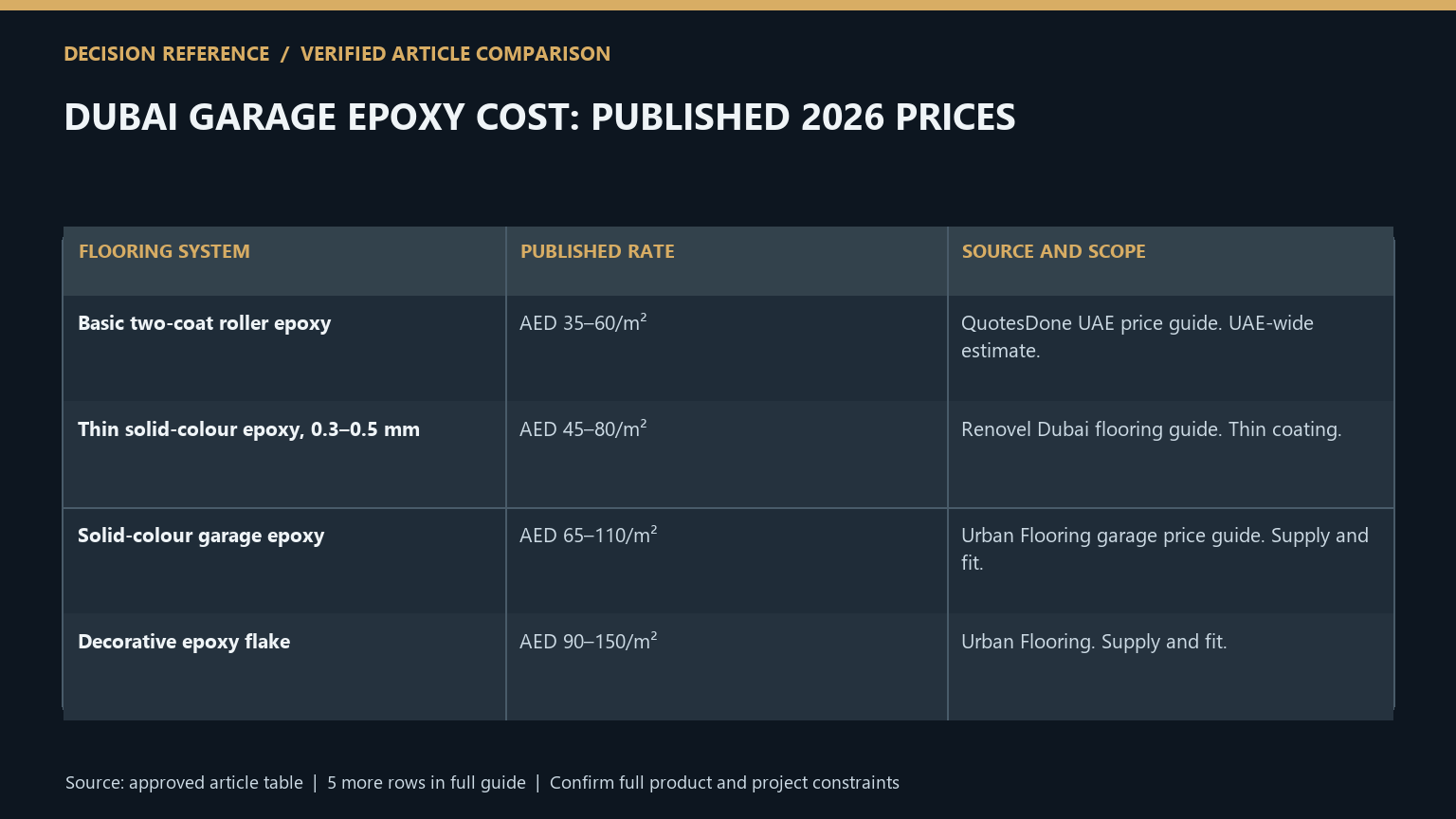
A broader UAE guide also lists basic two-coat roller epoxy at AED 35–60/m². That figure should not be treated as a complete garage-floor quote without checking its scope. It may describe a thinner or less demanding coating system.
Compare garage epoxy prices by system
The table brings together supplier-published prices available in 2026. It separates coating types so the rates can be read in context.
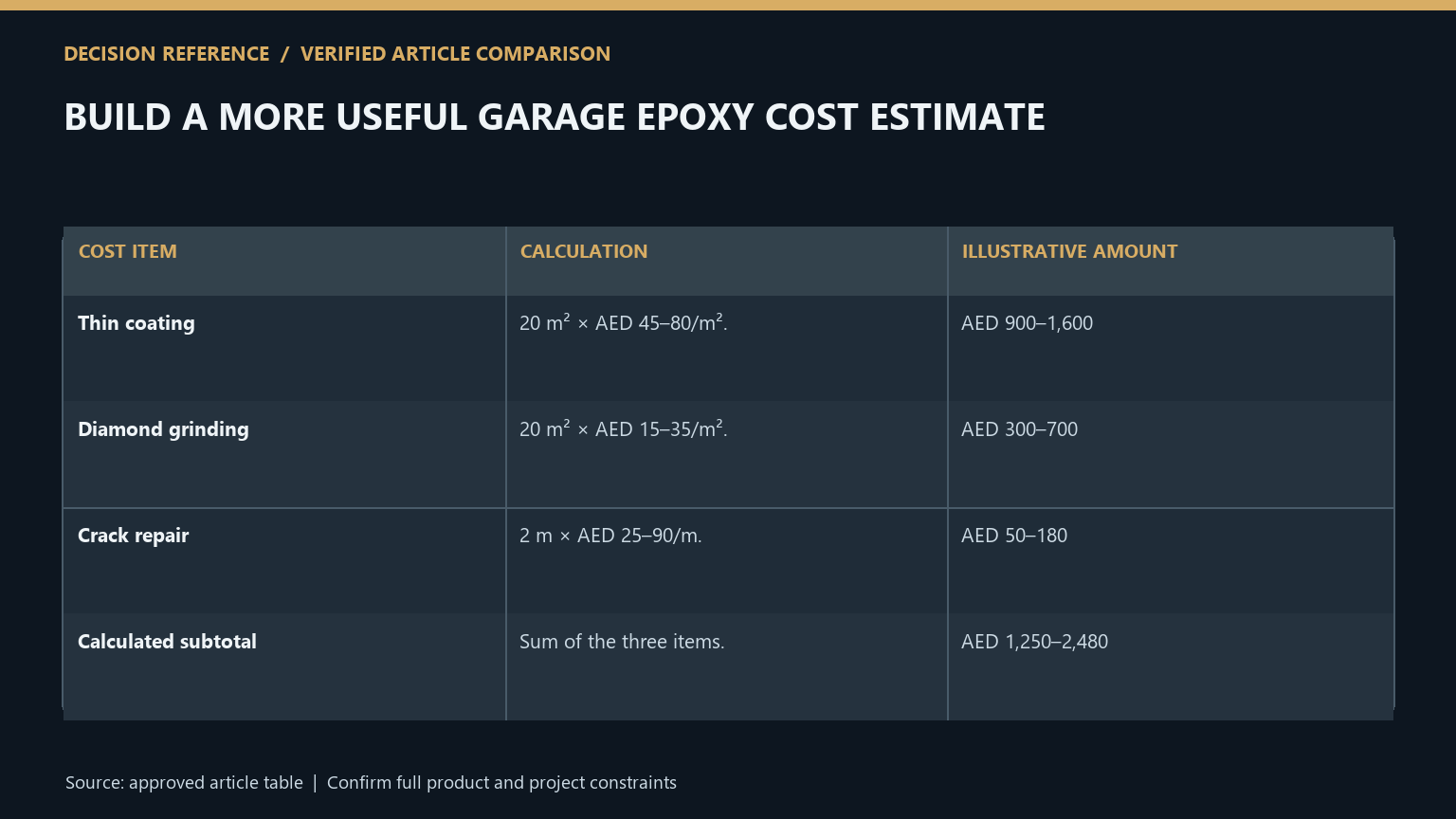
| Flooring system | Published rate | Source and scope |
|---|---|---|
| Basic two-coat roller epoxy | AED 35–60/m² | QuotesDone UAE price guide. UAE-wide estimate. |
| Thin solid-colour epoxy, 0.3–0.5 mm | AED 45–80/m² | Renovel Dubai flooring guide. Thin coating. |
| Solid-colour garage epoxy | AED 65–110/m² | Urban Flooring garage price guide. Supply and fit. |
| Decorative epoxy flake | AED 90–150/m² | Urban Flooring. Supply and fit. |
| Self-levelling epoxy, 2–3 mm | AED 90–180/m² | Renovel. Thicker seamless floor. |
| Decorative flake epoxy | AED 110–200/m² | Renovel. Garage finish. |
| Solid-colour or flake epoxy | From AED 160/m² | RBS Group garage coating prices. Contractor starting rate. |
| High-build epoxy mortar, 4–9 mm | AED 130–260/m² | Renovel. Heavy-duty system. |
| Polyurethane/polyaspartic garage finish | AED 120–200/m² | Urban Flooring. Different resin chemistry. |
These ranges overlap, but they do not describe identical products. A thin roller coat has a different build from a thick self-levelling floor. Preparation, decorative layers, and topcoats can also differ.
Some published rates cover supply and fitting. Others are starting prices or assume sound concrete. Ask each supplier to define the work included before using its rate for your budget.
What counts as a comparable quote?
Two contractors may measure the same 30 m² garage. One quotes a thin solid-colour coating. The other includes grinding, primer, flakes, and a clear topcoat. Both may call the finished result an epoxy garage floor.
The area matches, but the work does not.
Before comparing AED/m² rates, ask both firms to name the coating system and intended thickness. Check whether repairs, primer, and the final protective coat are included. A cheaper quote may simply cover fewer steps.
A sound comparison needs a common scope. If the proposed systems differ, first decide which one meets the garage’s needs. Then compare contractors offering that system or a well-defined equivalent.
Estimate the Cost of a Single or Double Garage
An 18–20 m² single garage has a published Dubai budget of roughly AED 1,300–3,000. A 36–40 m² double garage has a published range of about AED 2,500–6,000. Other suppliers may quote more for a different coating system or preparation scope.
These figures are useful starting points for villa owners. They are not guaranteed prices for a particular floor. The calculations below show how garage size and system choice affect the estimate.
Single-garage cost: a 20 m² example
Suppose your garage measures 5 m by 4 m. Its floor area is 20 m².
Using Urban Flooring’s published solid-colour rate of AED 65–110/m² gives two useful budget limits:
- Low example: 20 m² × AED 65 = AED 1,300.
- High example: 20 m² × AED 110 = AED 2,200.
The same supplier publishes a broader whole-garage range of AED 1,300–3,000 for about 18–20 m². Its wider figure reflects possible differences in the system and floor condition.
For a decorative flake finish, the supplier’s AED 90–150/m² rate gives AED 1,800–3,000 over 20 m². That is an area-based calculation, not a guaranteed contractor offer.
A floor with oil stains, cracks, or an old coating may need more work. Check those issues before settling on either budget. The site condition matters as much as the garage dimensions.
Double-garage cost: a 36–40 m² example
A two-car garage does not always have a standard floor size. Side storage areas, walkways, and the actual space to be coated can change the measured area.
For 40 m², Urban Flooring’s published solid-colour rate gives AED 2,600–4,400. Its flake rate produces AED 3,600–6,000. These calculations assume the published unit rates apply to the full area.
Urban Flooring also publishes a whole-garage budget of roughly AED 2,500–6,000 for 36–40 m². RBS Group gives a 36 m² two-car garage starting price of about AED 5,800.
Neither figure is a bid for the same specified project. The advertised packages may differ in preparation, resin build, finish, and service scope.
Measure the whole floor before asking for prices. Request two or three itemised quotes based on the same finish. Share any known cracks, stains, and sun-exposed areas so each contractor can assess the work.
Build a More Useful Garage Epoxy Cost Estimate
A useful epoxy budget separates the coating from work that may be charged on top. Floor preparation, repairs, and finish upgrades can change the final amount. Some contractors include these items in their unit rate. Others show them separately.
Use this cost formula when reviewing a quote:
Estimated cost = coating system + floor prep + repairs + finish upgrades + separate minimum-job charges.
The formula is a breakdown, not a request to add every item twice. If grinding, primer, and repairs are already included in a supply-and-fit rate, keep them inside that rate.
Worked cost builder: 20 m² garage
Consider a hypothetical 20 m² garage that needs diamond grinding and 2 linear metres of crack repair. Assume a thin epoxy coating. For this exercise, every item is priced separately using Renovel’s published 2026 Dubai rate bands.
| Cost item | Calculation | Illustrative amount |
|---|---|---|
| Thin coating | 20 m² × AED 45–80/m². | AED 900–1,600 |
| Diamond grinding | 20 m² × AED 15–35/m². | AED 300–700 |
| Crack repair | 2 m × AED 25–90/m. | AED 50–180 |
| Calculated subtotal | Sum of the three items. | AED 1,250–2,480 |
The subtotal follows directly from the stated assumptions. At the low end, AED 900 + AED 300 + AED 50 equals AED 1,250. At the high end, AED 1,600 + AED 700 + AED 180 equals AED 2,480.
This is a calculation model, not a contractor quotation. It assumes all three rates are available for the same job and charged separately.
The estimate excludes unpriced coating removal, moisture treatment, special finishes, and minimum charges. Confirm whether the coating price includes primer and its required final layers.
A second preparation method may also change the bill. Renovel lists industrial shot blasting at AED 20–45/m². That would represent AED 400–900 for 20 m² if charged separately. It is an alternative preparation scenario, not a charge to add automatically on top of grinding.
Why small garages can cost more per square metre
A smaller garage does not remove every fixed job cost. The contractor still needs equipment, materials, travel, and time to prepare the site. Curing stages may also limit how quickly the crew can finish.
Those fixed costs can raise the unit price of a small residential project. A larger floor may spread the same setup cost across more square metres.
Ask whether the contractor applies a minimum project charge. Then compare the total AED amount, not just the advertised rate. A lower unit price may offer little benefit if a large minimum charge applies.
When finish upgrades change the budget
Decorative flakes, anti-slip aggregate, and UV-stable topcoats change the coating system. Edge coving, special markings, and detailed border work may add further labour.
The word ‘premium’ does not define any of these features. Ask for the product names, layers, and intended finish. A flake floor with a clear protective coat is not the same specification as a plain roller coating.
For upgrades without verified local unit prices, ask the contractor for a separate amount. Do not add an invented percentage to the base budget.
Why Coating Thickness Changes the Price
A 0.3–0.5 mm roller coat should not be compared directly with a 2–3 mm self-levelling epoxy floor. The systems use different amounts of material and different application methods. Their intended uses may differ too.
Thin coatings may suit basic protection on sound concrete. Thicker floors can provide a specific smooth finish or meet more demanding service needs. The correct choice still depends on the full product system and substrate.
Thin roller coating versus self-levelling epoxy
A roller coating forms a relatively thin layer over the prepared concrete. Self-levelling epoxy is placed at a greater build and can form a smooth, seamless resin surface.
Jotun’s Jotafloor EP SL product data lists a dry-film thickness of 1.5–5 mm. Jotun describes the product as solvent-free, self-levelling, and designed for heavy-duty use.
Dry-film thickness, or DFT, is the final thickness after curing. It is more useful for comparison than simply counting coats. Two coats from different systems do not always produce the same thickness.
Mapei’s MAPEFLOOR I 500 W product information provides another concrete example. Its stated material use is about 4 kg/m² for a 2 mm smooth self-levelling application over the specified primer.
That consumption figure belongs to the named Mapei system. Other products may use different amounts. It should not become a general rule for estimating all epoxy floors.
Ask every bidder to name the product, layer build, and intended thickness. If a quote gives only the number of coats, request more detail before comparing prices.
When is a thicker system worth considering?
A workshop or high-use garage may place greater demands on its floor. Dropped tools, moving equipment, chemical spills, and regular traffic can affect the system choice. Jotun identifies abrasion, impact, and chemical resistance among the features of EP SL.
A family garage does not always need an industrial build. More thickness alone cannot guarantee a better result. The coating also needs sound concrete, suitable preparation, and a product matched to its use.
If a contractor suggests a heavy-duty floor, ask which load or exposure calls for it. A useful answer should name the real operating condition and the product intended to handle it.
The added cost has a purpose only when the extra build meets a genuine need.
Concrete Preparation: The Cost You Shouldn’t Ignore
Floor preparation is a core part of epoxy work. A new coating needs a sound surface to bond to. Dust, oil, loose paint, weak concrete, and surface residue can all affect the result.
Jotun’s Jotafloor EP Coating technical data calls for removing laitance by diamond grinding or captive blasting, followed by vacuum cleaning. Laitance is a weak surface layer that can form on concrete.
Preparation should follow the selected manufacturer’s instructions. A cheap coating price is poor value if the work omits necessary surface treatment.
What raises preparation costs?
An older garage may have oil marks, worn paint, tyre residue, cracks, or loose surface material. Each defect can require a different response. Some problems need cleaning. Others call for grinding, removal, repair, or further testing.
ASTM F710 gives concrete preparation principles for resilient flooring. Its procedures may also help with coatings and paints. The practice calls for clean, sound concrete free of materials that harm bonding.
ASTM F710 is not an epoxy-specific application standard. The chosen coating maker’s instructions still govern the work.
A site review should identify which defects need treatment. It should also state what the contractor has not priced. Without that detail, even an accurate coating rate can lead to an incomplete project estimate.
Crown Edge’s additional flooring services provide a relevant point of reference when discussing preparation and related floor work. The actual repair method and price still need confirmation for the garage being coated.
When floor levelling becomes a separate job
An epoxy coating cannot correct every damaged or uneven slab. Deep dips, broken areas, and poor floor levels may need work before the finish is applied.
Crown Edge’s self-levelling flooring services cover floor smoothing and levelling options. More substantial base correction may involve floor screeding.
These are separate decisions, not routine additions to every epoxy project. A garage with sound, reasonably even concrete may need surface preparation without a new screed.
The contractor should distinguish surface grinding from levelling and deeper base repair. Grinding prepares the surface for bonding. It should not be assumed to solve major floor-level problems.
Ask for a clear proposal if the slab needs substantial correction. The scope should explain what will be repaired, how the level will be addressed, and which coating work follows.
Moisture Can Change the Coating Plan
A garage slab must meet the chosen coating’s moisture limits. Excess moisture can affect bonding and the finished surface. Applying an unsuitable system before the slab is ready may lead to repair costs later.
The right acceptance limit comes from the selected product. No single moisture percentage applies to every epoxy floor.
For example, Jotun’s Jotafloor EP Coating technical data calls for concrete at least 28 days old and moisture content not above 4%. These conditions belong to that named product. They are not universal epoxy rules.
ASTM F2170 describes testing relative humidity within concrete slabs using in-situ probes. Such tests can help assess moisture condition. The acceptable result must still come from the selected flooring system’s instructions.
When should a garage be checked?
New concrete deserves particular care because it may still hold moisture. Past damp problems, visible water movement, or coating failures also justify closer attention.
Ground-floor and basement garages can face different moisture conditions. A slab may appear dry at the surface while still holding moisture within it.
Ask the installer how the slab will be assessed. If moisture testing is needed, the quotation should identify the method and the relevant product limit.
A contractor might recommend more drying time, further checks, or a suitable moisture-tolerant system. The response should follow the cause and measured condition. Do not approve a coating date solely because the surface looks dry.
Decide if the Garage Needs a UV-Resistant Finish
Direct sunlight can affect the appearance of some epoxy coatings. A garage entrance, open parking bay, or exposed driveway section may benefit from a compatible UV-resistant finish.
The amount of sun matters more than the city name. A shaded garage and an open parking area in Dubai do not face identical exposure.
Jotun’s Jotafloor PU Topcoat is described as a non-yellowing polyurethane finish designed for colour and gloss retention under direct sunlight. Jotun lists car parks, driveways, parking bays, and ramps among its applications.
Polyurethane and epoxy are different resin types. A suitable topcoat must be compatible with the base system. The manufacturer should support the complete layer build.
Enclosed garage or sun-exposed floor?
A fully enclosed garage may not need the same UV protection as an open driveway. Start by checking where direct sunlight reaches the floor and for how long.
Partly open garages need closer attention. The entrance may receive hours of sun while the rear stays shaded. A uniform coating without suitable UV protection could face different exposure across the same floor.
Jotun also offers Jotafloor PU Topcoat HS, described as UV- and weather-resistant. Its suitability must be assessed as part of the chosen coating system.
Ask the contractor what finish is proposed for sunlit areas. Request the product name and written compatibility details. An upgrade is worthwhile when it addresses actual exposure, not merely because the property is in Dubai.
Choose the Garage Floor System Before Choosing the Quote
The right system depends on garage use, floor condition, slip risk, and the finish you want. A basic residential garage may suit a solid-colour coating. A decorative garage calls for a different finish. Workshop use can change the technical needs.
Use the matrix below to narrow the system category before requesting final prices. It is a buyer decision aid, not a substitute for checking the concrete and the product data.
| Garage condition or goal | System to consider | Main quote check |
|---|---|---|
| Sound concrete, basic protection | Solid-colour roller epoxy. | Preparation and thickness. |
| Decorative villa garage | Epoxy flake system. | Flake coverage and clear topcoat. |
| Smooth, thicker resin floor | Self-levelling epoxy. | DFT and layer build. |
| Heavy tool or workshop use | Higher-build epoxy. | Product suitability for loads. |
| Wet or oily slip risk | Textured anti-slip system. | Aggregate and final grip. |
| Direct sun exposure | Compatible UV-stable topcoat. | Colour retention and system match. |
| Cracks, weak concrete, or contamination | Preparation and repair first. | Treatment before coating. |
The most important distinction is between a floor that needs repair and one that only needs a different finish. A more costly coating cannot fix an unsound base by itself.
Crown Edge’s epoxy flooring service page describes roller, self-levelling, anti-slip, and parking-related options. These are useful categories for discussing a garage project.
For technical product context, Jotun’s Jotafloor EP Coating overview identifies garages, workshops, and car parks among its suitable use environments.
That does not establish which brand Crown Edge uses. Ask each contractor to name the actual system it proposes and explain why it suits the floor.
Compare Garage Epoxy Quotes Line by Line
A complete garage epoxy quote should describe the finished floor and the work needed to produce it. A price per square metre is useful only after the scope is clear.
Ask contractors for the same base system and finish where possible. Then compare the total installed price, preparation, repairs, and exclusions. Written details make later changes easier to assess.
What a complete quotation should explain
Use this checklist before choosing a contractor. Each item covers a detail that can affect cost, suitability, or the work delivered.
- The floor area should be measured in m² and agree with the site dimensions.
- The coating system should name the manufacturer and products to be used.
- The quote should state the primer, basecoat, and topcoat where applicable.
- The coating build should show the number of layers and intended thickness.
- The preparation scope should explain grinding, cleaning, and old-coating removal.
- Crack and joint repairs should have clear inclusions and exclusions.
- Any moisture checks should state the method and relevant product limit.
- The finish should name any flakes, anti-slip aggregate, or special texture.
- Sun-exposed areas should have a stated UV-protection plan where needed.
- The schedule should state when work starts and when each stage can proceed.
- The contractor should state when people and vehicles may safely use the floor.
- The quote should describe warranty terms, exclusions, and the total AED amount.
- The final amount should make clear whether VAT is included.
A quote that omits an item is not automatically wrong. Some items may not apply to the project. The contractor should still explain the relevant scope and make clear which work is excluded.
The checklist becomes especially useful when one contractor includes preparation and another prices it separately. It also helps you compare the planned finish rather than relying on broad labels such as ‘industrial grade’.
A completed comparison: low bid versus full scope
Consider two hypothetical bids for the same 20 m² garage. Both promise an epoxy floor, but their written scope differs. This comparison shows what can be assessed before prices are judged.
| Quote detail | Bid A | Bid B |
|---|---|---|
| Floor area | 20 m². | 20 m². |
| System | Thin solid colour. | Named flake system. |
| Surface prep | Not stated. | Grinding specified. |
| Primer | Not stated. | Product named. |
| Layer thickness | Not stated. | Thickness stated. |
| Crack repairs | Not stated. | Repair method stated. |
| Topcoat | Not stated. | Clear coat specified. |
| Return to vehicle use | Not stated. | Product-based timing stated. |
| Price comparison | Incomplete scope. | More defined scope. |
These are fictional quote profiles, not actual contractor bids. No prices are assigned because the specified systems differ.
Bid B is easier to assess, but that alone does not make it better value. Bid A may be suitable for a simpler garage. Its missing details must first be supplied.
Ask both contractors to price the same agreed system if a direct cost comparison is the goal. If one suggests a different build, require a clear reason based on the floor’s use and condition.
Why Two Quotes for the Same Garage Differ
A final quote reflects a sequence of decisions. Some costs come from the chosen system. Others arise from site findings, repair work, or the way a contractor bundles its services.
The first price may cover coating alone. The next may include site preparation and repairs. A third may add a decorative finish or protective topcoat. These differences should appear in the scope, not remain hidden behind one total.
Read the work sequence, not just the price
A typical project starts with checking the concrete and measuring the area. The contractor then prepares the slab and deals with any required repairs. Primer, resin layers, and specified finish coats follow. Curing controls when the garage can return to use.
The stages are connected, but they are not always priced the same way. A contractor might include grinding in the coating rate. Another may give grinding its own line. The actual difference cannot be judged until both totals cover the same work.
Use these four checks to identify possible double-counting or missing costs:
- Compare the base coating rate with its stated preparation allowance.
- Check whether crack repairs are included or charged by length.
- Confirm whether the quoted system includes its required primer and topcoat.
- Review minimum charges and VAT before comparing final totals.
These checks are especially useful after a contractor has inspected the floor. They help separate real scope differences from different ways of presenting the same work.
An unresolved concrete defect is not a reason to add a made-up contingency percentage. Ask what inspection or test is needed to define the repair. Where the contractor cannot price it yet, keep the item clearly identified as an exclusion or provisional cost.
Frequently Asked Questions
These answers cover common decisions before a Dubai garage-floor project. The chosen products, concrete condition, and full scope still determine the final price.
What is the average cost to epoxy a garage floor in Dubai?
There is no reliable single average across all epoxy systems. Published local solid-colour garage prices include AED 65–110/m², while other contractor packages start at AED 160/m². Thin roller coatings, decorative flake floors, and self-levelling systems should be priced separately.
How much would a two-car garage cost?
One published supplier guide places a 36–40 m² double garage at about AED 2,500–6,000. Another Dubai contractor lists a 36 m² garage starting near AED 5,800. The figures reflect different supplier offers and may not include the same work.
Is epoxy cheaper than garage floor tiles?
The research does not support one reliable Dubai-wide cost ranking. Tile type, preparation, fitting, and coating system all affect the result. Compare complete installed quotes. The expected use and maintenance needs should also guide the choice.
Do epoxy garage floors need grinding?
Many epoxy systems need sound, properly prepared concrete. Mechanical grinding or blasting may be required to remove weak surface layers and prepare the slab for bonding. The exact method depends on the chosen product and the concrete condition.
Can epoxy be applied over old garage paint?
Existing paint needs checking for soundness and compatibility. Loose or unsuitable coatings may need removal. A strong new coating cannot make a weak underlying paint layer bond properly to the concrete.
How long before I can park on a new epoxy floor?
The safe return time depends on the named product, thickness, temperature, and curing conditions. Do not rely on one universal number. Ask for the manufacturer’s vehicle-return instructions and get the agreed schedule in writing.
Will epoxy turn yellow in Dubai sunlight?
Some epoxy systems can change colour under UV exposure. Sunlit entrances and open parking areas may benefit from a compatible UV-stable topcoat. A shaded, enclosed garage can have different needs.
Is decorative flake epoxy worth the extra cost?
A flake system provides a decorative, speckled finish and is priced separately from standard solid-colour coatings. Some systems also include a textured finish. Choose the full coating build based on appearance, slip needs, and product suitability. Decorative flakes alone do not guarantee longer service life.
Final Budget Rule for a Dubai Garage
Use published 2026 epoxy prices to set an initial budget. Then refine the estimate using the actual floor area, concrete condition, selected system, preparation scope, and final finish.
For a sound residential garage, a standard solid-colour system and a decorative flake option are reasonable starting points for comparison. A heavier resin build or UV-resistant topcoat should have a clear use-based reason.
Before approving any quote, confirm the named products, thickness, repairs, exclusions, cure schedule, warranty terms, and total AED amount. Make sure you know which costs are already included.
For a Dubai project, Crown Edge can be approached for a site-specific assessment and quotation. A defined scope offers a sounder basis for a budget than one general AED/m² figure.