

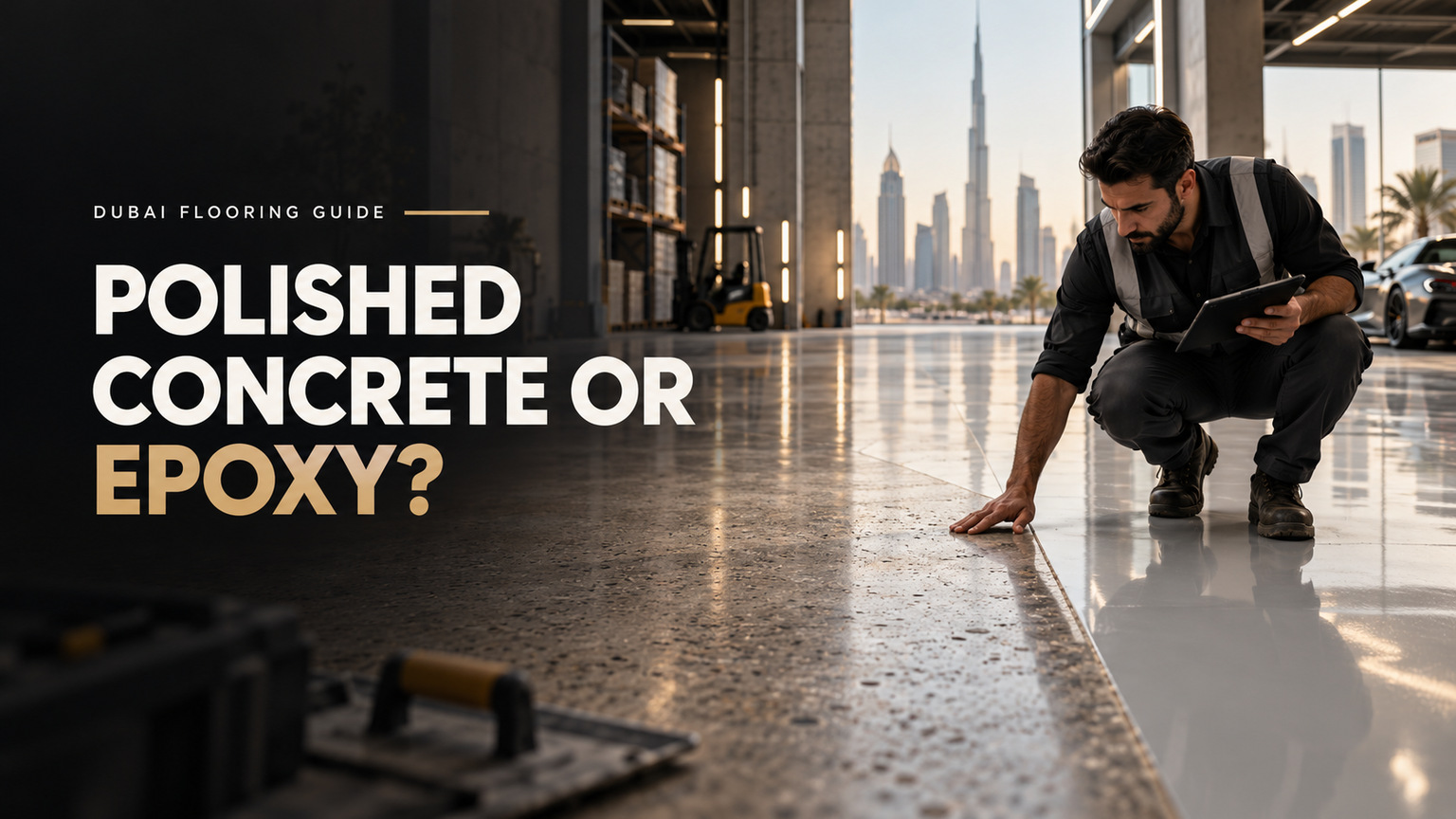

Polished Concrete vs Epoxy Flooring in Dubai: Which Should You Choose?
Quick Answer
Polished concrete is often a better fit for sound, relatively dry Dubai floors with limited chemical exposure, while epoxy flooring is usually preferable when a protective resin surface and verified chemical resistance are needed. Neither is always best. Slab moisture, traffic, cleaning needs, slip resistance and total installed cost should guide the final choice.
Key Takeaways
The choice depends on how the floor will be used, not just how it looks. These seven points help narrow the options before a site survey or quotation.
- Polished concrete refines the existing slab through grinding and polishing, while epoxy adds a separate resin coating over prepared concrete.
- Dry warehouses and showrooms may suit polished concrete, while workshops with chemical exposure often need a specified protective resin system.
- High slab moisture, weak concrete or poor surface preparation can cause epoxy bonding failures and costly repairs.
- Neither polished concrete nor smooth epoxy is automatically slip-resistant when exposed to water, oil or other contaminants.
- Published Dubai epoxy prices vary widely, and no reliable like-for-like polished concrete cost comparison establishes a universal winner.
- Polished concrete may need shine restoration, while epoxy can require local coating repairs or eventual recoating.
- Buyers should request substrate tests, exact system details, an approved sample, clear opening times and itemised AED/m² quotations.
For most projects, first assess the slab and its daily use. Then compare systems that can meet the same needs. Appearance and price should help decide between suitable options, not override basic performance requirements.
Polished Concrete vs Epoxy: At-a-Glance Comparison
The main difference is simple. Polishing turns the concrete slab itself into the finished surface. Epoxy adds a bonded resin layer above the concrete. Each approach has distinct strengths, limits and repair needs.
The comparison below covers common commercial applications in Dubai. Actual results depend on the chosen products, existing slab and operating conditions.
| Decision factor | Polished concrete | Epoxy flooring |
|---|---|---|
| Construction | Mechanically ground, densified and polished concrete. | Separate resin coating over prepared concrete. |
| Best setting | Sound, relatively dry slabs with limited chemical exposure. | Spaces needing a specified protective wearing surface. |
| Chemical exposure | Limited protection; stains and etching remain possible. | Resistance depends on the exact resin formulation. |
| Appearance | Natural concrete tones and visible aggregate. | Solid colours, decorative finishes and line markings. |
| Existing slab | Repairs, patches and colour differences may remain visible. | Can conceal some repairs, but cannot fix unsound concrete. |
| Moisture | No separate epoxy film to debond. | Moisture can impair adhesion or cause blisters. |
| Slip resistance | Finish must suit actual wet and dry use. | Texture or aggregates can be specified. |
| Maintenance | Cleaning and possible burnishing or repolishing. | Cleaning, local repairs and possible recoating. |
| Surface failure | Staining, etching, dulling or concrete wear. | Peeling, blisters, scratches, cracks or coating wear. |
| Return to use | Depends on grinding, repairs and surface treatments. | Depends on coating cure and intended exposure. |
| Installed cost | Requires a slab-specific quotation. | Depends on preparation, thickness and system type. |
A floor that performs well in a dry showroom may fail in a workshop. The difference often comes from exposure, not product quality.
The American Concrete Institute’s ACI SPEC-310.1-20 provides a technical framework for polished concrete slab finishes. The American Society of Concrete Contractors’ polishing glossary also distinguishes grinding, polishing, burnishing and related processes.
Manufacturer guidance describes the use of diamond tools and surface treatments during mechanical concrete polishing. Densifiers can help improve the concrete surface. Some systems also use protective guards. These treatments have their own care and wear needs.
An epoxy floor works differently. Its primer and resin layers must bond to the substrate. The system’s thickness, coating chemistry and preparation method affect the result. Buyers can review the main applications of epoxy flooring systems in Dubai before comparing a specific coating proposal.
The two finishes should not be judged only by their gloss. A polished surface can look much like a glossy coating, yet behave very differently under spills, moisture and wear.
Choose the Floor by How the Space Is Used
Daily use is the strongest first filter. Start with traffic, water, chemicals and cleaning. Then check whether the existing concrete can support the proposed finish.
This Dubai flooring selection matrix gives a preliminary direction. It is a screening tool, not a final technical approval.
| Dubai application | Preliminary choice | Main condition to check |
|---|---|---|
| Dry retail showroom | Polished concrete candidate. | Approve the slab appearance and finish sample. |
| Dry warehouse | Polished concrete candidate. | Check traffic, surface wear, dust and contamination. |
| Residential garage | Either system may work. | Compare spills, slab condition and appearance. |
| Automotive workshop | Specified protective resin system. | Check oils, fuels, solvents and cleaning chemicals. |
| Wet food-processing space | Specialist textured resin system. | Check washdown, hygiene, heat and chemical exposure. |
| Decorative commercial interior | Either system or a decorative overlay. | Decide whether natural aggregate or uniform colour is wanted. |
| Slab with excessive moisture | Investigation before coating choice. | Test moisture and assess suitable corrective options. |
| Sun-exposed exterior slab | Separate outdoor-rated specification. | Check UV, heat, drainage and wet traction. |
The main dividing line is chemical and operational exposure. Moisture problems and exterior conditions can change the choice entirely.
Dry Warehouses, Retail Floors and Showrooms
Polished concrete is often a sensible candidate for a sound, relatively dry slab. It provides a direct concrete finish without adding a separate epoxy wearing film. This can suit showrooms, retail areas and warehouses with limited chemical exposure.
The slab must still support the desired result. Old repairs, aggregate distribution and colour variation may become visible after grinding. A sample area should show what the full floor is likely to look like.
Warehouse buyers also need to consider forklift routes, wheel loads, abrasion and cleaning. A polished floor should not be approved from photographs alone. Its surface quality and finish must match the actual site.
Garages, Workshops and Chemical-Exposure Areas
A suitable resin coating is often the stronger candidate where fluid spills are common. Automotive workshops may need protection from specific oils, fuels, cleaners or solvents. Coloured work zones and safety markings may also favour a resin system.
The industry comparison published by CPC Floor Coatings in July 2026 reflects this use-based distinction. It is contractor-authored guidance, not independent proof that every epoxy formulation outperforms polished concrete.
Ask for the selected product’s chemical-resistance information. Exposure time and concentration matter. A coating that tolerates an occasional splash may not tolerate prolonged contact with the same substance.
Wet Processing, Commercial Kitchens and Outdoor Areas
These areas need more care than a basic epoxy-versus-polishing choice. Wet processing can involve hot water, repeated washdown, chemicals and hygiene needs. The floor may require textured resin, coving, suitable joints and other specialist details.
An ordinary epoxy coating should not be treated as an automatic food-safe or heat-resistant solution. The exact system needs approval for the stated service conditions.
Outdoor floors in Dubai face strong sunlight, heat and thermal movement. Some epoxy systems can discolour under UV exposure. An outdoor-rated coating or another finish may be more suitable. Drainage and wet traction also need review.
For design-led interiors, decorative microtopping finishes offer another route. Microtopping uses a separate decorative cement-based layer. It is not automatically the same as grinding and polishing the original structural slab.
Compare Durability, Chemical Resistance and Stain Protection
Neither floor has a universal service-life advantage. Durability depends on what the floor faces each day. Traffic, slab quality, chemical contact, maintenance and the chosen finish all affect its useful life. Abrasive traffic can wear either surface, while chemicals may stain concrete or damage a coating. Epoxy also relies on a lasting bond with the slab. Compare these separate risks before deciding which finish offers better protection for the intended use.
Where Polished Concrete Performs Well
A well-prepared, densified concrete surface can serve many dry commercial areas. It does not rely on a separate epoxy film for its main wearing surface. This removes one possible failure mode: epoxy coating delamination.
It does not make the floor damage-proof. Acids may etch the concrete. Oil or other fluids may stain it. High traffic can reduce the sheen, while repairs and aggregate changes may stay visible.
Sika’s concrete densifiers and sealers guidance shows how surface treatments can improve certain properties. A densifier or stain guard must not be confused with a full chemical-resistant coating.
Polished concrete may be a good long-term choice when owners accept natural variation. It is less suitable when a uniform protective film is central to the brief.
Where a Specified Epoxy System Adds Protection
Epoxy can provide a continuous resinous wearing surface with defined chemical and mechanical properties. The benefit comes from the selected system, not from the word epoxy alone.
A complete specification should identify the primer, resin layers, nominal thickness, surface finish and intended exposure. Product data should confirm resistance to actual chemicals at relevant concentrations and contact times.
The owner should also check cleaning agents. Strong chemicals used in daily cleaning can affect a coating even when the main production process does not.
Coating thickness matters, but thicker is not automatically better. The correct layer build depends on substrate conditions, service loads, product design and manufacturer instructions.
What Common Floor Failures Mean
Visible defects can point to different causes. Treating every mark as a reason to replace the full floor may waste money.
| Visible problem | Possible cause | Sensible next action |
|---|---|---|
| Polished floor loses shine. | Traffic wear or finish deterioration. | Review cleaning and possible repolishing. |
| Concrete shows dark stains. | Absorbed liquids or damaged surface protection. | Identify the substance and assess cleaning or local repair. |
| Concrete surface is etched. | Chemical attack on cement-based material. | Check exposure before restoring the finish. |
| Epoxy forms blisters. | Moisture, trapped material or application conditions. | Investigate the source before recoating. |
| Epoxy peels or debonds. | Bond failure or substrate problems. | Test the coating and concrete condition. |
| Coating cracks or wears. | Movement, impact, loading or wear. | Assess the defect and specify a suitable repair. |
These are diagnostic clues, not confirmed causes. A site inspection may show several factors acting together. In particular, coating failure should not be covered with another layer until the root problem is understood.
Advertised lifespans of five, ten or twenty years are poor substitutes for a service plan. Compare likely maintenance and renewal needs under the same operating conditions instead.
Check the Concrete Slab Before Choosing Either Finish
Unsuitable concrete can undermine either flooring choice. For epoxy, moisture and adhesion are especially important. Polishing also depends on slab soundness and the appearance left by grinding.
Before selecting a finish, the contractor should complete a slab assessment. The following checks turn common defects into clear decisions.
| Slab condition | Required assessment | Decision consequence |
|---|---|---|
| Moisture or damp patches. | Measure relevant moisture conditions and identify the source. | Hold standard coating approval until compatibility is established. |
| Weak or dusty surface. | Assess concrete strength and surface condition. | Repair or treat the substrate as specified. |
| Cracks and movement joints. | Identify movement, damage and repair needs. | Detail joints and repairs before finishing. |
| Oil or chemical contamination. | Inspect and assess removal methods. | Do not coat over untreated contamination. |
| Old coatings or sealers. | Identify existing treatment and compatibility. | Remove or prepare as required. |
| Uneven slab. | Survey levels and assess correction. | Specify suitable screeding or levelling work. |
| Visible patches and mixed aggregate. | Produce a polished sample area. | Approve the likely visual result before full work. |
| Previously polished surface. | Check profile, treatments and bond. | Prepare mechanically before a suitable epoxy system. |
A serious issue in any row may change the chosen system. The survey should lead to an agreed repair and preparation scope, not just a note that the floor needs cleaning.
Moisture, Rising Damp and Dew Point
Slab moisture can cause coating failure. It may also reveal water ingress or a wider building problem. A surface that looks dry does not prove the concrete meets a resin system’s limits.
ASTM F2170 describes testing relative humidity within concrete using in-situ probes. The linked ASTM record includes historical edition information. The applicable current edition should be confirmed when writing the project specification.
A manufacturer may also use moisture content by weight. These are different measurements. A reading of 4% by mass cannot be treated as 4% relative humidity.
For instance, a published Sikafloor-264 method statement gives a concrete moisture condition below 4% by weight and a pull-off strength above 1.5 N/mm². These figures belong to that method and product. They are not universal Dubai requirements.
Condensation matters as well. A Sikafloor-161 primer data sheet requires a substrate temperature at least 3°C above dew point under its stated application conditions.
Dubai sites may have air-conditioned interiors, humid air and changing surface temperatures. The contractor should record actual conditions and follow the selected system’s current UAE product data.
Where there is genuine water ingress, separate waterproofing works may need investigation. Ordinary epoxy flooring does not replace a designed waterproofing system at joints, cracks or other vulnerable details.
Cracks, Repairs, Existing Coatings and Surface Strength
Concrete cracks and old surface treatments can affect both finishes. Polishing may make completed repairs more visible. Epoxy may hide some colour differences, but it cannot make unstable concrete sound.
The ASTM D7234 coating adhesion test provides a method to measure pull-off strength on concrete. It can also help identify failure behaviour. The method does not set one universal passing value for all flooring systems.
Surface preparation must suit the chosen finish. Resin systems may need mechanical profiling, contamination removal and repairs. Sika’s concrete treatment guidance also highlights the effect of existing curing agents and surface treatments.
Uneven floors may need floor screeding or suitable self-levelling flooring work before the main finish. Such layers need their own product approval. An ordinary levelling compound should not be assumed suitable as an exposed polished wearing surface.
Can Epoxy Be Applied Over Previously Polished Concrete?
Yes, in some cases. The polished surface must first be assessed and prepared for a reliable bond. A smooth or guarded floor may not offer the surface profile that the coating needs.
The contractor should identify old guards, sealers and contaminants. Mechanical preparation and a compatible primer may be required. An adhesion assessment or trial area can help establish suitability.
Applying epoxy directly over glossy treated concrete is a poor shortcut. Good appearance on the first day does not prove long-term adhesion.
Slip Resistance, Cleaning and Dubai Environmental Conditions
Both flooring types can become slippery under the wrong conditions. Gloss alone does not determine safe use. The right finish must suit water, oil, dust, footwear and cleaning methods.
Owners should set the expected use before asking for a texture or slip-resistance test. These checks help define the operating conditions.
- Identify where water, oil, dust or cleaning fluids may reach the floor.
- Record the footwear and traffic used in each area.
- Check slopes, drains, ramps and changes in level.
- Specify a surface texture suited to the work area.
- Agree on the relevant slip test and acceptance criteria.
- Confirm that routine cleaning can maintain the intended traction.
The result should be a floor that is practical to clean and suitable for the people using it. An aggressive texture may help wet traction but can also make soil removal harder.
Smooth Floors, Wet Traffic and Added Texture
Smooth polished concrete can be slippery under certain contaminants. Smooth epoxy can have the same problem. The risks depend on more than the material name.
A textured resin system may contain suitable anti-slip aggregates. The aggregate size, amount and coating build should match the intended traffic and cleaning method. Polished concrete also needs finish and slip criteria suited to actual use.
A technical comparison of polished concrete and epoxy discusses these differences. It is general guidance, not a Dubai regulatory specification.
Do not apply the often-quoted ANSI A326.3 wet DCOF figure of 0.42 as a universal UAE legal threshold for these floors. Project rules and the relevant test method must be established separately.
Heat, UV and Condensation
Dubai’s climate can affect both application and service life. Air temperature alone is not enough. Substrate temperature, humidity and dew point also need checking before resin work.
Strong sunlight can alter the appearance of some epoxy coatings. A UV-stable topcoat or another outdoor-rated system may be needed. Solar heat, movement and drainage make exterior floors a separate design task.
Indoor spaces also need care during fitting. Air-conditioning changes may affect the conditions at the slab surface. The installation method should state acceptable conditions and how the contractor will monitor them.
Cleaning Without Damaging the Finish
Both floors need regular care. Spills should be removed promptly using products that suit the finish.
Sika’s guidance for treated concrete floors supports routine cleaning and spill management. A polished floor may later need burnishing or renewed surface treatment to improve its appearance.
Epoxy cleaning must also follow the coating maker’s instructions. Strong or unsuitable chemicals can damage the surface. Scrubber equipment, pads and cleaning methods should be agreed before handover.
Polished Concrete vs Epoxy Flooring Cost in Dubai
There is no reliable universal cost winner for Dubai. The right comparison is a full installed quotation for each suitable system on the same floor area and with the same known site conditions.
A quote should cover the preparation, repairs, selected finish, details and return-to-service needs. Without those items, two AED/m² figures may describe very different work.
What Published Dubai Epoxy Prices Show
Local published epoxy estimates vary. Two commercial guides illustrate the spread.
| Published guide | Date | Reported epoxy price | Evidence limitation |
|---|---|---|---|
| DubaiClean epoxy cost guide | March 2025. | AED 120–400/m². | Commercial estimate; no verified representative transaction sample. |
| Dubai Painters epoxy cost guide | October 2026. | AED 60–250/m². | Contractor-published estimate; scope may differ. |
The bands overlap, but neither establishes a market average. They do not provide matching polished-concrete prices. No valid percentage saving can be calculated from this evidence.
System thickness, floor size, product grade and site access can all change a quote. A cheaper advertised rate may exclude major preparation or repair work.
Why Square-Metre Rates Can Mislead
A fair comparison starts with the same measured area and slab condition. Each contractor must state what is included, what is excluded and which problems could change the price.
Use this scope comparison as a quotation brief. Both bids should answer every relevant row rather than leaving hidden assumptions.
| Quotation item | What the buyer should require |
|---|---|
| Area and location | Agreed floor area in m² and work-zone boundaries. |
| Existing concrete | Recorded slab condition, cracks, contamination and old treatments. |
| Testing | Stated moisture, strength or adhesion checks where needed. |
| Preparation | Grinding, profiling, cleaning and waste handling. |
| Repairs | Defined patching, crack work and levelling. |
| Proposed system | Product name or polishing process, with clear layer details. |
| Thickness | Nominal coating thickness in mm where relevant. |
| Appearance | Aggregate exposure, gloss, colour, markings and approved sample. |
| Edges and joints | Treatment of corners, joints, drains and transitions. |
| Safety finish | Specified texture and applicable slip criteria. |
| Programme | Working hours, site access and return-to-service stages. |
| Commercial terms | Total AED, VAT treatment, exclusions and warranty terms. |
The most useful quotes explain what the buyer will actually receive. They also identify conditions that could trigger extra charges.
Calculate the installed rate using one agreed basis:
Installed rate (AED/m²) = Comparable total installed cost (AED) ÷ Agreed floor area (m²).
The total should use the same VAT treatment for both options. Any separate moisture mitigation or major repair work must be included or clearly identified.
Compare Lifecycle Cost, Not Only Installation Price
The cheapest first quote may not be the cheapest floor to own. Cleaning, local repairs, planned restoration and business closure can change the result.
A practical lifecycle comparison should use the same evaluation period for both choices. Include real maintenance plans and realistic operating restrictions.
Evaluated lifecycle cost = Initial installation + Maintenance + Repairs + Planned renewal + Operational downtime.
This simple sum is useful for an undiscounted budget comparison. A formal financial model should also state any inflation or discount-rate assumptions.
For instance, a warehouse that cannot shut for long periods may value a shorter future maintenance closure. A showroom may place more weight on appearance and predictable finish restoration. Neither preference can be reduced to a universal price ranking.
Before awarding work, buyers can request a flooring assessment and itemised quotation based on the same area, usage brief and known slab condition.
Installation Time, Downtime and Maintenance
Return-to-service time varies by system and intended use. Polished concrete avoids a separate epoxy coating cure stage, but it still needs preparation, grinding and finishing. Epoxy may need staged curing before the floor can carry traffic or chemicals.
From Surface Preparation to Reopening
Separate the work schedule from the date the space can reopen. A coating may be firm enough for light walking before it is ready for vehicles, heavy machines or chemical cleaning.
Request four clear milestones from each contractor: completion of preparation, completion of the finish, first permitted access and full service readiness. The programme should also state the planned environmental conditions.
The Sika resinous-floor maintenance guide explains that some high-performance coatings may need up to 14 days to reach maximum cure and performance. That is not a universal 14-day closure for all epoxy floors.
Actual opening times must come from the chosen product and the site plan. A garage reopening to cars has different needs from a showroom reopening to pedestrians.
How Repairs Differ
Polished concrete may need local stain treatment, repairs, burnishing or further polishing. Its finished appearance can change over time, especially in busy traffic lanes.
Epoxy repairs may involve removing weak coating, preparing the affected area and applying compatible new material. Colour or gloss differences can remain after a local patch. Wider coating failure may need a deeper investigation before renewal.
Both floors benefit from a written cleaning and maintenance plan. Record approved cleaning chemicals, pads, equipment, spill response and inspection frequency. Maintenance should protect the floor’s useful properties, not just its shine.
Standards and Tests Worth Checking Before Approval
Use technical standards to answer defined questions. They help set a common basis for testing and acceptance, but no single standard makes polished concrete or epoxy the right choice for every site.
For Dubai projects, the contract should state which references apply and what results are acceptable. A test method alone does not provide a universal pass mark.
| Reference | Main purpose | Project requirement |
|---|---|---|
| ACI SPEC-310.1-20. | Polished concrete finish and acceptance framework. | State finish quality and mockup approval. |
| ASTM F2170. | In-situ relative humidity testing for concrete slabs. | Use the applicable edition and system moisture limits. |
| ASTM D7234-22. | Pull-off strength testing of coatings on concrete. | Agree on acceptance criteria and failure assessment. |
| Manufacturer product data. | Preparation, moisture, thickness, cure and exposure limits. | Obtain current system-specific UAE information. |
| Applicable UAE and project safety rules. | Safe grinding, coating work and site controls. | Confirm local requirements and approved work methods. |
ACI and ASTM references are not automatically binding Dubai laws. They become relevant through the applicable project specification, contract or other governing requirements.
Concrete grinding can also produce hazardous respirable silica dust. The U.S. OSHA crystalline silica construction rule provides an example of formal exposure controls. Its action level is 25 micrograms/m³ as an eight-hour time-weighted average. This is a U.S. regulatory figure, not an asserted UAE limit.
Dubai contractors should follow applicable local safety rules and use suitable dust extraction, containment and worker protection. The project method statement should cover these risks before work starts.
Final Selection Checklist for Dubai Flooring Projects
Approve the finish only when the intended use, slab condition and proposed system are clear. The final decision should rest on documented requirements rather than a colour sample or a headline price.
Use these ten checks before signing the flooring contract.
- Record traffic and loads. Identify pedestrians, vehicles, forklifts, machinery and expected wear.
- List all exposures. Include water, oils, fuels, chemicals, washdown and cleaning products.
- Inspect the slab. Record cracks, repairs, contamination, joints and concrete soundness.
- Confirm moisture conditions. Require suitable tests and investigate signs of rising damp.
- Define the exact finish. Identify the polishing method or complete resin system and product names.
- Set performance criteria. Agree on chemical resistance, wet traction and cleaning needs.
- Approve preparation details. Record repairs, surface profile, primer and coating thickness where relevant.
- Review a sample. Accept appearance, texture, colour variation and exposed aggregate where applicable.
- Confirm the programme. State site conditions, work stages, cure and permitted reopening times.
- Compare complete quotations. Review AED/m², VAT, exclusions, maintenance duties and warranty terms.
A complete checklist is not a substitute for a qualified site assessment. It gives the owner a sound basis for reviewing the contractor’s proposal and asking for missing evidence.
The best choice is the floor that meets the site’s real needs and can be installed on the existing slab with a clear, supportable method. For sound, dry interiors with limited chemical exposure, polished concrete deserves serious consideration. Where proven protective properties are needed, a specified resin system is often the better route.
Frequently Asked Questions
These answers cover common questions from Dubai flooring buyers. Final approval still depends on the site and the proposed system.
Is polished concrete better than epoxy for a warehouse?
Polished concrete is often suitable for dry warehouses with sound slabs and limited chemical exposure. Epoxy may be preferable where spills, protective markings or a defined resin surface are needed. Traffic and substrate checks should decide the final option.
Which flooring is cheaper in Dubai?
Neither has a proven universal cost advantage. Published local epoxy estimates vary, and no representative matched polished-concrete price range was established. Compare full installed AED/m² quotations for the same floor and scope.
Is epoxy more resistant to chemicals and oil?
A suitable epoxy system can offer stronger protection against specified chemicals and oils. Resistance depends on formulation, concentration, temperature and contact time. The manufacturer must confirm compatibility with the actual exposure.
Can epoxy flooring peel?
Yes. Epoxy can peel or debond when the coating loses its bond with concrete. Moisture, poor preparation, weak substrate material or incompatible old treatments may contribute. The cause should be assessed before repair.
Can damaged concrete be polished?
Some damaged slabs can be repaired and polished. The result depends on concrete soundness and the type of damage. Old patches, aggregate changes and colour differences may remain visible. Approve a sample first.
Is polished concrete slippery when wet?
It can be. Smooth epoxy may also become slippery. Safety depends on finish texture, water or oil contamination, footwear and cleaning. Use suitable project-specific slip criteria and testing.
Can epoxy be applied over polished concrete?
Sometimes. Existing guards, sealers and smooth surfaces may need removal or mechanical preparation. The proposed primer and coating must be compatible, with suitable bond assessment where required.
Which flooring suits outdoor areas in Dubai?
Choose an outdoor-rated system based on UV exposure, heat, thermal movement, drainage and wet traction. Ordinary interior epoxy is not automatically suitable. A specialist coating or another exterior finish may be needed.