

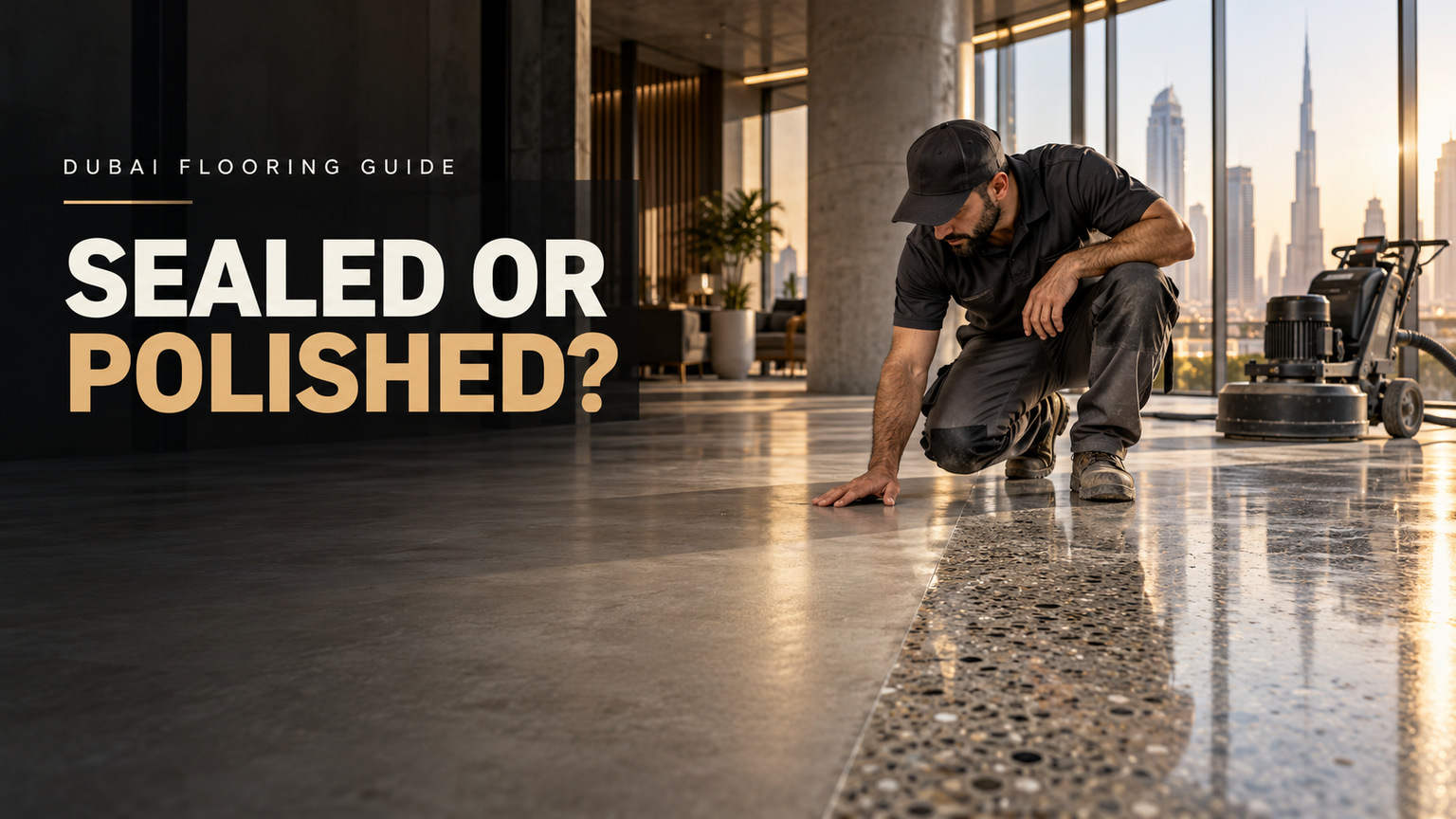

Sealed Concrete vs Polished Concrete: Which Is Better for Dubai Floors?
Quick Answer
Sealed concrete uses an applied protective treatment, while mechanically polished concrete gets its finish through grinding, honing, and polishing. For Dubai floors, the better choice depends on traffic, appearance, stains, moisture, and slab condition. Polished concrete can also receive compatible stain protection, so sealing and polishing are not always competing options.
Key Takeaways
The main differences involve how each finish is made, what it protects against, and how much care it needs. These seven findings help narrow the choice for Dubai properties.
- A glossy sealed floor is not automatically polished concrete. True mechanical polishing uses bonded abrasives to refine the slab itself.
- Topical sealers, penetrating densifiers, and mechanical polishing work differently and need separate product and finish specifications.
- Polished concrete can receive compatible protective guards to improve stain resistance without losing its mechanically refined character.
- Chemical resistance depends on the complete flooring system. Neither basic sealing nor polishing makes concrete immune to aggressive chemicals.
- Wet-floor safety needs relevant slip-resistance evidence. Surface gloss alone cannot establish whether a floor is safe.
- Dubai flooring costs depend on slab preparation, treatments, repairs, access, and maintenance. No reliable universal AED/m² comparison is established.
- Dry warehouses may suit densified or polished concrete, while chemical areas may need purpose-specified protective coatings.
The best finish is the one that suits the slab and its daily use. Judge the full flooring system, not just its gloss or initial price.
Sealed vs Polished Concrete: The Main Differences
The main difference is how each floor gets its finish. Sealing adds a protective treatment. Mechanical polishing changes the concrete surface through abrasive work. A third approach uses penetrating treatments to harden or protect the slab without creating a thick surface film.
The Concrete Polishing Council’s glossary defines bonded-abrasive polishing as a multistep mechanical process. It also distinguishes polished concrete from surface-coated finishes. Two Dubai floors can look equally glossy yet have very different wear and maintenance needs.
The comparison below separates the three methods. This matters because a contractor may use the word sealed for several different types of treatment.
| Feature | Topical sealed concrete | Penetrating or densified concrete | Mechanically polished concrete |
|---|---|---|---|
| Finish process | Applies a film or protective coating. | Uses a treatment that penetrates or reacts with concrete. | Uses grinding, honing, and polishing abrasives. |
| Appearance | Depends on coating type and sheen. | Often keeps the existing surface character. | Offers specified gloss and aggregate exposure. |
| Aggregate exposure | Usually retains the prepared surface. | Usually retains the existing surface. | Can expose aggregate through grinding. |
| Dust and wear | Depends on the coating system. | Some densifiers improve dust control and abrasion resistance. | Depends on slab quality and polishing process. |
| Stain protection | Depends on the film and its chemistry. | Varies by treatment; hardeners are not always stain repellents. | May need a compatible stain guard. |
| Common maintenance | Cleaning, repairs, and possible recoating. | Cleaning and possible retreatment. | Cleaning, possible re-burnishing, and guard renewal. |
| Main concern | Film wear, damage, or loss of adhesion. | Limited stain protection or unmet gloss expectations. | Slab-dependent appearance and more process steps. |
| What to specify | Chemistry, thickness, preparation, and tested properties. | Product, treatment rate, and intended result. | Process, aggregate exposure, gloss, and protection. |
These are process categories, not performance rankings. A light acrylic sealer and a heavy-duty resin coating are not equivalent. Ask what each quoted treatment actually contains before comparing prices.
Topical Sealed Concrete
Topical sealing places protective material on the concrete surface. Some products form a thin film. Others create a thicker coating designed for more demanding use. Acrylic, polyurethane, and epoxy-based products can differ greatly in wear, stain protection, adhesion, and upkeep.
A suitable sealer may help with dust, staining, or surface wear. The result depends on the product and slab condition. A glossy film can look like polished concrete, but the sheen alone does not prove that mechanical polishing took place.
For a basic indoor storage room, a simple treatment might be enough. A busy workshop may need a much stronger system. The quotation should name the product, intended use, surface preparation, and expected maintenance. Concrete sealing on its own is too vague for a reliable comparison.
Penetrating and Densified Concrete
Penetrating treatments work within the concrete rather than relying only on a surface film. Silicate densifiers react with suitable components in the slab. They can reduce dusting and improve surface hardness and abrasion resistance under appropriate conditions.
Sika’s Sikafloor CureHard-24 product information describes a sodium-silicate-based hardener, dustproofer, and sealer. This is a specific product example. The cited page serves the UK market, so Dubai buyers should obtain current product data applicable to the material actually supplied.
Densification can make sense in a dry warehouse where dust control matters more than decorative sheen. It does not automatically create a polished floor. Nor does every densifier repel oils or resist chemical attack. Where staining matters, a compatible protective treatment may also be needed.
Mechanically Polished Concrete
Mechanical polishing uses several abrasive steps to refine the slab. Grinding may first expose the desired aggregate. Finer abrasives then hone and polish the surface to the selected finish.
Some floors show little visible stone. Others reveal small or large aggregate. The depth of grinding affects that appearance, while later steps control the finish. Gloss and aggregate exposure must be specified separately.
Polished concrete can also receive protective treatments. PROSOCO LSGuard is one manufacturer example designed to enhance sheen and stain resistance on suitable finished concrete. Such a guard supplements the mechanical finish. It does not replace the grinding and polishing process.
A high-gloss finish is not essential for every project. Some industrial owners may prefer less reflection and easier visual upkeep. A representative sample helps establish what the actual slab can achieve.
Choose the Right Finish for Your Dubai Property
Choose a finish based on how the space works. Warehouses, showrooms, garages, and workshops expose concrete to different loads and contaminants. Sand, wheeled traffic, spills, cleaning methods, and downtime all affect the decision.
The following matrix gives a starting direction for common Dubai properties. Each recommendation remains subject to slab inspection and proof that the selected product suits the intended use.
| Dubai application | Main operating concern | Initial finish direction | What to check before approval |
|---|---|---|---|
| Dry warehouse | Dust, abrasion, forklifts, and cleaning. | Compare densified and mechanically polished floors. | Slab quality, wheel loads, traffic, and repairs. |
| Retail showroom | Appearance, foot traffic, and daily cleaning. | Consider polished concrete with compatible protection. | Finish sample, stains, and maintenance. |
| Residential garage | Oils, tyre marks, and wet cleaning. | Compare suitable sealers and protective coatings. | Oil resistance, tyre effects, and slip risk. |
| Industrial chemical area | Spills, chemicals, and contact duration. | Assess a purpose-specified resin coating. | Named chemicals and system test evidence. |
| Commercial kitchen | Food spills, moisture, hygiene, and slip risk. | Require a system suited to kitchen use. | Cleaning chemicals, drainage, and wet safety. |
| Outdoor or exposed area | Sun, water, drainage, and surface texture. | Make a separate outdoor finish assessment. | UV exposure, drainage, weather, and slip resistance. |
The strongest distinction is between spaces that mainly need dust and wear control and those facing serious chemical exposure. A finish suitable for a dry warehouse may fail in a frequently washed food-processing area.
Warehouses and Industrial Floors
Dry warehouses often need good dust control, cleanable surfaces, and resistance to regular traffic. Abrasive grit and hard wheels can affect both coatings and exposed concrete. A suitable densifier may improve the surface without adding a decorative finish. Mechanical polishing is another option where the slab supports it.
Forklift tyres, wheel types, pallet handling, and loading patterns should guide the choice. The finish must suit actual traffic rather than a generic warehouse label. Weak or damaged concrete may need repairs before either system can work well.
Cleaning equipment also matters. Ask if the finish can handle the planned floor scrubber, brushes, pads, and cleaning products. An attractive sample offers little value if routine cleaning soon damages it.
Showrooms, Retail Spaces, and Commercial Interiors
Polished concrete is worth considering when appearance drives the project. It can provide a selected sheen and aggregate finish without relying on a thick decorative film. However, its final appearance depends heavily on the existing slab.
Repairs, colour variation, and old construction marks may remain visible after polishing. A showroom owner should approve a sample under the lighting planned for the space. That review should cover gloss, aggregate exposure, repairs, and acceptable colour changes.
Daily foot traffic brings grit indoors. Entrance mats and regular dust removal help reduce surface wear. Food, drinks, or oily goods may also call for a compatible stain guard. Plan the cleaning method before approving the finish.
Garages, Workshops, and Chemical-Exposure Areas
Garages and workshops need protection suited to their spills and cleaning habits. Oil, vehicle fluids, tyre contact, and tracked water can all affect the result. Ordinary polishing may not offer enough protection for these uses.
A suitable film-forming sealer or resin coating may be a better starting point. Crownedge’s epoxy flooring systems offer a related flooring category to assess for protective applications in Dubai. The exact coating must still match the planned use.
Epoxy does not resist every chemical by default. Ask about each liquid, its concentration, expected contact time, and cleaning method. A commercial kitchen adds food acids, wet cleaning, drainage, and hygiene concerns. These uses require proof of performance, not a finish chosen from photographs.
Compare Durability, Stain Protection, and Slip Resistance
Neither sealed nor polished concrete is always more durable. A coating may offer useful protection but wear under traffic. A densifier can improve some surface properties while providing limited stain resistance. Polishing creates a refined concrete wear surface, yet its result still depends on the slab.
Compare each proposed system against the specific risk. Abrasion, chemicals, and wet-floor safety need different forms of evidence. A product that performs well in one category may be unsuitable in another.
Abrasion and High-Traffic Wear
For topical sealed concrete, the applied film may become the main wear layer. Its chemistry, thickness, bond, and preparation affect how it performs. Heavy traffic can cause scratches, worn patches, or coating damage. Repairs may need local treatment or broader recoating.
A densifier changes properties within the concrete surface. Its abrasion result depends on the product, slab quality, and treatment conditions. Mechanical polishing refines the slab itself, so the strength and condition of the concrete remain central.
Sand and grit deserve attention across Dubai interiors. Abrasive particles can mark a floor as people and equipment move over them. Remove loose grit before it spreads, and use the cleaning pads recommended for the finish.
Avoid promised lifespan multiples without comparable test or service records. A claim that polished concrete lasts twice as long as sealed concrete ignores the wide range of products and use conditions.
Stains, Oils, and Chemical Exposure
A densifier is not always a stain barrier. Polished concrete may still absorb liquids or suffer chemical damage. A protective guard can improve resistance to staining without making concrete immune to attack.
The PROSOCO LSGuard product data sheet warns that acidic materials can etch protected concrete. It also calls for prompt spill removal and suitable cleaning. Reducing a visible stain is not the same as preventing chemical damage.
For workshops, kitchens, and industrial areas, describe the actual exposure before requesting performance evidence. A useful chemical review should cover these points:
- Name the chemicals that may reach the floor.
- Record expected concentration and contact time.
- Describe routine washing and cleaning products.
- Request resistance data for the complete proposed flooring system.
- Agree on spill response and maintenance duties.
For organic coatings, ASTM D1308-20(2025) describes a test method for assessing the effects of household chemicals. Effects can include discolouration, gloss changes, softening, and film damage.
That method alone does not qualify a floor for concentrated industrial chemicals. The supplier should provide evidence relevant to the actual substances and service conditions. A floor facing frequent aggressive spills may need a purpose-designed protective system.
Slip Resistance on Wet Floors
A shiny floor is not automatically unsafe when wet. A matte floor is not automatically safe either. Slip risk depends on the surface, liquid or contaminant, footwear, test method, and how the floor is used.
The Concrete Polishing Council published a position statement on polished-concrete slip resistance in October 2017. It reported laboratory testing conducted in 2015. The programme compared multiple concrete finishes under defined conditions.
| CPC laboratory measure | Reported finding |
|---|---|
| Concrete test slab | About 20 × 45 ft. |
| Finish sections | 48. |
| Finish combinations | 16. |
| Wet DCOF measurements | 576. |
| Reported test results | All exceeded 0.42 DCOF. |
| Reference for 0.42 | ANSI A137.1 ceramic-tile wet-use criterion cited by CPC. |
DCOF means dynamic coefficient of friction. It measures friction under a defined moving-contact test. The results challenge the assumption that higher gloss always means poorer wet slip resistance.
The 0.42 figure came from a specific ceramic-tile testing context. It is not a universal approval threshold for polished concrete or a Dubai building-code rule. The laboratory programme also cannot establish safety on ramps, oily surfaces, or floors with cleaning residue.
For wet entrances, garages, kitchens, and industrial spaces, request slip-resistance evidence for the proposed complete floor system. The method and acceptance criteria must suit the intended conditions, including likely contamination and slope.
Installation Cost vs Long-Term Maintenance
Basic sealing may need fewer work steps than multistage polishing. That can make the initial treatment simpler. Yet a fair cost comparison must include the state of the slab, preparation, repairs, future care, and downtime.
No reliable Dubai-wide installed price range was established for a like-for-like sealed-versus-polished comparison. Instead of assuming a typical AED/m² rate, ask contractors to price the same scope. Then compare the full cost of each suitable system.
What Changes the Installation Quote?
The slab can have more influence on cost than the finish name. Removing an old coating, repairing damaged areas, or dealing with moisture can add substantial work. Access and reopening rules may also shape the schedule.
The following factors explain why two quotations for the same floor area may differ.
| Cost factor | Why it affects the quotation |
|---|---|
| Floor area in m² | Affects material use and work planning. |
| Existing coatings | Removal can add labour and equipment time. |
| Cracks and damaged areas | Repairs may be needed before finishing. |
| Moisture and contamination | Testing and corrective work may be required. |
| Surface preparation | Different systems need different preparation. |
| Polishing finish target | Grinding depth and abrasive steps may vary. |
| Sealer or guard system | Chemistry, coverage, and coat count affect cost. |
| Access and site restrictions | Work may need staging or limited operating hours. |
| Reopening conditions | Curing and traffic restrictions can affect operations. |
Compare included materials, equipment, preparation, repairs, protection, cleaning, and waste removal. A low quoted unit rate may exclude work that another contractor has already included.
Compare Total Cost of Ownership
Compare the finishes over the same ownership period and floor area. Include what it takes to keep each system serviceable, not just its initial treatment price.
Total evaluated cost = preparation + installation + planned cleaning + restoration or reapplication + operational disruption.
This is a decision framework, not a measured Dubai cost benchmark. It helps reveal trade-offs that a simple price per square metre can hide.
Consider a hypothetical operating warehouse with two technically suitable proposals. Proposal A uses a topical sealer. Proposal B uses mechanical polishing with compatible stain protection. Both cover the same floor, but their future care may differ.
| Decision point | Proposal A: topical sealer | Proposal B: polished and protected concrete |
|---|---|---|
| Initial process | Prepare the slab and apply the specified sealer. | Prepare, grind, hone, polish, and apply compatible protection. |
| Wear response | Repair worn film or recoat when needed. | Assess finish wear, re-burnish, or renew protection when needed. |
| Cleaning plan | Use cleaners approved for the coating. | Use cleaners and pads approved for the polished finish. |
| Work disruption | Include any coating repair and cure-related closure. | Include restoration work and guard-related restrictions. |
| Main cost uncertainty | Film wear and future treatment scope. | Slab condition, polishing work, and restoration needs. |
| Evidence needed | Product care guidance and contractor prices. | Finish care guidance and contractor prices. |
Suppose Proposal A is cheaper at first but needs more frequent closures for repair. Proposal B might then have a lower evaluated cost. If traffic is light and the sealer meets all needs, Proposal A may remain better value. Neither outcome can be assumed without actual quotes and care plans.
Use the same assessment period and operating assumptions for both proposals. This avoids rewarding a system merely because its future maintenance costs were omitted.
Maintenance and Restoration Requirements
Both finishes need routine care. Topical sealed concrete requires cleaning suited to its film. Damaged areas may need local repair or wider recoating. Polished concrete needs dust removal and suitable cleaning products. Some polished floors also require re-burnishing or guard renewal.
For Dubai interiors, tracked sand should be part of the care plan. Entrance mats, regular grit removal, and suitable floor scrubbers can reduce avoidable wear. Clean spills promptly, especially where food, oils, or chemicals are present.
Ask each bidder for written care instructions. These should name approved cleaners, equipment, inspection needs, and restoration methods. Do not accept a fixed recoating or polishing interval without product data and a realistic traffic basis.
Check the Concrete Slab Before Choosing a Finish
The slab must suit the finish being proposed. Cracks, moisture, contamination, weak areas, and old coatings can change which treatments are practical. Surface work cannot restore unsound concrete or correct every underlying defect.
A proper site review should identify the condition of the slab before the final price is agreed. It should also establish the finish that can be achieved without promising an appearance the concrete cannot deliver.
Existing Surface and Preparation
Start with concrete soundness, existing repairs, contamination, and moisture conditions. Cracks and uneven areas need separate attention. Old coatings may need removal before mechanical polishing or a new treatment can begin.
ICRI Guideline 310.2R-2013 covers selecting concrete preparation methods for sealers, coatings, overlays, and repairs. It also addresses surface-profile considerations. Surface profile refers to the texture or roughness left by preparation.
A thin sealer may need a different texture from a thick coating. Penetrating products can have their own preparation needs. Follow the chosen system’s technical instructions rather than applying one grinding method to every floor.
Crownedge lists concrete floor grinding and surface preparation among its related services. Such work may help prepare an existing slab for a suitable finish. Grinding alone cannot repair major structural defects, so weak or moving areas may need specialist assessment.
Where floor levels need correction, self-levelling flooring may be a separate option for assessment. Its suitability depends on the selected system and slab conditions. A levelling layer should not be assumed to replace structural repair or to provide the same finish as polished structural concrete.
Appearance Mockups and Acceptance
Approve the expected appearance before treating the entire floor. Mechanical polishing can reveal aggregate, old repairs, and colour variation. Grinding may make some defects more visible rather than hiding them.
The ACI 310.1-20 polished-concrete specification provides an established technical framework. Its published scope includes materials, equipment, construction, testing, evaluation, and acceptance. This international reference is not presented as mandatory Dubai law.
For a showroom, agree on aggregate exposure, sheen, acceptable repairs, and sample location. Inspect the sample under the lighting expected in the finished space. A sealed floor also needs an appearance review, as coatings can show patching and colour differences.
Construction work after finishing can damage an approved surface. The Concrete Polishing Council’s slab-protection position statement addresses protecting concrete during construction, including after polishing. The handover plan should cover protection, final cleaning, and finish acceptance.
Application Conditions and Reopening
Temperature, moisture, humidity, and cure conditions can affect flooring treatments. Their limits depend on the exact material. One general drying time cannot cover sealers, densifiers, guards, and protective coatings.
Dubai contractors should supply current product data applicable to the proposed materials. Confirm that site conditions stay within the stated limits. If the product needs moisture checks or a controlled environment, include those tasks in the work plan.
The schedule should distinguish application completion, safe foot access, equipment traffic, and full return to service. A finish may feel dry before it can withstand water, heavy loads, or normal cleaning.
For an operating warehouse, staged work may help maintain access where the chosen method allows it. Identify barriers, work zones, cleaning duties, and reopening rules before the crew begins.
Concrete Floor Specification and Contractor Checklist
Request a written description of the complete floor system. A quotation that says only sealed concrete or polished concrete cannot show whether the proposed work meets the operating need.
Each contractor should explain the materials, preparation, appearance target, test evidence, maintenance, and handover terms. Use the following checks to make bids comparable before price becomes the deciding factor.
Specify the Floor System
A useful flooring specification describes the slab, proposed finish, expected use, and acceptance conditions. These twelve checks cover the main items for a Dubai project.
- Record the total floor area in m² and explain how each space is used.
- Inspect the slab for cracks, weakness, repairs, and existing finishes.
- Check moisture and contamination using methods suited to the proposed system.
- Define the grinding, cleaning, and other surface preparation work.
- Identify each treatment by manufacturer, product name, and chemistry.
- State coating thickness or treatment coverage where relevant.
- Define polishing steps, aggregate exposure, and gloss targets when polishing is proposed.
- Request abrasion, stain, chemical, or slip evidence suited to actual use.
- Approve a representative sample area and written acceptance criteria.
- Confirm product application limits and the planned site conditions.
- Agree on cleaning, repair, and future restoration methods.
- Record traffic reopening rules, exclusions, and warranty conditions.
These checks help expose gaps before the contract is signed. If a bidder offers a different system, assess it against the same needs. Demanding chemical, hygiene, or structural conditions may require a suitably qualified flooring specialist or designer.
Compare Installation and Handover Terms
Ask every bidder to price the same scope. Otherwise, two accurate quotations can still be impossible to compare. In particular, make clear which repairs and preparation tasks are included.
| Quotation item | What the contractor should provide |
|---|---|
| System identification | Full finish description and named products. |
| Area and unit basis | Total m² and rate basis. |
| Preparation | Included grinding, cleaning, removal, and repairs. |
| Application | Abrasive steps, coats, thickness, or coverage. |
| Performance evidence | Applicable product data and test results. |
| Appearance | Sample area and acceptance criteria. |
| Work programme | Start, access limits, cure, and reopening. |
| Handover | Cleaning instructions and maintenance schedule. |
| Warranty | Coverage, conditions, exclusions, and duration. |
| Final commercial scope | Total price, taxes, and listed exclusions. |
The table also helps define responsibility. One contractor may exclude repairs that another includes. Existing slab defects may be outside a flooring contractor’s warranty, but those exclusions should be clear before work starts.
Owners reviewing a wider fit-out can compare Crownedge’s flooring and related services when assessing other suitable floor systems. A site inspection and written proposal remain more useful than choosing a treatment from a photograph.
Final Decision: Which Floor Should You Choose?
For a sound, dry warehouse slab, compare suitable densification and mechanical polishing. Focus on dust control, wear, wheeled traffic, cleaning, and total cost. Decorative sheen need not drive the choice.
For a retail unit or showroom, mechanical polishing may be attractive where concrete appearance matters. Approve a representative sample and check stain protection before specifying the finish.
For garages and workshops, the liquids and cleaning conditions deserve more weight than gloss. A compatible sealer or protective coating may be the better option. Chemical handling and demanding wet or hygiene areas need system-specific proof.
Before signing, confirm the slab condition, full work scope, product performance, and care plan. The right decision is the finish that meets the room’s needs and can be maintained at an acceptable total cost.
Frequently Asked Questions
These answers address common buying questions after the main finish comparison. They do not replace a site inspection or product-specific checks for demanding floors.
Can polished concrete also be sealed?
Yes. Mechanically polished concrete can receive a compatible protective guard or penetrating treatment. Such products can help with stain resistance and surface care. Confirm that the treatment suits the polishing process and the planned use.
Is sealed concrete cheaper than polished concrete in Dubai?
A simple sealer may need fewer operations and cost less initially. Coating removal, repairs, preparation, and product choice can change the result. Compare quotes for the same slab and scope. No reliable universal Dubai AED/m² difference was established.
Is polished concrete slippery when wet?
Not necessarily. Gloss alone does not determine wet slip resistance. Request test evidence relevant to the proposed finish and likely contamination. A laboratory result from a different floor cannot guarantee safety at the project site.
Is polished concrete suitable for warehouses?
It can suit some dry warehouses with sound concrete. Forklift loads, wheel types, abrasion, cleaning, and spills all affect the choice. Compare polishing with densification and other suitable systems.
Can an existing sealed concrete floor be polished?
Sometimes. Incompatible coatings may first need removal. The concrete must also be sound and suitable for grinding. An inspection should establish whether the expected finish is realistic.
Does a concrete densifier make the floor waterproof?
No. A densifier can improve certain surface properties, but it is not automatically a waterproofing membrane. Water exclusion needs a suitable system supported by product data and project design.
Which finish is easier to maintain in a Dubai showroom?
Both can be manageable with the right care plan. Polished concrete may need re-burnishing or guard renewal. Sealed concrete may need film repair or reapplication. Compare cleaning, tracked sand, stains, and planned restoration.
How long does sealed or polished concrete flooring last?
No universal lifespan applies to either category. Service life depends on the slab, product, traffic, exposure, and maintenance. Request realistic restoration expectations and warranty terms for the proposed system.